
Fast funding real estate strategies are financial solutions designed to secure investment capital within days or weeks, bypassing the approval delays that kill time-sensitive deals. For investors facing foreclosure, chasing a fix-and-flip, or recycling equity across a growing portfolio, the standard 30 to 60 day bank timeline is simply not an option. The four methods that consistently deliver quick real estate financing are DSCR loans, delayed financing, bridge loans, and hard money lending. Each carries distinct speed profiles, cost structures, and qualification requirements. Knowing which one fits your situation is the difference between closing and losing.
1. What makes DSCR loans a top fast funding option
DSCR loans, short for Debt Service Coverage Ratio loans, qualify borrowers based on a property's rental income rather than personal income, tax returns, or employment history. That single distinction removes the two biggest documentation bottlenecks in conventional lending. No W-2s, no pay stubs, no IRS transcripts. The underwriting clock starts faster and stays faster.
DSCR loans can close in as few as 15 days on qualifying transactions with complete files and same-day condition responses. That 15-day window is achievable, but it is not automatic. It requires the borrower to treat every lender request as urgent.

The real speed barrier is the appraisal. Property appraisal scheduling typically runs 5 to 10 business days, and a delayed or inaccessible property can push your closing from 15 days to 22 or more. Advanced investors solve this by coordinating appraiser access on day one and ordering insurance simultaneously. These are not optional courtesies. They are critical path items.
Common factors that slow DSCR closings:
- Incomplete lease agreements or missing rent rolls
- Delayed property access for the appraiser
- Slow borrower responses to lender conditions
- Title issues discovered mid-process
- Insurance binders not ordered early enough
Pro Tip: Order your insurance binder and schedule appraiser access on the same day you submit your loan application. This single habit can shave 5 to 7 days off your DSCR closing timeline.
For investors running the BRRRR strategy, DSCR loans carry an added advantage. The shortest seasoning window for cash-out refinancing is 6 months, which lets you recycle equity and fund the next acquisition faster than conventional loan products allow.
2. How delayed financing accelerates refinancing for cash buyers
Delayed financing is one of the most underutilized tools in real estate investing. It allows a buyer who closed with cash to immediately apply for a mortgage without waiting the standard 6-month seasoning period. The loan is coded as a rate-and-term refinance rather than a cash-out refinance, which directly affects your rate.
Delayed financing loans carry rates generally lower than hard money loans and often comparable to or slightly better than standard cash-out refinances. That cost advantage matters when you are recycling capital across multiple acquisitions in a single year.
The timeline is not instant. Mortgage application, underwriting, and closing still take approximately 30 to 45 days, but there is no mandatory waiting period before you apply. You can submit your application the day after your cash closing. For investors who can purchase with cash and need to recover that capital quickly, this is a powerful liquidity tool.
Key documentation requirements for delayed financing:
- A settlement statement from the original cash purchase
- Proof that no mortgage was used at closing
- Evidence that funds came from your own accounts (not a gift or unsecured loan)
- A new appraisal on the property
- Standard credit and income documentation
The practical play here is straightforward. Buy with cash to win a competitive offer or close fast, then use delayed financing to pull most of that capital back out within 30 to 45 days. You preserve your negotiating position and your liquidity at the same time.
3. When and how to use bridge loans for urgent real estate funding
Bridge loans are short-term, interest-only financing instruments designed to cover the gap between acquisition and permanent financing. They are the right tool when a property is not yet rent-ready, when you need to move faster than any conventional product allows, or when foreclosure is imminent and you need capital to stabilize a situation immediately.
Bridge loans typically run 6 to 12 months, covering acquisition, rehab, and lease-up before the investor refinances into a long-term product like a DSCR loan. That window sounds generous, but it disappears quickly once construction delays and tenant placement are factored in.
The bridge-to-DSCR refinance is one of the most effective real estate cash flow solutions for value-add investors. The sequence works like this:
- Acquire the property using a bridge loan
- Complete rehab within the planned timeline
- Lease the property and document stabilized rental income
- Hit the 6-month seasoning mark
- Refinance into a DSCR loan and recover equity
The risk is in the timing. Bridge-to-DSCR refinancing requires synchronized rehab completion, lease-up, and seasoning. Miss any one of those milestones and you face bridge extensions, added fees, and reduced cash-out proceeds at refinance. Budget and timeline discipline are not optional on a bridge loan.
Pro Tip: Build a 30-day buffer into your bridge loan timeline for every phase. Contractors miss deadlines. Tenants take longer to place than expected. That buffer is cheap insurance against an expensive extension.
Use a bridge loan calculator to model your total carry cost before committing to a bridge structure. The interest-only payments look manageable in isolation, but they compound quickly if your exit timeline slips.
4. How hard money loans compare as fast funding options
Hard money loans are asset-based loans issued by private lenders, secured by the property rather than the borrower's creditworthiness. They are the fastest funding option in real estate, period. Hard money loans close in as few as 5 to 7 days and do not require appraisals, which eliminates the single longest lead-time item in most other loan types.
The cost is real. Hard money loans carry interest rates of 10 to 15%, plus origination fees. That cost is justified when the alternative is losing a deal, missing a foreclosure deadline, or sitting on a property you cannot finance any other way. Speed and access are the product. The rate is the price.
| Feature | Hard money loans | DSCR loans | Delayed financing |
|---|---|---|---|
| Closing speed | 5 to 7 days | 15 to 22 days | 30 to 45 days |
| Interest rate | 10 to 15% | Market rate | Market rate |
| Appraisal required | No | Yes | Yes |
| Credit-driven | No | Partial | Yes |
| Best use case | Urgent acquisition, foreclosure | Stabilized rental | Post-cash purchase |
Hard money lending fills a specific niche. Investors without sufficient cash reserves, those with credit challenges, or anyone facing a time-critical acquisition where a conventional lender would take 45 days all benefit from this product. The key is planning your exit before you close. Hard money is a short-term bridge to a longer-term solution, not a permanent financing strategy.
5. How to choose the best fast funding strategy for your needs
Choosing among these real estate funding options comes down to five variables: how fast you need to close, what the property's current condition is, how much documentation you can produce quickly, what your credit profile looks like, and what the total cost of capital means for your return.
| Strategy | Speed | Cost | Best for |
|---|---|---|---|
| Hard money | 5 to 7 days | Highest | Foreclosure, urgent acquisition |
| DSCR loan | 15 to 22 days | Moderate | Stabilized rentals, BRRRR exit |
| Bridge loan | 7 to 14 days | Moderate to high | Value-add, non-rent-ready properties |
| Delayed financing | 30 to 45 days | Lowest | Post-cash purchase capital recovery |
Situational matching matters more than any single metric. If you are 10 days from a foreclosure auction, hard money is your only realistic path. If you just closed a cash deal and want your capital back, delayed financing gives you the best rate with no waiting period. If you are acquiring a distressed property that needs work before it qualifies for permanent financing, a bridge loan with a planned DSCR exit is the right structure.
The investors who move fastest are not the ones with the most capital. They are the ones with the most preparation. A complete documentation package, a lender relationship already in place, and a clear exit strategy cut days off every closing. Working with a lender who specializes in fast property acquisition tips and urgent timelines, rather than a generalist bank, is the single most reliable way to compress your closing timeline.
Pro Tip: Build a standing documentation checklist: entity docs, insurance contacts, property access instructions, and rent rolls. Keeping this current means you can respond to any lender condition within hours, not days.
Use a DSCR calculator to pre-qualify your rental income before you apply. Knowing your DSCR ratio in advance tells you whether a property qualifies and at what loan amount, which prevents wasted time on deals that will not close.
Key takeaways
The fastest real estate funding strategies succeed because investors match the right product to the right situation and arrive prepared, not because any single loan type is universally superior.
| Point | Details |
|---|---|
| Hard money closes fastest | 5 to 7 day closings with no appraisal make hard money the go-to for foreclosure and urgent deals. |
| DSCR loans favor prepared borrowers | Complete files and same-day condition responses are what actually achieve 15-day closings. |
| Delayed financing recovers cash quickly | Cash buyers can apply immediately after closing and recover capital in 30 to 45 days at competitive rates. |
| Bridge loans require timing discipline | Missing rehab or lease-up milestones triggers costly extensions that erode your refinance proceeds. |
| Preparation beats capital | Investors with documentation ready and lender relationships in place close faster than those with more money but less readiness. |
What I've learned about fast funding after years in the field
The investors who consistently close fast are not the ones with the deepest pockets. They are the ones who treat the lender relationship like a business partnership and show up prepared every single time.
The most common mistake I see is investors shopping for the fastest loan product without first asking whether their file is ready to support a fast close. You can find a lender who promises 5 days, but if your entity documents are expired, your insurance agent takes 48 hours to return calls, or the property is inaccessible for an appraiser, that 5-day promise becomes 18 days. The bottleneck is almost never the lender.
The second thing I have observed is that investors underestimate the cost of a slow decision. Losing a deal because you spent three days comparing rates on a $200,000 loan is a far more expensive mistake than paying an extra 1% to a lender who can actually close. Speed has a real dollar value in competitive markets, and experienced investors price it accordingly.
My practical advice: build your fast-close documentation package before you need it. Know which lender you are calling for each scenario. Have your bridge lender, your DSCR lender, and your hard money contact already vetted. When the right deal appears, you execute. You do not research.
The investors who treat financing as a system rather than a transaction are the ones who scale. Everyone else is always one step behind the deal.
— Brian
Close your next deal in 5 to 7 days with Gannlending
When a deal cannot wait for a 45-day bank approval, Gannlending delivers. Gann Private Lending specializes in hard money loans for investors that close in as few as 5 to 7 business days, with no appraisal required and financing up to 75% LTV on residential and commercial properties. With over $50 million funded, Gannlending has the track record to back the timeline.
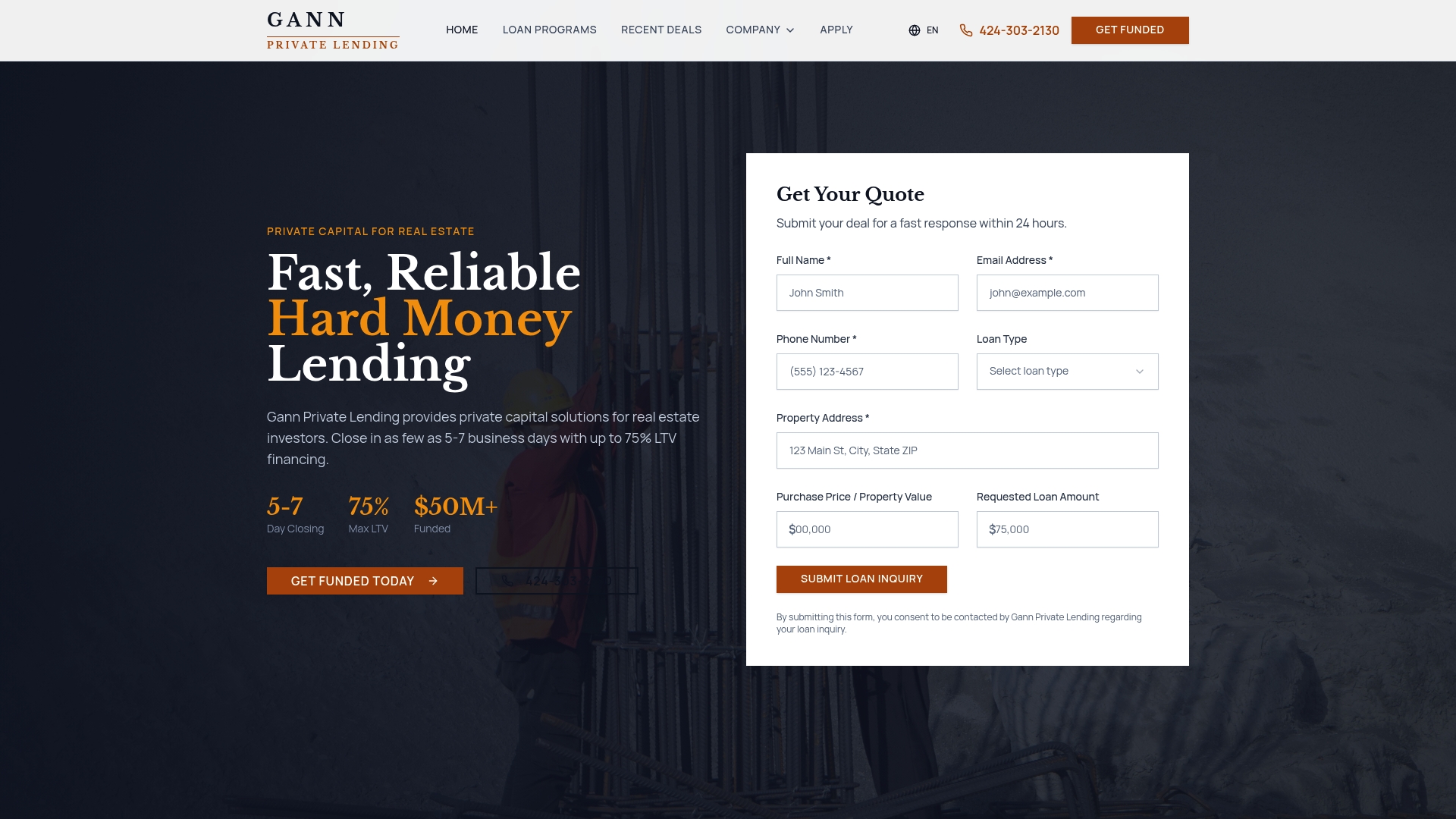
Whether you are stopping a foreclosure, acquiring a distressed property, or need to move before a competing buyer does, Gannlending's asset-focused approval process cuts through the paperwork. If you need emergency refinancing options or a fast acquisition loan, contact Gannlending today and get your deal funded.
FAQ
What is the fastest way to get funding for a real estate deal?
Hard money loans are the fastest real estate funding option, closing in as few as 5 to 7 business days without requiring an appraisal. They are best suited for urgent acquisitions, foreclosure situations, or deals where conventional financing timelines are not viable.
How fast can a DSCR loan close?
DSCR loans can close in as few as 15 days on qualifying transactions when the borrower submits a complete file and responds to lender conditions the same day. Appraisal scheduling, which typically takes 5 to 10 business days, is the most common cause of delays.
Can I refinance immediately after buying a property with cash?
Yes. Delayed financing allows cash buyers to apply for a mortgage immediately after closing, bypassing the standard 6-month seasoning period. The full underwriting and closing process still takes approximately 30 to 45 days, but there is no mandatory waiting period before you apply.
When does a bridge loan make more sense than hard money?
Bridge loans are the better fit when a property needs rehab before it qualifies for permanent financing and you have a clear exit plan, typically a DSCR refinance after stabilization. Hard money is the better choice when speed is the only priority and the property is already in acceptable condition.
What documentation do I need to close a real estate loan fast?
The core documents that accelerate any fast funding closing include entity formation documents, a current insurance binder, proof of property access for the appraiser, a rent roll or lease agreement, and a completed loan application. Having these ready before you submit your application is the single most reliable way to compress your closing timeline.