
Appraisal in hard money lending is the independent property valuation that determines how much a lender will fund, using both the current as-is value and the after-repair value (ARV) to set loan limits. The role of appraisal in hard money is not a formality. It is the foundation of every underwriting decision. Without a credible valuation, lenders cannot calculate loan-to-value (LTV) or loan-to-cost (LTC) ratios, and borrowers cannot know how much capital they can access. Real estate investors, property developers, and landlords who understand this process close faster, negotiate better terms, and avoid costly surprises at the closing table.
How does the hard money loan appraisal process work?
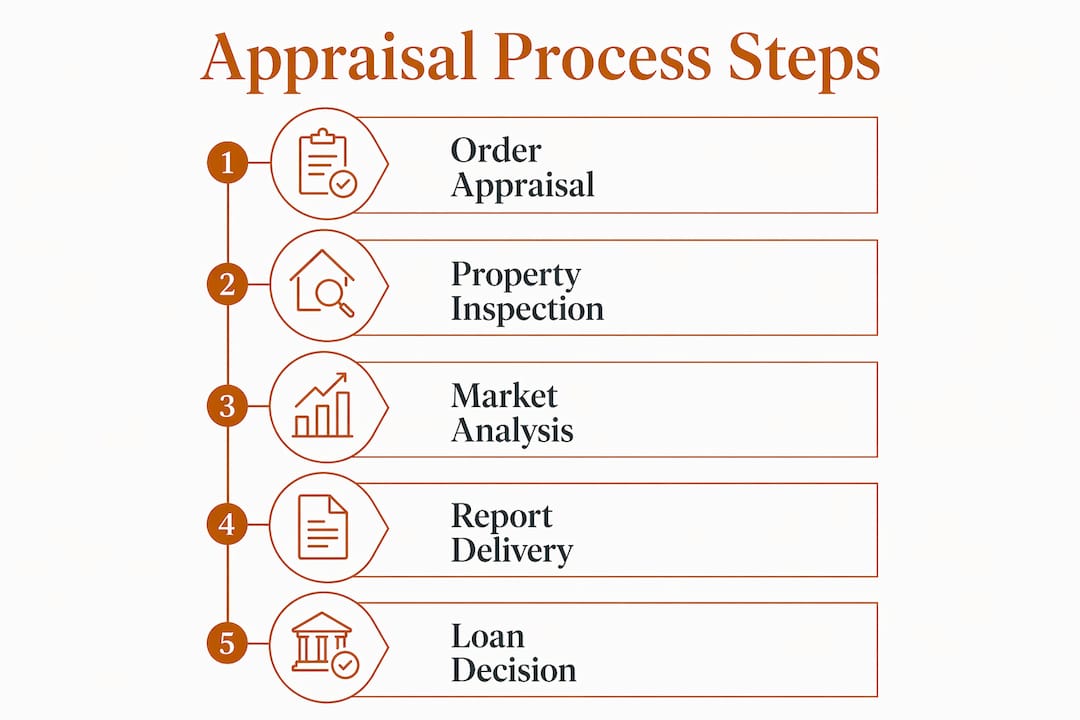
The hard money loan appraisal process follows a defined sequence that differs from conventional mortgage appraisals. Speed and asset focus drive every step.
-
Lender orders the appraisal. Hard money lenders require independent appraisals ordered by their own team, not provided by the borrower. This removes conflicts of interest and prevents inflated valuations from distorting loan sizing.
-
Borrower submits supporting documentation. The lender's underwriting team collects the purchase contract, a detailed rehab scope of work, comparable sales (comps), and an exit strategy. Borrower documentation like these inputs gives the appraiser context for both the current condition and the projected post-renovation value.
-
Appraiser selects the evaluation method. For lower-risk loans with abundant comps, a desktop or drive-by evaluation may be used. Desktop and drive-by appraisals complete within 24–48 hours. Full interior appraisals typically take 3–7 days. The lender selects the method based on LTV and property type.
-
Appraiser establishes as-is value and ARV. The as-is value reflects the property in its current condition. The ARV projects market value after all planned renovations are complete. Both numbers feed directly into the loan sizing calculation.
-
Underwriting team applies ratio caps. The lender runs the appraisal output through LTV, LTC, and ARV-based formulas. The loan amount is based on the smallest ratio result, not the most favorable one.
Pro Tip: Prepare your rehab scope and comps before the lender orders the appraisal. A well-documented scope of work directly supports a higher ARV and can increase your maximum loan amount.
Why does appraisal determine loan size and terms?

Appraisal values set the ceiling on every hard money loan. Lenders do not fund based on what you paid or what you hope to sell for. They fund based on what an independent appraiser confirms.
Hard money lenders cap leverage at roughly 70%–75% of ARV and 80%–90% of LTC. Those caps exist to protect the lender's collateral position if the deal goes sideways. A property with a $300,000 ARV, for example, would yield a maximum loan of $210,000 at 70% ARV. That $90,000 gap is the lender's buffer against market shifts, cost overruns, and liquidation discounts.
| Scenario | ARV | LTV Cap | Max Loan Amount |
|---|---|---|---|
| Fix-and-flip residential | $300,000 | 70% | $210,000 |
| Commercial rehab | $500,000 | 75% | $375,000 |
| Rental property bridge | $250,000 | 70% | $175,000 |
The table above shows how the same percentage cap produces very different loan amounts depending on the appraised ARV. A higher ARV does not automatically mean a larger loan. The lender always applies the most conservative ratio result.
Hard money loans are funded on the lesser of the purchase contract price or the appraised value. If the appraisal comes in below the contract price, the borrower must cover the difference out of pocket. That is a critical point many first-time investors miss until they are sitting at the closing table short on funds.
Pro Tip: Never assume the contract price equals the appraised value. Run your own conservative ARV estimate before signing a purchase contract so you know your likely loan ceiling in advance.
Understanding LTV ratio examples in real estate deals helps investors model loan scenarios before they ever speak to a lender.
What variations exist in appraisal requirements among hard money lenders?
Not every hard money deal requires a full interior appraisal. Lender requirements vary based on loan size, LTV, property type, and regional market conditions.
-
Full interior appraisals are standard for larger loans, higher LTV requests, or properties in thin markets with few comparable sales. A licensed appraiser physically inspects the property, photographs the interior, and produces a formal report.
-
Desktop appraisals rely on public records, MLS data, and satellite imagery. No physical visit occurs. Lenders use these for straightforward properties in active markets where comps are plentiful and LTV is conservative.
-
Drive-by evaluations involve an exterior inspection only. The appraiser confirms the property exists and assesses curb condition. These are faster than full appraisals but provide less detail on interior condition.
-
Broker price opinions (BPOs) are informal valuations prepared by a real estate agent rather than a licensed appraiser. Some lenders accept BPOs for very low-LTV loans or as a preliminary screening tool before ordering a formal appraisal.
Some hard money lenders waive full appraisals entirely when LTV is low and comparable sales are abundant. This speeds up the approval timeline significantly. However, waiving a full appraisal does not mean the lender skips valuation. It means they use a faster method to reach the same conclusion.
A common misconception is that borrowers can supply their own appraisal to speed up the process. Hard money lenders reject borrower-provided appraisals because they introduce bias. The lender controls the appraisal order to protect their collateral position, not to slow down the deal.
Regional factors also matter. Rural properties or specialty asset types like mixed-use buildings often require full appraisals because comparable sales are scarce. Urban properties in high-volume markets are better candidates for desktop or drive-by methods.
How do appraisal outcomes impact loan risk and investment success?
Appraisal accuracy is the single biggest variable in whether a hard money deal succeeds or collapses. An inflated ARV creates a chain of problems that compounds over the life of the loan.
-
Overleveraging risk. If the appraised ARV is too optimistic and the renovation falls short, the investor exits at a sale price below the loan balance. The lender faces a loss, and the borrower faces a deficiency.
-
Refinancing complications. Delays in rehab or low ARV appraisals can trigger refinancing issues and balloon payment risks. Hard money loans carry higher interest rates and shorter terms than conventional loans, so any project delay compounds the cost.
-
Balloon payment pressure. Most hard money loans mature in 6–24 months. If the property has not reached its projected ARV by maturity, the borrower cannot refinance into a conventional loan and may face a forced sale or extension fees.
-
Liquidation discounts. Hard money appraisals reflect liquidation risk and discount deferred maintenance, unlike retail estimates from tools like Zillow's Zestimate. The appraised value is a protective floor, not an optimistic ceiling.
-
Deal viability signals. A low appraisal is not always bad news. It can signal that the purchase price is too high, the rehab budget is underestimated, or the exit strategy needs revision. Catching those issues before funding saves investors from a losing deal.
Appraisal outcomes are central to hard money underwriting because they define the asset-based risk and enable faster decisions compared to traditional banks.
Hard money underwriting treats appraisal as core asset-based protection. That focus on collateral value is exactly why hard money lenders can approve deals in days rather than weeks. The appraisal replaces the lengthy income verification and credit analysis that slows down conventional mortgage processing. For investors working on short-term real estate loans, understanding this trade-off is what separates profitable deals from expensive mistakes.
Key Takeaways
The role of appraisal in hard money lending is to establish independent property value, set loan size through LTV and ARV caps, and protect both lender and borrower from overleveraging.
| Point | Details |
|---|---|
| Appraisal sets the loan ceiling | Hard money lenders fund based on the lesser of contract price or appraised value, not borrower estimates. |
| ARV drives maximum loan amount | Lenders cap loans at 70%–75% of ARV, so a higher supported ARV directly increases available capital. |
| Lenders control the appraisal order | Borrower-provided appraisals are rejected to prevent inflated valuations and protect collateral. |
| Faster methods exist for low-LTV deals | Desktop and drive-by appraisals complete in 24–48 hours when comps are strong and LTV is conservative. |
| Low appraisals reveal deal problems early | A below-expectation appraisal signals pricing, budget, or exit strategy issues before funding locks them in. |
What I've learned about appraisal after years in hard money deals
Most investors treat the appraisal as a bureaucratic hurdle. That mindset costs them money. The appraisal is the most honest feedback you will get on a deal before you are committed to it.
I have seen investors walk away from deals they were excited about because the appraisal confirmed the numbers never worked. That is not a failure. That is the appraisal doing exactly what it should. The investors who get burned are the ones who shop for a favorable appraisal rather than using the result to stress-test their assumptions.
The documentation you bring to the appraisal matters more than most investors realize. A detailed scope of work, recent comps pulled from the same zip code, and a clear exit strategy give the appraiser the evidence to support a strong ARV. Showing up with nothing and hoping for the best is a strategy that consistently produces low valuations and smaller loans.
One more thing worth saying directly: the gap between a Zillow estimate and a hard money appraisal is not the lender being conservative for no reason. It reflects liquidation risk, deferred maintenance, and the reality that a forced sale does not happen at retail prices. Build that gap into your deal model from day one, and you will never be surprised at the closing table.
— Brian
Gannlending: fast hard money with flexible appraisal options
Real estate investors who need capital fast cannot afford a lender that treats appraisal as an obstacle. Gannlending funds deals in as few as 5–7 business days, with financing up to 75% LTV across residential and commercial properties.

Gannlending has funded over $50 million in hard money loans by keeping the focus on the asset, not endless paperwork. For deals where the numbers are strong and comps are clear, Gannlending offers no-appraisal options that cut days off the approval timeline. Whether you are closing a fix-and-flip, protecting a property from foreclosure, or funding a commercial rehab, apply with Gannlending and get a decision based on your deal, not your tax returns.
FAQ
What is the role of appraisal in hard money lending?
Appraisal establishes the as-is value and ARV of a property, which hard money lenders use to calculate LTV and LTC ratios and set the maximum loan amount. It is the primary underwriting tool in asset-based lending.
Can a borrower provide their own appraisal for a hard money loan?
No. Hard money lenders require independent, lender-ordered appraisals to prevent conflicts of interest and inflated valuations. Borrower-provided appraisals are not accepted.
How long does a hard money appraisal take?
Desktop and drive-by appraisals complete within 24–48 hours. Full interior appraisals typically take 3–7 days, depending on property type and market conditions.
What happens if the appraisal comes in lower than the purchase price?
The loan is based on the lesser of the contract price or the appraised value. If the appraisal is lower, the borrower must cover the difference with their own funds at closing.
Do all hard money lenders require a full appraisal?
No. Some lenders waive full interior appraisals when LTV is low and comparable sales are strong, using desktop evaluations or drive-by assessments instead to speed up the approval process.