
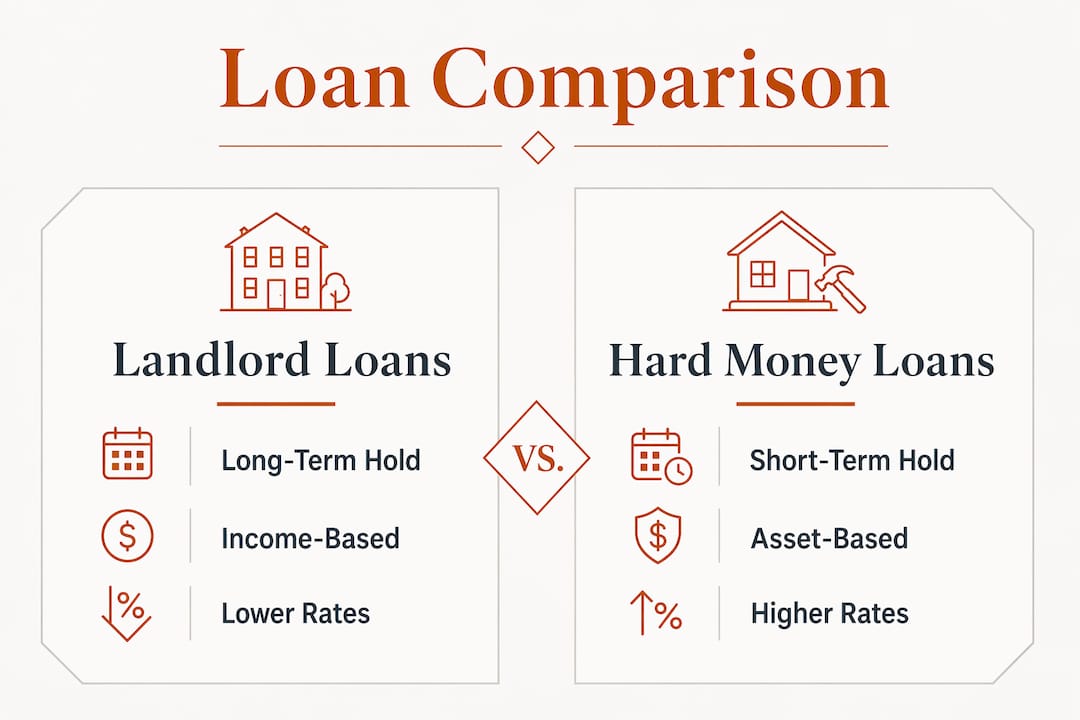
Landlord loans and hard money loans serve fundamentally different purposes, and choosing the wrong one can cost you a deal or lock you into the wrong cost structure for years. Landlord loans are income-verified, long-term financing products built for rental property holds. Hard money loans are short-term, asset-based instruments built for speed. The core differences come down to five things: qualification criteria, approval speed, interest rates, loan duration, and what the lender actually cares about when reviewing your file.

Real estate investors who understand both tools use them in sequence. Hard money gets you into a distressed property fast. A landlord loan or DSCR product holds it once it's stabilized. Getting that sequence right is where the money is made.
At a glance, here's how the two loan types stack up:
- Qualification: Landlord loans require income verification, tax returns, and a credit score typically above 660. Hard money lenders focus on the property's collateral value, not your W-2.
- Speed: Landlord loans close in 30+ days. Hard money can fund in as few as 5–7 business days.
- Rates: Landlord loan rates run roughly 7%–9%. Hard money rates typically range 12%–18%.
- Terms: Landlord loans amortize over 15–30 years. Hard money runs 6–18 months, usually interest-only.
- Best for: Landlord loans suit long-term rental holds. Hard money fits flips, distressed acquisitions, and fast closings.
Gannlending has funded over $50 million in hard money loans for real estate investors across the U.S., with approvals built around the asset rather than the borrower's paperwork.
Table of Contents
- How landlord loans and hard money loans actually differ
- Side-by-side comparison: landlord loans vs. hard money
- Why Gannlending's approach works for real estate investors
- Which loan fits your situation?
- Fast hard money funding for your next deal
- Key Takeaways
How landlord loans and hard money loans actually differ
Landlord loans: income-first, long-term hold
A landlord loan is any conventional, DSCR, or portfolio loan used to finance a rental property. The lender's primary concern is your ability to repay over time, which means income documentation, credit history, and debt ratios all matter. Down payments run 20%–25% in 2026, and conventional products cap you at 10 financed properties under Fannie Mae guidelines.
DSCR loans are the most popular landlord loan variant for scaling investors right now. They qualify on the property's rental income rather than your personal income, with 2026 rates typically in the 7%–9% range, matching landlord loans more broadly. The tradeoff is a slightly higher rate than conventional and often a prepayment penalty of one to three years.
Portfolio loans bundle multiple properties under one lender's guidelines and suit investors who've outgrown the conventional loan cap. Rates sit around 8.5% in 2026, and they typically require a minimum DSCR of 1.2.
Hard money loans: asset-first, short-term hold
Hard money is a short-term, asset-based loan where approval hinges on the property's value, not your financial history. Private lenders fund these, not banks, which is why the process moves so fast. Credit history and income are secondary considerations. What matters is the collateral.
Terms run 6–18 months, payments are typically interest-only, and the full principal comes due at the end. Rates reflect the speed and risk: 12%–18% is the standard range in 2026. Hard money bridge loans, which specifically connect a purchase to permanent refinancing, can close even faster, sometimes in five days.
Pro Tip: Hard money and construction loans are often confused, but they're different products. Construction loans use phased draws tied to lender inspections, which slows projects. Hard money typically disburses as a lump sum at closing, giving you immediate capital access.
Side-by-side comparison: landlord loans vs. hard money
| Dimension | Landlord Loan | Hard Money Loan |
|---|---|---|
| Primary purpose | Long-term rental hold | Fix-and-flip, fast acquisition |
| Loan term | 15–30 years (amortizing) | 6–18 months (interest-only) |
| Typical rate (2026) | 7%–9% | 12%–18% |
| Max LTV | 75% | Up to 75% |
| Qualification basis | Income, credit, DSCR | Property value/equity |
| Documentation | Tax returns, income verification | Appraisal, property condition |
| Best use case | Portfolio growth, stable rentals | Distressed properties, BRRRR |
Construction loans sit in a separate category entirely. They require phased draws and lender inspections at each milestone, which prioritizes cost control but extends timelines significantly. For ground-up builds, construction financing makes sense. For acquiring and rehabbing an existing structure quickly, hard money wins on speed every time.
Why Gannlending's approach works for real estate investors
Hard money's higher rates look expensive on paper. Run the actual numbers and the picture changes. Interest costs of $20,000–$35,000 over a 6–12 month hold can be offset by $50,000–$75,000 in equity created through a well-executed rehab. Experienced investors treat that interest as a project expense, not a penalty.
Gannlending funds residential and commercial properties at up to 75% LTV, with approvals built around the asset rather than a borrower's tax returns. The process moves fast because the underwriting focuses on what the property is worth, not on assembling a file of income documents. For investors competing in tight markets or working distressed acquisitions, that speed is the product.
Gannlending has closed over $50 million in hard money loans for U.S. real estate investors. The process runs in five steps: property evaluation, asset-based approval, term agreement, loan documentation, and funding. No drawn-out income verification. No waiting on bank committees.
Key benefits investors use Gannlending for:
- Funding in as few as 5–7 business days
- Asset-based qualification, not income-based
- Up to 75% LTV on residential and commercial properties
- Flexible on property types, including non-standard assets
- Support for investors facing foreclosure who need fast solutions
For investors who want to understand which property types qualify for hard money financing, that detail matters when structuring a deal.
Which loan fits your situation?
The right loan depends on your timeline, exit strategy, and what your credit profile looks like right now.
Choose a landlord loan when:
- You're holding a stabilized rental for the long term
- You have documentable income and a credit score above 660
- Lower monthly cost matters more than speed
- You're scaling a portfolio and want 30-year amortization
- The property qualifies under conventional or DSCR guidelines
Choose hard money when:
- You need to close in days, not weeks
- The property is distressed or non-standard
- Your credit is below 680 or income is hard to document
- Your exit is a flip or a refinance into a landlord loan after rehab
- You're executing a BRRRR strategy and need fast acquisition capital
Bridge loans occupy a specific niche here: they're short-term products designed to connect a purchase to permanent financing, typically lasting 3–12 months. They share the asset-based qualification logic of hard money but are specifically structured for the gap between acquisition and refinance.
The most common investor sequence is hard money for purchase and rehab, then a DSCR refinance at 75% LTV once the property is stabilized and rented. That combination lets you move fast on the acquisition without locking into a long-term rate before the property is performing. Landlord-focused resources like RentrIQ's property management guides can help you think through the rental income side of that equation before you refinance.
Fast hard money funding for your next deal
Real estate investors who need capital in days, not weeks, get exactly that from Gannlending. While landlord loans require income documentation, credit scrutiny, and 30-plus day timelines, Gannlending's asset-based process cuts through that. You get up to 75% LTV on residential and commercial properties, approval focused on what the property is worth, and funding in as few as 5–7 business days.
Over $50 million funded. No appraisal delays. No bank committee waiting. If you're acquiring a distressed property, executing a BRRRR strategy, or need to close before another buyer does, apply at Gannlending and get your deal moving.
Key Takeaways
Landlord loans and hard money loans serve different stages of a real estate investment, and matching the right product to the right moment is what separates profitable deals from expensive mistakes.
| Point | Details |
|---|---|
| Qualification criteria | Landlord loans require income and credit verification; hard money qualifies on property value alone. |
| Speed of funding | Hard money closes in 5–7 business days; landlord loans typically take 30+ days. |
| Rate and cost tradeoff | Hard money rates run 12%–18%; landlord loan rates run 7%–9% with longer amortization. |
| Strategic sequencing | Investors use hard money to acquire and rehab, then refinance into a DSCR or landlord loan after stabilization. |
| Gannlending's role | Gannlending funds hard money loans up to 75% LTV in as few as 5–7 business days, with over $50 million funded. |