
Revolving credit in real estate is defined as a financing structure that lets borrowers draw funds up to a set limit, repay them, and draw again without reapplying for a new loan. Products like HELOCs and commercial revolving credit facilities function as property-backed credit lines, giving investors and homeowners flexible access to capital for acquisitions, renovations, or bridging financial gaps. The Federal Reserve reported that US revolving credit grew at a 3.8% annual rate in Q1 2026, reflecting how widely borrowers now rely on this structure. Understanding how it works, where it fits, and where it can hurt you is the difference between using it as a tool and being trapped by it.
How does revolving credit work in real estate?
Revolving credit real estate explained simply: you get a credit limit, draw what you need, pay it back, and draw again. The two most common products are the Home Equity Line of Credit (HELOC) for residential borrowers and the commercial revolving credit facility for investors with income-producing properties.

The HELOC structure for homeowners
A HELOC operates in two distinct phases. The draw period typically lasts about 10 years, during which you make interest-only payments on the amount you have drawn. After that, the repayment period begins and can run about 20 years, requiring full principal and interest payments on the outstanding balance.
Your credit limit is tied directly to your home's equity. Lenders typically allow you to borrow up to 85% of the home's appraised value minus your existing mortgage balance. A professional appraisal establishes that number, and it sets the ceiling for everything you can draw.
- Establish your equity. Get a professional appraisal and calculate 85% of the appraised value minus your mortgage balance.
- Open the line. The lender sets your credit limit based on that equity calculation and your creditworthiness.
- Draw as needed. Pull funds during the draw period for renovations, down payments, or project costs.
- Pay interest only. During the draw period, minimum payments cover only the interest on the drawn balance.
- Enter repayment. After the draw period closes, full amortizing payments begin on whatever balance remains.
Pro Tip: Never treat your HELOC limit as your budget. Draw only what a specific project phase requires. Interest accrues on every dollar drawn, not on the full limit.
Commercial revolving credit facilities
Commercial real estate revolving credit facilities follow a draw, repay, and redraw model that charges interest only on the funds actually in use. This structure is built for investors managing multiple acquisitions or value-add projects simultaneously. You close one deal, repay the drawn amount from proceeds or cash flow, and the credit becomes available again for the next opportunity. Facility covenants and collateral coverage thresholds govern how much you can draw at any given time, based on current property values and loan-to-value ratios.
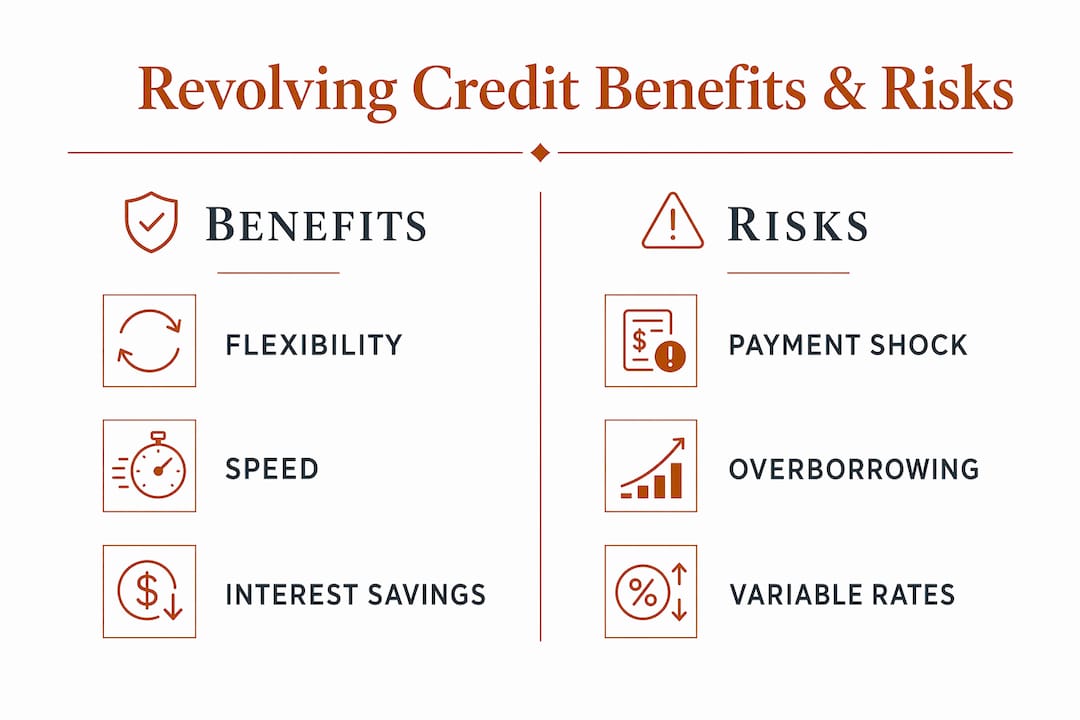
What are the benefits and risks of revolving credit for real estate?
Revolving credit delivers genuine advantages for investors and homeowners who understand its mechanics. It also carries specific risks that catch unprepared borrowers off guard.
The core benefits:
- Liquidity on demand. Revolving credit facilities provide access to capital for acquisitions, property stabilization, and renovations without repeated loan applications. That speed matters when a deal has a short window.
- Interest efficiency. You pay interest only on what you draw, not on the full credit limit. A $200,000 HELOC with $50,000 drawn costs interest on $50,000.
- Cash flow management. Investors running renovation projects with unpredictable timelines can draw funds as costs arise rather than carrying a large lump-sum loan balance from day one.
- Portfolio flexibility. Revolving credit serves as a liquidity management tool within the capital stack, allowing fast access to funds that supports timely investment decisions.
The risks you must plan for:
- Payment shock. Minimum payments during the draw period may not reduce principal at all. When the repayment phase begins, payments can increase significantly as full amortization kicks in.
- Collateral risk. HELOCs are second mortgages secured by your home. Default puts the property at risk, not just your credit score.
- Overborrowing temptation. An open credit line is easy to draw against. Borrowers who treat available credit as available cash often carry larger balances than their project actually requires.
- Balloon payment exposure. Depending on the terms, some revolving products require a balloon payment at the end of the repayment period rather than a gradual payoff.
Pro Tip: Run your repayment phase numbers before you open the line. Use a HELOC payoff calculator to see exactly what your monthly payment becomes once amortization starts. If that number is uncomfortable now, it will be worse under financial pressure.
How does revolving credit compare to other real estate loan types?
Revolving credit is not the right tool for every situation. Comparing it directly to installment loans and fixed mortgages shows where it wins and where it falls short.
| Feature | Revolving Credit (HELOC / Credit Facility) | Fixed Mortgage / Installment Loan |
|---|---|---|
| Draw flexibility | Borrow, repay, and redraw as needed | Single lump sum disbursed at closing |
| Repayment structure | Interest-only draw period, then amortizing | Fixed monthly payments from day one |
| Interest pricing | Variable rate, charged on drawn balance only | Fixed or variable, charged on full loan amount |
| Best use case | Renovations, bridge financing, portfolio liquidity | Long-term purchase financing |
| Primary risk | Payment shock, overborrowing, collateral loss | Rate risk on adjustable products |
| Reapplication required | No | Yes, for each new loan |
Fixed mortgages and term loans offer predictability. You know your payment on day one and it does not change on a fixed-rate product. That predictability has real value for long-term holds where cash flow planning matters over years, not months.
Revolving credit wins on flexibility and speed. For a house flipper drawing funds in phases as renovation milestones complete, paying interest on a $40,000 draw instead of a $150,000 lump sum loan is a material cost difference. For an investor who needs to close deals fast across multiple properties, a commercial revolving facility eliminates the friction of repeated underwriting cycles.
The right choice depends on your project timeline, your cash flow certainty, and your tolerance for variable payments. Revolving credit is a short-to-medium-term tool. It is not a substitute for permanent financing on a long-term hold.
What strategies help investors manage revolving credit effectively?
Effective management of revolving credit separates investors who use it as a competitive advantage from those who get buried by it. These five practices apply whether you are using a HELOC for a single renovation or a commercial facility across a portfolio.
- Align draws with actual project costs. Draw against renovation or lease-up expenses as they occur, not in advance. Borrowing the full limit on day one maximizes interest costs without accelerating project completion.
- Monitor your LTV and covenants. Facility covenants limit draws based on current property values. If values drop, your available credit can shrink. Understanding LTV ratio mechanics keeps you from planning around credit that may not be available.
- Plan the repayment phase before you draw. Know exactly when your draw period ends, what your amortizing payment will be, and whether a balloon payment applies. Repayment phase planning is not optional. It is the most common place borrowers get into trouble.
- Use revolving credit as a bridge, not a foundation. Revolving credit can cover liquidity gaps in distressed scenarios, but it cannot solve affordability problems without a clear refinancing or repayment path behind it.
- Keep a draw log. Track every draw, its purpose, and its expected repayment source. This discipline prevents the gradual accumulation of balance that turns a flexible tool into a fixed liability.
Pro Tip: If you are using a HELOC to fund a renovation before a sale or refinance, set a hard deadline for when the line must be paid off. Treat it like a construction loan with a defined exit, not an open credit card.
Key takeaways
Revolving credit in real estate works best as a short-to-medium-term liquidity tool when borrowers plan the repayment phase before they draw the first dollar.
| Point | Details |
|---|---|
| Core structure | Borrow, repay, and redraw up to a set limit without reapplying for a new loan. |
| HELOC limits | Lenders typically allow up to 85% of appraised value minus the existing mortgage balance. |
| Payment shock risk | Draw-period minimums cover only interest; full amortizing payments begin when repayment starts. |
| Best use case | Short-term bridge financing, phased renovations, and portfolio liquidity management. |
| Critical discipline | Align draws with actual project costs to avoid carrying unnecessary interest on unused funds. |
Why most borrowers misread their revolving credit line
The biggest mistake I see is borrowers treating their credit limit as a guarantee. The limit is set at origination based on a specific appraisal and a specific LTV calculation. Property values move. Covenants tighten. What was available at closing may not be available six months into a project.
The second mistake is ignoring the repayment phase until it arrives. I have watched experienced investors get caught off guard by the jump from interest-only payments to full amortization. The math is not complicated, but people avoid running it because the number is uncomfortable. Run it anyway, before you open the line.
Revolving credit belongs in a broader capital stack, not as the entire stack. Pair it with hard money for acquisitions, use it for renovation draws, and exit into permanent financing once the asset stabilizes. That sequence works. Using a revolving line as a long-term hold vehicle does not. The variable rate exposure alone makes it a poor fit for anything beyond a defined project window.
The investors who use revolving credit well treat it like a scalpel. They draw precisely, repay quickly, and keep the line clean for the next opportunity. The ones who struggle treat it like a savings account they can spend twice.
— Brian
How Gannlending supports real estate investors who need flexible financing
When a revolving line is not the right fit or you need capital faster than a bank can move, Gannlending provides a direct alternative. Gannlending specializes in hard money loans for investors with funding in as few as 5–7 business days and no appraisal requirement slowing the process down.

Gannlending has funded over $50 million in real estate transactions, covering residential and commercial properties up to 75% LTV. For investors facing foreclosure, tight timelines, or deals that do not fit conventional credit criteria, Gannlending offers a path that focuses on the asset rather than the paperwork. If you are weighing your real estate credit options and need speed alongside flexibility, Gannlending is worth a direct conversation.
FAQ
What is revolving credit in real estate?
Revolving credit in real estate is a financing structure that lets borrowers draw funds up to a set limit, repay them, and draw again without reapplying. Common products include HELOCs for homeowners and commercial revolving credit facilities for investors.
How is a HELOC different from a standard mortgage?
A HELOC provides a reusable credit line secured by home equity, with interest-only payments during the draw period. A standard mortgage disburses a lump sum at closing with fixed monthly payments from day one.
What does payment shock mean for HELOC borrowers?
Payment shock occurs when the draw period ends and full principal and interest payments begin, often significantly higher than the interest-only minimums paid during the draw period. Borrowers who do not plan for this transition face serious cash flow pressure.
Can revolving credit help with real estate investment portfolios?
Yes. Commercial revolving credit facilities allow investors to draw, repay, and redraw across multiple deals without repeated loan applications, supporting faster acquisitions and more flexible cash flow management across a portfolio.
When should an investor choose hard money over a revolving line?
Hard money loans are the better choice when speed is critical, when the property does not qualify for a revolving facility, or when the investor needs a defined loan structure with a clear exit rather than an open credit line.