
Zoning in real estate is the system of local government laws that divides land into designated districts and controls how each parcel can be used, built on, and developed. Every city and county in the United States operates under a zoning ordinance that spells out permitted uses, building heights, setbacks, density limits, and parking requirements for every piece of land within its jurisdiction. Whether you are buying a home, planning a commercial project, or underwriting an investment, zoning laws determine what is legally possible on a given property before a single permit is filed. Understanding these rules is not optional for serious property owners. It is the foundation of every sound real estate decision.
What is zoning in real estate and how does it work?
Zoning is implemented through two complementary tools: the zoning ordinance and the zoning map. The zoning ordinance is the written local law that defines the rules for each district, including what uses are allowed and what dimensional standards apply. The zoning map assigns every parcel in the jurisdiction to a specific district. Together, they tell you exactly what you can and cannot do with a piece of land.
The purpose of zoning goes beyond bureaucratic organization. Local governments use zoning to protect community health, safety, and welfare by keeping incompatible uses separated. A heavy industrial facility next to a residential neighborhood creates noise, pollution, and safety hazards. Zoning prevents that conflict by design. For property owners and investors, this means the district your parcel sits in is one of the most consequential facts about that property.

Zoning codes vary significantly by municipality. A district labeled "R-2" in Chicago carries different rules than "R-2" in Houston. This local variability is why verifying the applicable district for a specific parcel before underwriting any development or investment plan is non-negotiable.
What are the main types of zoning classifications?
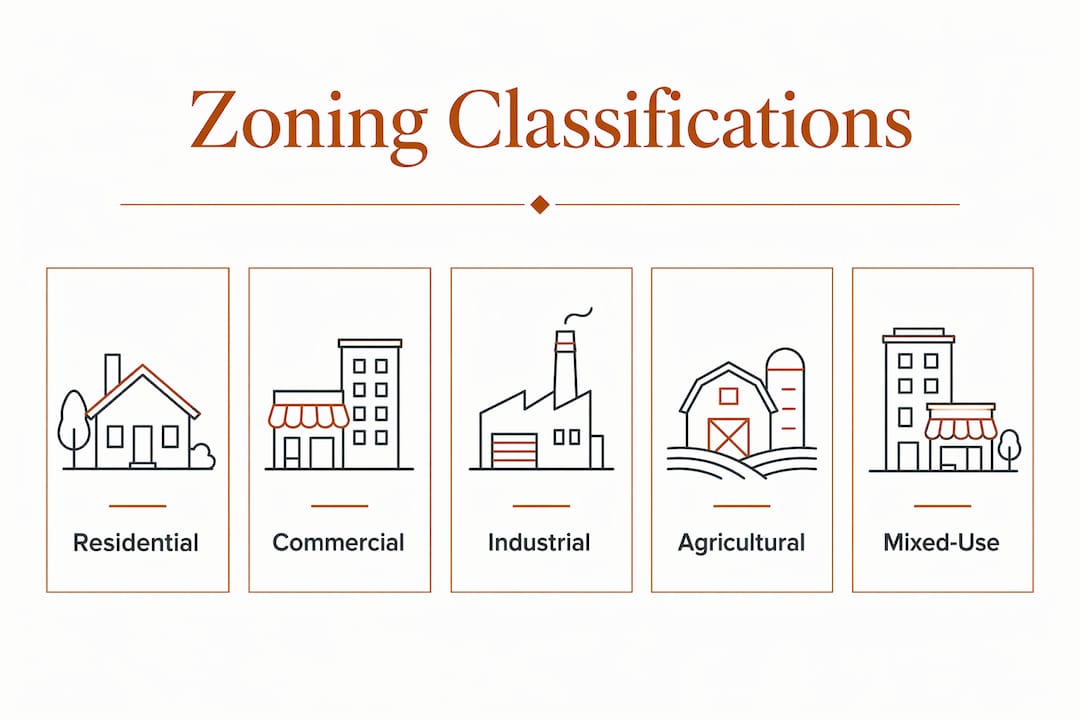
Zoning classifications fall into five broad categories, each with sub-classifications that add precision to what is allowed.
| Classification | Typical allowed uses |
|---|---|
| Residential (R) | Single-family homes, duplexes, multi-family apartments (varies by sub-zone) |
| Commercial (C) | Retail, offices, restaurants, hotels, neighborhood or heavy commercial |
| Industrial (I) | Warehouses, manufacturing, distribution, heavy industrial operations |
| Agricultural (A) | Farming, ranching, rural residential, open space preservation |
| Mixed-Use (MU) | Combination of residential, retail, and office in a single district |
Beyond these core categories, municipalities layer on special and overlay districts. A historic overlay district restricts exterior modifications to preserve architectural character. A conservation district limits development to protect natural resources. A planned development (PD) district allows a developer to negotiate custom rules with the local government in exchange for public benefits like parks or affordable housing. Understanding commercial rental property classifications is especially useful when evaluating income-producing assets across different zoning types.
Sub-classifications within residential zoning matter enormously for investors. An R-1 district typically allows only single-family detached homes, while an R-3 or R-4 district may permit apartment buildings with dozens of units. The difference between those two designations on the same parcel can represent millions of dollars in development value.
Pro Tip: Before you analyze any deal, pull the zoning map for the specific parcel address, not just the neighborhood. Two adjacent lots can sit in different zoning districts, and that line on the map changes everything about feasibility.
How does zoning affect property value and development potential?
Zoning directly controls key development parameters on every lot, including allowable density, building height, parking requirements, setbacks, and lot coverage. These parameters are not abstract. They determine how many units you can build, how tall your structure can be, and how much of the lot you can cover with impervious surfaces. Each constraint shapes the financial model of a project.
The district assignment alone can transform a property's value. A parcel rezoned from single-family residential to mixed-use commercial in a high-demand urban corridor can see its market value multiply several times over. Conversely, a property downzoned from commercial to residential loses development potential and typically loses value. Zoning's role in investment feasibility is why sophisticated investors treat zoning due diligence as a first step, not an afterthought.
Understanding how zoning affects value also requires knowing the three tiers of use permissions:
- Permitted-by-right uses: These are allowed without any discretionary approval. You meet the code requirements, you pull the permit, you build. No public hearing required.
- Conditional or special uses: These are allowed in the district but only after an approval process. A church in a residential zone or a drive-through in a commercial zone often falls into this category. Approval is not guaranteed.
- Prohibited uses: These are not allowed in the district at all. The only path forward is a full rezoning, which is a legislative process with no guaranteed outcome.
One critical nuance that trips up even experienced developers: a project can be permitted by use but still fail at the dimensional standards. A project allowed by use can still require a variance if the building footprint, height, or setbacks do not conform to the district's dimensional requirements. You need to clear both hurdles, not just one.
Pro Tip: When evaluating a property for development, run two separate zoning checks. First, confirm your intended use is permitted or conditionally permitted. Second, confirm your proposed building dimensions comply with setbacks, height limits, and lot coverage maximums. Skipping the second check is one of the most expensive mistakes in development.
What is the process for changing zoning or getting a variance?
When a property's current zoning does not support your intended use, you have three primary paths: rezoning, a variance, or a conditional use permit. Each follows a different legal process and carries a different probability of success.
-
Rezoning is a legislative act. You petition the local government to change the zoning district classification for your parcel. The process typically involves a pre-application meeting with planning staff, a formal application, a planning commission review and recommendation, a public hearing, and a final vote by the city council or county board. Rezoning can take six months to two years depending on the jurisdiction and the complexity of the request.
-
Variances provide relief from specific dimensional standards, such as a reduced setback or an increased building height, without changing the underlying zoning district. Variances and appeals are handled by a Board of Zoning Appeals (BZA) or Board of Zoning Adjustment, which operates in a quasi-judicial capacity. The applicant must typically demonstrate a hardship unique to the property that prevents reasonable use under the current standards.
-
Conditional use permits (CUPs) allow a use that is listed in the code as conditionally permitted. Conditional use review typically requires planning commission review followed by final action from the city council or another designated authority. The commission evaluates compatibility with surrounding uses, traffic impacts, and site design before making a recommendation.
The most common mistake applicants make is treating a conditional use as automatic approval. The fact that a use is listed as conditionally permitted does not mean it will be approved. Conditional uses require a discretionary review process, and the outcome depends on how well the application addresses the review criteria and how the surrounding community responds at the public hearing.
Pro Tip: Attend a planning commission meeting before you submit your application. Watch how commissioners respond to similar projects. You will learn more about local priorities in two hours than you will from reading the code for a week.
How to read zoning maps and ordinances for your property
Reading zoning documents is a two-step process. The zoning map tells you which district applies to your parcel. The zoning ordinance tells you what that district allows. You need both to get a complete picture.
Here is how to work through a zoning analysis for any property:
- Step 1: Go to the city or county planning department's website and find the online zoning map. Enter the property address or parcel number to identify the zoning district designation (for example, "C-2" or "R-MF").
- Step 2: Open the zoning ordinance and locate the chapter or section for that district. Read the list of permitted uses, conditional uses, and prohibited uses.
- Step 3: Review the dimensional standards table for the district. Note the minimum lot size, maximum building height, front and rear setbacks, side yard requirements, maximum lot coverage, and parking ratios.
- Step 4: Check for overlay districts. Search the map for any historic, flood, conservation, or other overlay zones that apply to the parcel. Overlays add requirements on top of the base district rules.
- Step 5: Verify with planning staff. Call or email the planning department to confirm your interpretation before making any financial commitments.
Zoning's local variability means that the same letter-number code carries different rules in different cities. Never assume a classification you know from one market applies in another. Area selection and zoning compatibility are deeply connected, and how zoning shapes property economics is a factor that experienced investors weigh before any other underwriting variable.
Pro Tip: Most counties publish their zoning ordinances on Municode or a similar platform. Search "[city name] zoning ordinance Municode" to find the current code. Always confirm you are reading the most recently amended version, since codes are updated regularly.
How zoning laws differ from HOA rules
Zoning and HOA rules are both restrictions on property use, but they come from entirely different sources and carry different legal weight.
- Zoning is government law. It is enacted by a city council or county board, enforced by local code enforcement officers, and applies to every parcel within the jurisdiction regardless of ownership. Violating zoning is a legal offense that can result in fines, stop-work orders, or mandatory demolition of non-conforming structures.
- HOA rules are private contracts. They are created by a homeowners association and apply only to properties within that specific community. They are enforced through civil action by the HOA, not by government authorities.
- Scope differs significantly. Zoning governs land use, building size, density, and development. HOA covenants typically regulate aesthetics, such as paint colors, landscaping, fence styles, and parking of recreational vehicles.
- Both can restrict the same property simultaneously. A property inside an HOA community must comply with both the local zoning ordinance and the HOA's covenants, conditions, and restrictions (CC&Rs). The more restrictive rule governs.
Treating zoning as equivalent to HOA rules is a common and costly mistake. An HOA cannot grant you permission to operate a business from your home if the zoning district prohibits commercial activity. Government zoning always supersedes private HOA agreements on matters of land use.
Key takeaways
Zoning in real estate is a government-enforced land-use system that determines what you can build, how you can use a property, and what approvals you need to change either.
| Point | Details |
|---|---|
| Zoning controls development parameters | Density, height, setbacks, and parking are all set by the zoning district, not the owner. |
| Use permissions have three tiers | Permitted-by-right, conditional, and prohibited uses each require a different approval path. |
| Rezoning vs. variance | Rezoning changes the district classification; a variance grants relief from dimensional standards only. |
| Zoning differs from HOA rules | Zoning is government law; HOA covenants are private contracts, and zoning always takes precedence. |
| Due diligence requires two checks | Verify both use permissions and dimensional standards before committing to any development plan. |
Why zoning is the first thing I check on every deal
I have reviewed hundreds of real estate transactions over the years, and the deals that go sideways almost always share one trait: the buyer or developer assumed the zoning would work out. They fell in love with the property, ran the numbers on their intended use, and treated zoning as a box to check later. That approach is expensive.
The most instructive cases I have seen involve conditional uses. A buyer purchases a property intending to operate a small daycare in a residential zone. The use is listed as conditionally permitted in the code, so they assume approval is a formality. Then the public hearing happens. Neighbors show up. The planning commission raises traffic concerns. The application is denied. The buyer now owns a property they cannot use as intended, and the rezoning process to fix it will take 18 months.
The lesson is not that zoning is an obstacle. It is that zoning is information. When you read it correctly and early, it tells you exactly what a property can become and what it will cost to get there. The investors I have seen succeed consistently treat the zoning map as the first document they open, not the last. They also build relationships with planning department staff, not because they are trying to game the system, but because those conversations surface issues before they become deal-killers.
Local variability in zoning codes is also underestimated. Two cities 20 miles apart can have radically different rules for the same use type. What works in one market does not automatically transfer to another. Treat every jurisdiction as its own learning curve.
— Brian
Finance your next project with Gannlending
Understanding zoning is the foundation of any real estate investment or development plan. The next step is securing financing that moves as fast as your opportunity does.

Gannlending funds residential and commercial real estate deals in as few as 5 to 7 business days, with no appraisal required and financing up to 75% LTV. When you have confirmed the zoning supports your intended use and you are ready to move, hard money lending through Gannlending keeps you from losing the deal to a slow approval process. With over $50 million funded, Gannlending focuses on the asset and the opportunity, not endless paperwork. Reach out to Gannlending today to discuss your project.
FAQ
What is zoning in real estate?
Zoning in real estate is a local government law that divides land into districts and regulates what uses, building sizes, and development standards apply to each parcel. It is implemented through a zoning ordinance and a zoning map that together govern every piece of land in a jurisdiction.
What are the main types of zoning classifications?
The five main zoning categories are residential, commercial, industrial, agricultural, and mixed-use. Each category contains sub-classifications, such as single-family versus multi-family residential, that further define what is permitted on a specific parcel.
How does zoning affect property value?
Zoning directly shapes property value by controlling density, building height, and permitted uses. A parcel rezoned from single-family residential to mixed-use commercial can increase dramatically in value because the development potential expands.
What is the difference between a rezoning and a variance?
Rezoning is a legislative act that changes a parcel's zoning district classification and requires city council approval after public hearings. A variance is a quasi-judicial relief from specific dimensional standards, such as setbacks or height limits, granted by a Board of Zoning Appeals without changing the underlying district.
Can HOA rules override zoning laws?
HOA rules cannot override zoning laws. Zoning is government law and always takes precedence over private HOA covenants on matters of land use. A property must comply with both, and the more restrictive rule governs in cases of conflict.