
Private lending is defined as capital sourced from non-bank individuals or funds, secured by real estate, and structured outside conventional mortgage guidelines. For investors building a rental property portfolio, it is the fastest path from one door to ten. Traditional banks move slowly, require extensive documentation, and cap how many mortgages one borrower can hold. Private lending sidesteps all three obstacles. With $1.3 trillion in commercial real estate loans maturing annually through 2029, the demand for private capital has never been higher, and lenders are actively looking to deploy it. If you want to build rental portfolio private lending is the tool that makes scaling possible without waiting on a bank.
What prerequisites do you need before seeking private lending?
Preparation separates investors who close deals from those who get ignored. Private lenders evaluate the borrower and the asset together, so you need both in order before you make your first call.
Legal entity setup is non-negotiable. Holding rental properties in your personal name exposes your savings, your home, and your other assets to liability. Proper LLC structuring protects your assets and limits liability in every private lending deal. Most experienced lenders actually prefer lending to an LLC because it signals that you operate like a business, not a hobbyist.
Before approaching any lender, have these items ready:
- Entity documents: Articles of organization, operating agreement, and EIN for your LLC
- Personal financial statement: Net worth summary, credit score, and liquid reserves
- Deal summary: Purchase price, estimated repairs, after-repair value (ARV), and projected rent
- Exit strategy: How you plan to repay the loan, whether through refinance, sale, or long-term rental cash flow
- Track record: A one-page summary of properties you have bought, rehabbed, or managed
Define your portfolio goals before you pitch. Know your target market, property type (single-family, small multifamily, commercial), and your maximum acquisition price. Lenders want to fund investors with a clear plan, not a vague ambition to "buy some rentals."
Pro Tip: Present your deal as a business proposal, not a loan request. Include a one-page executive summary with the property address, purchase price, ARV, rent projection, and your exit strategy. Lenders who see that level of preparation move faster and offer better terms.
How do you find and qualify the right private lenders?
Private lenders are not listed in a directory. You find them through relationships, and that process starts before you need the money.

The three most reliable sources are local Real Estate Investor Associations (REIAs), family offices, and wealth managers who serve high-net-worth clients looking for yield. REIAs hold monthly meetings where private lenders actively network with borrowers. Family offices manage capital for wealthy families and often allocate a portion to real estate debt because allocations at 8% interest generate steady monthly income with real property as collateral.
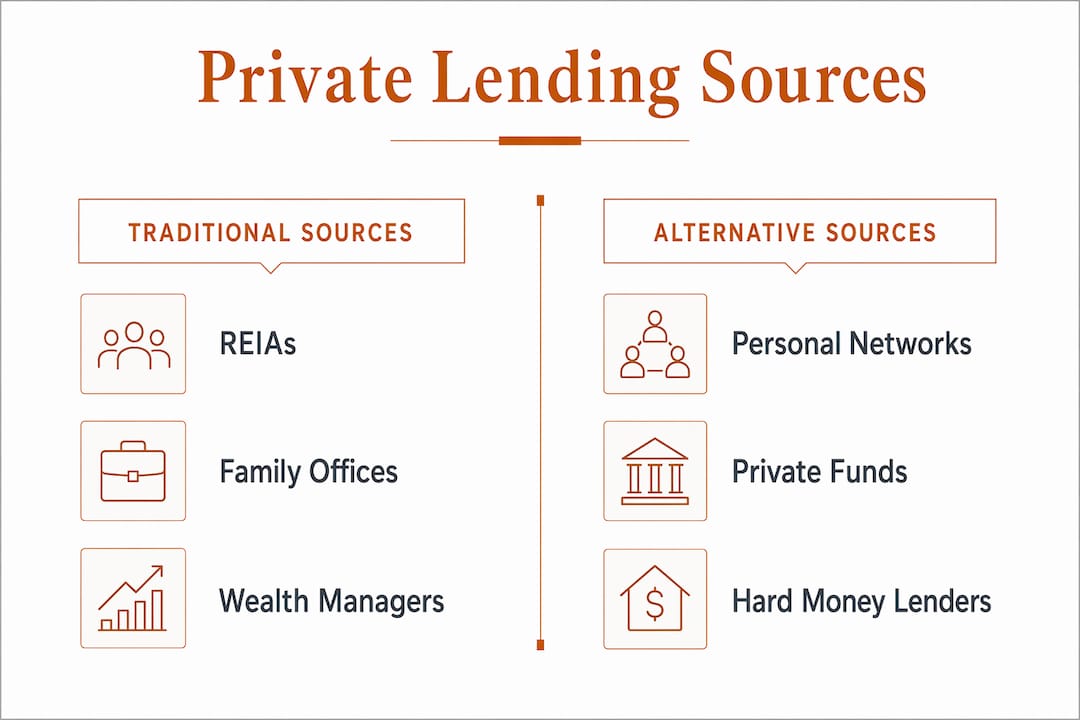
Hard money lenders and individual private lenders are different animals. Hard money lenders are companies with institutional capital. They move fast, charge higher rates, and have standardized underwriting. Individual private lenders are people, often retired professionals or successful business owners, who want better returns than a savings account offers. The best private lender terms come from long-term relationships, with rates commonly in the 8–10% interest-only range.
Follow these steps to qualify and pitch lenders professionally:
- Research the lender's track record. Ask how many deals they have funded, what property types they prefer, and what their typical loan size is.
- Match your deal to their criteria. A lender who funds single-family rehabs in Texas is not the right fit for a multifamily acquisition in Ohio.
- Present a clean deal package. Include photos, comps, a rent analysis, and your LLC documents.
- Start with a smaller loan. A first deal at $75,000 builds trust faster than asking for $500,000 on your first interaction.
- Follow up with results. After closing, send the lender a brief update when the property is rented and cash-flowing.
Pro Tip: Treat every lender meeting like a job interview where you are also interviewing them. Ask about their funding timeline, how they handle extensions, and whether they have funded deals similar to yours. A lender who hesitates on those questions is not the right partner.
Building long-term lender relationships is where real portfolio growth happens. Proactive communication, disciplined payments, and repeat deals build the trust that earns lower rates and faster approvals on your next acquisition.
What are common private lending structures and terms?
Understanding loan structures before you sign protects your cash flow and your portfolio. Private loans are not one-size-fits-all, but most follow a recognizable pattern.
Private loans typically carry 12-month terms, interest-only payments, and 70–75% loan-to-value ratios. Interest-only payments keep your monthly carrying cost low during a rehab or lease-up period. The 70–75% LTV cap means you need equity in the deal from day one, either through purchase price negotiation or a cash down payment.
Loan-to-cost (LTC) and loan-to-value (LTV) are two different calculations. LTC measures the loan against the total project cost including repairs. LTV measures it against the property's current or after-repair value. Private lenders use both, and knowing which one applies to your deal changes how much capital you can access.
| Feature | Private lending | Traditional bank financing |
|---|---|---|
| Approval timeline | 5–7 business days | 30–60 days |
| Credit requirements | Asset-focused, flexible | Strict credit and income verification |
| Loan-to-value | 70–75% | Up to 80% |
| Payment structure | Interest-only | Principal and interest |
| Term length | 6–24 months | 15–30 years |
| Property condition | Distressed accepted | Move-in ready required |
Single-property loans work well for your first few acquisitions. As your portfolio grows, portfolio loans bundle multiple properties under one loan, reducing paperwork and often improving terms. Some private lenders specialize in portfolio loans once you have three or more properties with a proven payment history.
Key loan terms to negotiate before signing:
- Extension options: Can you extend the loan 3–6 months if your refinance takes longer than expected?
- Prepayment penalty: Is there a penalty for paying off early? Many private lenders waive this.
- Draw schedule: For rehab loans, how are funds released and how quickly?
- Personal guarantee: Will the lender require a personal guarantee in addition to the LLC?
Pro Tip: Always negotiate the extension option before you close, not after. A 3-month extension clause costs nothing to add at signing but saves you from a forced sale if your refinance timeline slips.
How do you execute and manage private loans to grow your portfolio?
Closing a private loan is faster than most investors expect. Securing a bridge loan through a private lender can happen in as few as 5–7 business days when your documentation is complete. Speed is the primary advantage, and you protect it by being organized.
Private lending deals require first lien position, assignment of rents, and proper UCC filings to be legally sound. Your attorney handles these at closing. Never skip the assignment of rents clause. It gives the lender the right to collect rent directly if you default, which is exactly why lenders feel comfortable funding rental acquisitions.
The BRRRR method (Buy, Rehab, Rent, Refinance, Repeat) is the most effective framework for using private money to grow a rental portfolio. Private lenders with fast bridge loans and DSCR refinances enable you to recycle the same capital across multiple deals. You buy with private money, rehab, place a tenant, refinance into a long-term DSCR loan, pull your capital back out, and repeat the cycle.
Managing the loan after closing is where most investors make avoidable mistakes. The most common pitfalls are:
- Missing payments: Even one late payment damages the relationship and can trigger default clauses.
- Going silent: Lenders who do not hear from you assume something is wrong. Send a brief monthly update.
- Ignoring the exit: If your refinance is delayed, contact the lender early and request an extension before the loan matures.
- Skipping legal review: Have an attorney review every private loan agreement before you sign.
Repairing or improving rental properties with private capital also builds equity faster than waiting for appreciation. Investors who use private loans for value-add projects and then refinance at the higher appraised value extract more capital per deal than those who buy stabilized properties at full market price.
Key Takeaways
Using private lending to build a rental portfolio requires legal preparation, relationship-driven lender sourcing, disciplined loan management, and a clear exit strategy on every deal.
| Point | Details |
|---|---|
| LLC setup first | Hold every rental in an LLC before approaching any private lender. |
| Know your loan terms | Private loans typically carry 70–75% LTV, interest-only payments, and 12-month terms. |
| Source lenders through REIAs | Local investor associations are the fastest path to active private lenders. |
| Use the BRRRR method | Recycle private capital through buy, rehab, rent, refinance, and repeat cycles. |
| Communicate proactively | Monthly lender updates and on-time payments earn better terms on your next deal. |
Why private lending rewards the prepared investor
Most investors treat private lending like a transaction. The ones who build real portfolios treat it like a partnership. I have watched investors with average deals get funded repeatedly because they communicated well, paid on time, and brought the next deal before the current one closed. I have also watched investors with great deals lose lender relationships because they went silent after closing.
Basel III Endgame regulations reduced traditional bank exposure to commercial real estate, and that gap is permanent. Private lending is not a workaround anymore. It is a core part of how real estate gets financed in 2026. Investors who understand that are positioning themselves ahead of the market, not chasing it.
The legal structure point deserves more emphasis than most articles give it. Investors often neglect LLCs until something goes wrong. By then, a single lawsuit can unwind years of portfolio building. Set up the entity first, fund it properly, and keep your personal finances separate from your investment activity. That discipline also signals to lenders that you are a serious operator.
Disciplined portfolio growth through private lending is not about moving fast for its own sake. It is about moving fast when the deal is right and having the capital ready to act. Build the lender relationships before you need them. Structure every deal with a clear exit. Communicate like a professional. The investors who do those three things consistently are the ones who scale from two properties to twenty without a bank ever being involved.
— Brian
Gannlending: private lending built for rental investors
Real estate investors who need capital fast do not have 60 days to wait on a bank. Gannlending funds hard money loans in as few as 5–7 business days, with no appraisal required and financing up to 75% LTV on residential and commercial properties.
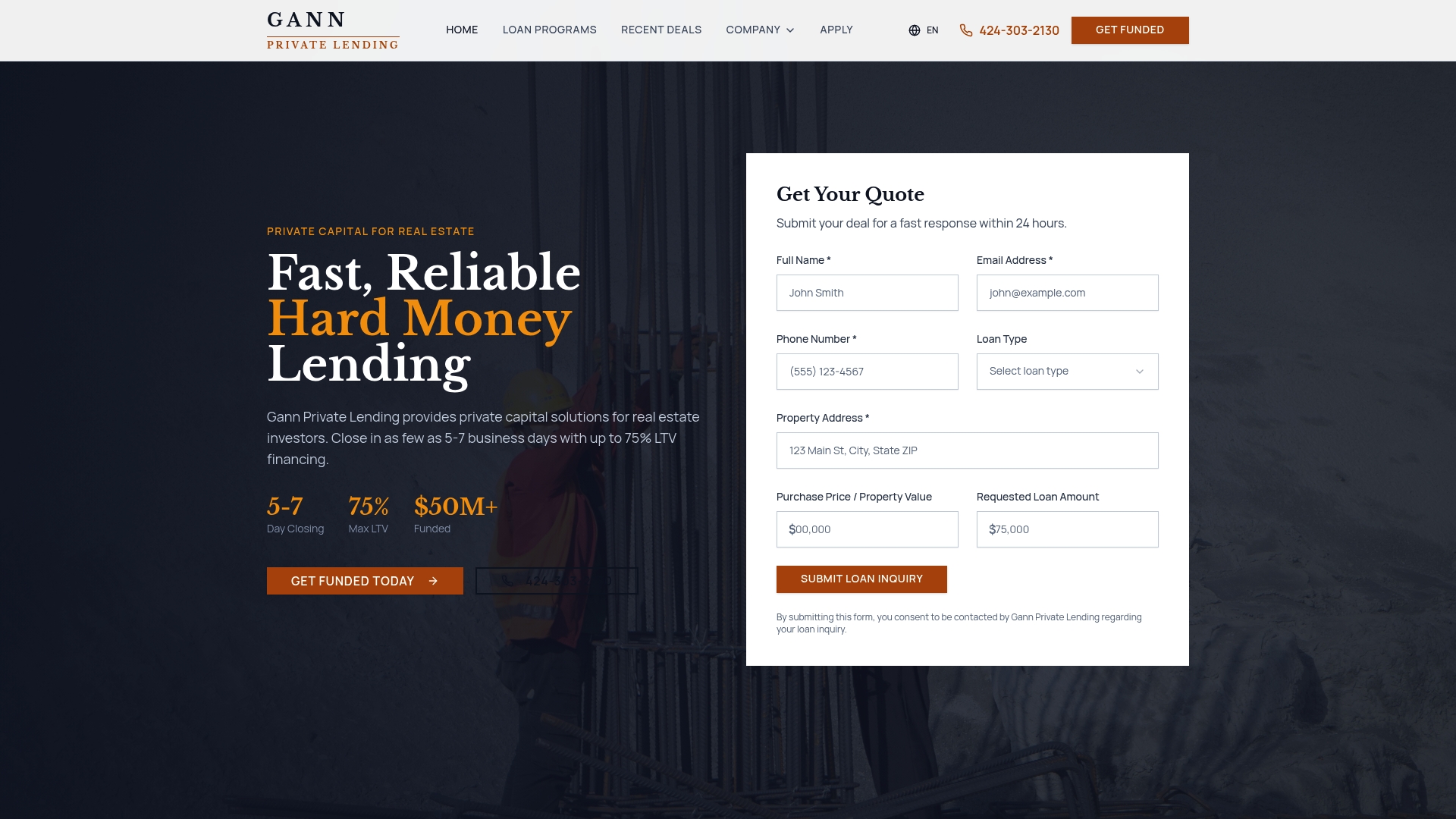
Gannlending has funded over $50 million in real estate loans, working with investors at every stage of portfolio growth. The approval process focuses on the asset, not a stack of paperwork, so you can move when a deal appears instead of watching it go to another buyer. Whether you are acquiring your first rental or refinancing your fifth, Gannlending's lending programs are built around the way real estate investors actually operate.
FAQ
What is private lending in real estate?
Private lending in real estate is financing provided by non-bank individuals or funds, secured by a property, and structured outside conventional mortgage guidelines. Loans typically carry interest-only payments, 70–75% LTV, and 12-month terms.
How do I find private lenders for rental properties?
Local Real Estate Investor Associations (REIAs), family offices, and wealth managers are the most reliable sources. Building relationships before you need capital gives you access to better terms and faster funding.
What is the BRRRR method and how does it use private lending?
BRRRR stands for Buy, Rehab, Rent, Refinance, Repeat. Private lenders fund the purchase and rehab, you place a tenant, refinance into a long-term loan, and recycle the capital into the next acquisition.
What documents do private lenders require?
Most private lenders require LLC entity documents, a personal financial statement, a deal summary with ARV and rent projections, and a clear exit strategy. Having these ready before your first meeting speeds up approval significantly.
Is private lending riskier than bank financing?
Private lending carries shorter terms and higher rates than bank loans, which creates refinancing risk if your exit takes longer than planned. Negotiating an extension clause at closing and maintaining lender communication reduces that risk substantially.