
Funding a retail residential mixed-use building is defined as assembling a layered capital structure that covers construction, predevelopment, and lease-up costs across two distinct asset classes within one project. The industry term for this process is mixed-use development finance, and it demands a different approach than single-asset lending. Developers who treat it like a standard residential loan routinely run short of capital mid-project. The investors who close fastest understand that government programs like the CMHC Apartment Construction Loan Program, private hard money lenders like Gannlending, and institutional equity each serve a different phase of the capital stack.
What funding options are available for retail residential mixed-use buildings?
Mixed-use development finance draws from four primary capital sources: government-backed construction loans, private debt, equity investment, and predevelopment programs. Each source covers a different phase and risk level. Knowing which to use, and when, determines whether your project closes in weeks or stalls for months.
Government-backed construction loans are the most cost-effective debt available for the residential component. The CMHC Apartment Construction Loan Program offers government-insured loans covering up to 100% of the residential component cost, with interest rates 0.5–1.5% lower than conventional financing. That spread translates directly into improved project returns on any development with 5 or more rental units.

Private construction debt fills the gap where government programs stop. Large commercial projects are often structured as floating-rate, interest-only loans to accommodate complex multi-phase timelines. A 798-unit Ohio mixed-use project, for example, closed on $55.16 million in construction financing using exactly this structure. Private lenders move faster than institutional sources and require less documentation, making them the right tool when timing matters.
Private equity anchors the capital stack from the bottom. Investment-grade mixed-use projects typically require minimum entry investments of $100,000, with preferred annual returns targeting around 8%. Institutional co-investors and operating partners often fill larger equity tranches, while developer equity signals commitment to lenders reviewing the deal.
- Predevelopment programs fund architectural plans, environmental reviews, and feasibility studies before construction financing is available.
- Programs like Amplify target early-stage capital for small residential developers, covering costs that traditional lenders routinely exclude.
- Mezzanine and preferred equity sit between senior debt and common equity, providing "patient capital" for multi-year project timelines.
- Loan-to-value ratios on private construction debt for mixed-use projects typically reach up to 75% LTV, with the balance covered by equity.
Pro Tip: Secure predevelopment funding before approaching construction lenders. Lenders want to see completed feasibility studies, architectural drawings, and cost reviews before they underwrite a dollar of construction debt.
What prerequisites influence funding eligibility for mixed-use projects?
Lenders apply stricter eligibility filters to mixed-use projects than to single-asset deals. Meeting these criteria before you apply reduces rejection risk and speeds up approval.
-
Minimum residential unit count. The CMHC Apartment Construction Loan Program requires a minimum of 5 residential units. Projects below that threshold do not qualify for government-backed residential financing and must rely entirely on private debt.
-
Retail component ratio. Most government and institutional lenders cap the retail or commercial portion of a mixed-use building at a defined percentage of gross floor area. Exceeding that cap reclassifies the project as commercial, changing the loan product, rate, and terms entirely.
-
Developer track record. Lenders prioritize experienced sponsorship teams for large-scale mixed-use loans. A developer with no multi-residential completions faces a much harder approval path than one with a documented delivery record. CMHC's Frequent Builder status rewards developers who have completed multi-residential projects with no defaults in the past 10 years, providing faster processing and improved terms.
-
Location and market demand. Transit-connected urban markets attract the strongest lender appetite. A project in a high-demand corridor with documented rental absorption data closes faster and at better terms than an equivalent project in a low-density suburban market.
-
Documentation package. Lenders require architectural plans, independent appraisals, third-party cost reviews, and environmental assessments before underwriting begins. Missing any one of these documents delays closing by weeks.
Mixed-use developments that align each component strategically so that retail, residential, and amenity uses reinforce each other present a stronger risk profile to lenders. A ground-floor café that serves building residents reduces retail vacancy risk. That reduced risk shows up in the lender's underwriting model.
How do you structure and execute the funding process step by step?
Closing capital on a mixed-use project follows a defined sequence. Skipping steps creates gaps in the capital stack that surface at the worst possible time.
-
Complete the feasibility study. Confirm market demand, project costs, and projected returns before spending on design. This document becomes the foundation of every lender conversation.
-
Secure predevelopment capital. Apply to early-stage programs or use developer equity to fund architectural design, environmental review, and permit applications. This phase typically costs 3–8% of total project budget.
-
Assemble the capital stack. Tiered capital structures combining equity, senior debt, and mezzanine or preferred equity are the standard for mixed-use development finance. Define the equity percentage first, then size the senior debt to the project's stabilized value.
-
Apply for government-backed residential financing. Submit the CMHC ACLP application with the full documentation package. Developers with Frequent Builder status receive faster processing. First-time applicants should budget 60–90 days for underwriting.
-
Arrange private construction debt for the commercial component. The retail portion of a mixed-use building does not qualify for CMHC residential financing. Private lenders cover this gap with asset-based underwriting and faster closings.
-
Negotiate floating-rate exposure. Most construction loans price off a floating benchmark. Consider interest rate caps or fixed-rate conversion options before signing. Rate movement during a 24-month construction period materially affects total project cost.
-
Close and manage draw schedules. Construction lenders fund in draws tied to project milestones. Align your contractor payment schedule with the lender's draw schedule to avoid cash flow gaps.
| Funding phase | Capital source | Typical timeline |
|---|---|---|
| Predevelopment | Developer equity, early-stage programs | 1–3 months |
| Construction (residential) | CMHC ACLP, private debt | 60–90 days to close |
| Construction (retail) | Private hard money, commercial debt | 5–30 days to close |
| Mezzanine/preferred equity | Institutional partners, private investors | 30–60 days to close |
| Stabilization/refinance | Conventional or agency debt | Post-completion |
Pro Tip: Engage your lenders and equity partners simultaneously, not sequentially. Waiting for one approval before approaching the next adds months to your timeline and signals inexperience to institutional investors.
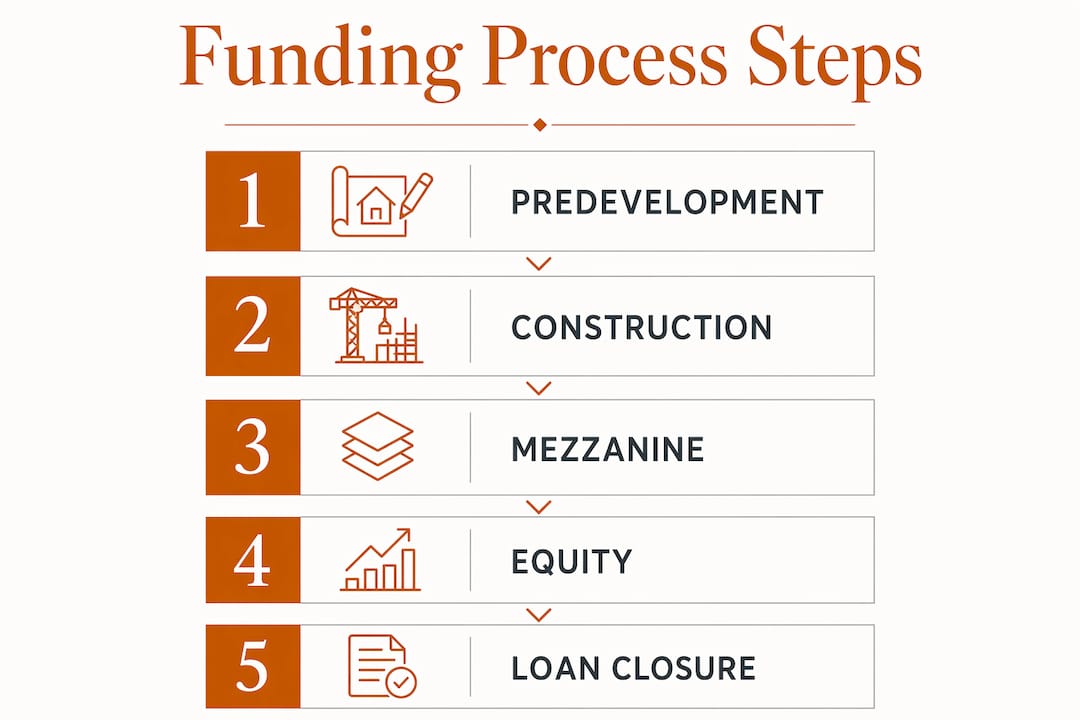
For a deeper look at capital structures for mixed-use projects, the funding sequence above applies across project sizes from 10 units to 800 units.
What are common pitfalls when funding mixed-use developments?
Most funding failures in mixed-use projects trace back to the same set of avoidable mistakes. Recognizing them early keeps your project on schedule.
- Overestimating retail income. Retail lease-up takes longer than residential absorption in most markets. Underwriting retail at 100% occupancy from day one creates a cash flow gap that strains the entire capital stack.
- Ignoring predevelopment costs. Architectural fees, environmental reviews, and permit costs arrive before any construction loan funds. Developers who skip predevelopment financing often drain equity reserves before breaking ground.
- Relying on a single funding source. A project dependent on one lender or one equity partner is one rejection away from a complete restart. Diversified capital structures survive setbacks; single-source structures do not.
- Underestimating floating-rate risk. Construction loans priced off floating benchmarks can increase total interest cost significantly over a 24-month build. Budget for rate movement, not just the opening rate.
- Weak documentation. Missing appraisals, incomplete cost reviews, or outdated architectural plans are the most common reasons lenders issue incomplete application notices. Assemble the full package before submitting.
Mixed-use properties provide natural diversification through multiple tenant types and income streams, buffering sector volatility. That diversification only works when each component is underwritten conservatively and the capital structure accounts for the different lease-up timelines of retail versus residential.
Maintaining transparent reporting with co-investors and equity partners throughout construction protects those relationships for future projects. Investors who receive regular updates stay patient during delays. Investors who receive silence do not.
For a practical breakdown of short-term loan structures commonly used in mixed-use construction, floating-rate and interest-only products are covered in detail.
Key Takeaways
Funding a retail residential mixed-use building requires a tiered capital stack that separates the residential and retail components, secures predevelopment capital first, and engages lenders and equity partners in parallel rather than in sequence.
| Point | Details |
|---|---|
| Tiered capital stack is non-negotiable | Combine equity, senior debt, and mezzanine financing to cover all project phases. |
| Predevelopment funding comes first | Secure capital for feasibility, design, and permits before approaching construction lenders. |
| Government programs cover residential only | CMHC ACLP funds the residential component; private debt must cover the retail portion. |
| Developer track record drives approval speed | Frequent Builder status and prior completions reduce processing time and improve loan terms. |
| Retail income requires conservative underwriting | Budget for extended retail lease-up timelines to avoid mid-project cash flow shortfalls. |
Why I think most developers underfund the retail component
The single most consistent mistake I see in mixed-use project financing is treating the retail component as an afterthought. Developers spend months assembling residential financing, then scramble to cover the ground-floor commercial space with whatever is left. That approach fails because retail and residential have completely different risk profiles, lease-up timelines, and lender appetites.
Government programs like the CMHC ACLP are purpose-built for the residential side. They are excellent tools, and developers who qualify for Frequent Builder status should use them aggressively. But those same programs do not touch the retail square footage. That gap requires a separate financing strategy, usually private debt, from the start of the capital planning process.
The developers I have seen close fastest are the ones who treat the retail and residential components as two parallel financing tracks from day one. They engage a private lender for the commercial component at the same time they submit the CMHC application. They do not wait for one approval before starting the next conversation. That parallel approach cuts months off the timeline and gives the project resilience if one source falls through.
My strongest recommendation is to build a contingency reserve into the capital stack before you need it. Retail lease-up delays, construction cost overruns, and interest rate movement are not edge cases. They are standard features of any multi-year mixed-use project. A capital structure with no buffer is not a capital structure. It is a countdown.
— Brian
Gannlending: fast capital for complex mixed-use projects
Real estate investors and developers working on mixed-use buildings often need capital faster than traditional lenders can move. Gannlending specializes in hard money loans for exactly this situation, with funding available in as few as 5–7 business days and no appraisal required.
Gannlending has funded over $50 million in real estate loans, covering residential and commercial properties with financing up to 75% LTV. For the retail component of a mixed-use project, where government programs stop and conventional lenders move slowly, Gannlending provides asset-based underwriting that focuses on the property rather than paperwork. Contact Gannlending directly to discuss loan sizing, terms, and how fast your project can close.
FAQ
What is the minimum project size to qualify for CMHC mixed-use funding?
The CMHC Apartment Construction Loan Program requires a minimum of 5 residential units and a minimum loan size of $1 million. Projects below these thresholds must use private or conventional financing for the residential component.
How do you fund the retail portion of a mixed-use building?
The retail component does not qualify for government-backed residential programs like CMHC ACLP. Developers typically fund it through private construction debt, commercial loans, or hard money lenders that underwrite based on asset value rather than income history.
What does a typical mixed-use capital stack look like?
A standard capital stack combines developer equity, senior construction debt, and mezzanine or preferred equity. Each layer covers a different risk tier, with senior debt sized to the stabilized property value and equity absorbing first-loss risk.
How does developer experience affect loan approval?
Lenders treat developer track record as a primary underwriting factor for large mixed-use loans. CMHC's Frequent Builder status, earned through prior multi-residential completions with no defaults in 10 years, reduces processing time and improves financing terms significantly.
Can a hard money lender fund a mixed-use building?
Yes. Private hard money lenders like Gannlending fund mixed-use buildings using asset-based underwriting, covering up to 75% LTV with closings in as few as 5–7 business days. This makes them the fastest option for the commercial component or for developers who need bridge capital quickly.