
A mixed use property is a real estate development that combines two or more distinct functions, such as residential, commercial, retail, or institutional uses, within one building or shared site. Unlike single-use zoning, which separates these functions into different districts, mixed use development places them together to reduce car dependency, improve walkability, and create more vibrant communities. The concept is not new, but its relevance to real estate investors has grown sharply as urban planners and municipalities push for denser, more connected neighborhoods. If you are exploring this asset class, understanding its structure, zoning rules, and financing requirements will determine whether it fits your portfolio.
What is mixed use property and how does it work?
A mixed use property integrates two or more distinct functions like residential, commercial, retail, or institutional uses within one building or site to enhance walkability and community vibrancy. The defining feature is intentional integration. A building with ground-floor retail and upper-floor apartments is a classic example. So is a campus-style development where a hotel, office building, and residential block share parking and landscaping on the same parcel.
The mixed use development definition in urban planning contrasts directly with Euclidean zoning, the traditional American approach that assigns a single permitted use to each land parcel. Euclidean zoning created the sprawling, car-dependent suburbs of the mid-20th century. Mixed use zoning reverses that logic by allowing, and often requiring, multiple uses to coexist. This shift has reshaped how cities grow and how investors evaluate real estate opportunities.
Gannlending finances mixed use properties as part of its broader real estate lending portfolio, recognizing that these assets carry both unique income potential and distinct risk profiles. Investors who understand the fundamentals are better positioned to act quickly when the right deal appears.
What are the main types of mixed use property structures?
Mixed use projects are primarily vertical or horizontal in their physical configuration, and the distinction matters for both development cost and investor strategy.
Vertical mixed use
Vertical mixed use stacks different functions within a single building. The most common pattern places retail or restaurant space on the ground floor, office or medical space on the middle floors, and residential units on the upper floors. This configuration maximizes land use in dense urban markets where lot sizes are small and land costs are high. A single building in a downtown corridor can generate three separate income streams from one footprint.

Horizontal mixed use
Horizontal mixed use distributes distinct building types across a shared site with common infrastructure such as roads, parking, and utilities. This approach is typical in suburban phased developments where a developer builds a retail strip, an apartment complex, and a hotel on adjacent parcels under a unified master plan. Each building operates independently, but the site functions as an integrated whole. Horizontal configurations give developers more flexibility to phase construction based on market demand.
| Feature | Vertical mixed use | Horizontal mixed use |
|---|---|---|
| Land efficiency | High, ideal for dense urban lots | Moderate, requires larger parcels |
| Construction complexity | High, shared structural systems | Lower, buildings are independent |
| Best context | Urban infill, downtown cores | Suburban campuses, phased projects |
| Income streams | Multiple from one building | Multiple from separate buildings |
| Management | Centralized but complex | Distributed across buildings |
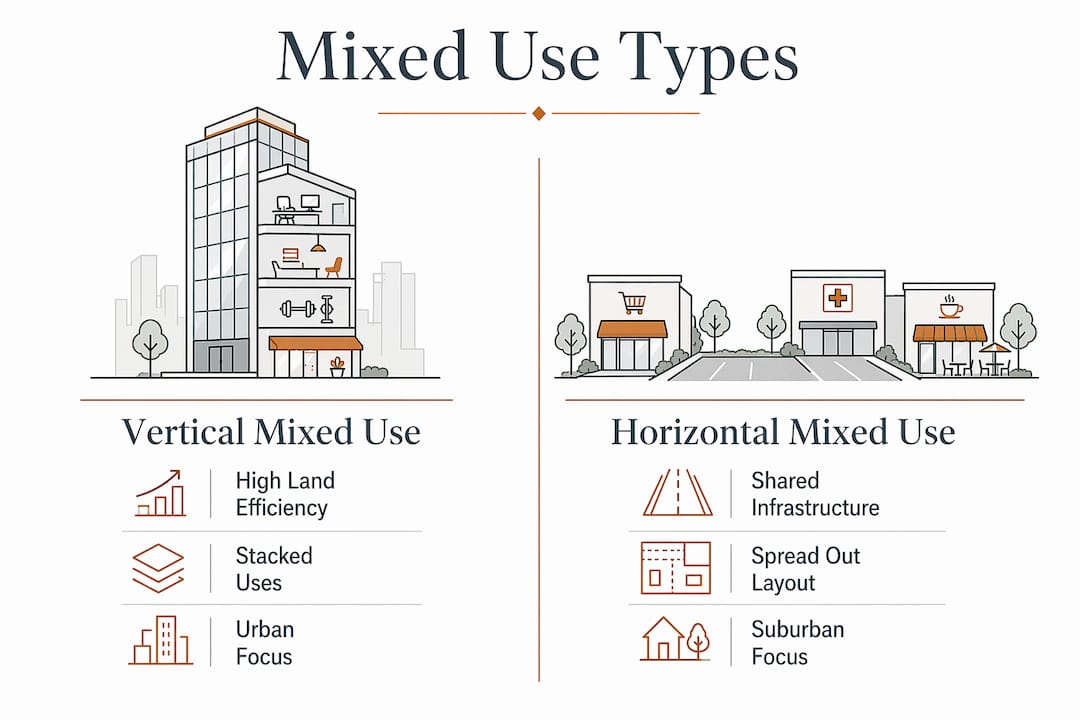
Specialized mixed use types include live-work units, which combine residential space with a personal workspace in one unit, and transit-oriented developments (TOD), which cluster density around public transit hubs to increase accessibility and reduce vehicle trips. Live-work units appeal to freelancers, artists, and small business owners. TODs have become a priority for cities trying to meet climate and housing goals simultaneously.
Pro Tip: When evaluating a vertical mixed use building, check whether the commercial and residential entrances are fully separated. Shared lobbies create noise complaints and tenant conflicts that erode occupancy rates over time.
What are the benefits and challenges of investing in mixed use properties?
Mixed use properties offer real advantages over single-use assets, but they also carry complexity that catches unprepared investors off guard.
Benefits worth knowing
Income diversification is the most cited reason investors pursue mixed use properties. Residential and commercial leases run on different cycles. When retail softens, residential rents may hold steady. When office demand drops, ground-floor food and beverage tenants may thrive. This offset effect helps stabilize cash flow across economic cycles.
Mixed use properties also tend to generate stronger foot traffic, which benefits commercial tenants and supports higher retail rents. A coffee shop on the ground floor of a 50-unit apartment building has a built-in customer base before it opens. That dynamic makes the commercial space more attractive to quality tenants and reduces vacancy risk.
Mixed use properties create significant neighborhood value through increased foot traffic and revitalization, which can lift surrounding property values and attract further investment to the area.
Challenges investors must prepare for
- Managing diverse user groups and shared infrastructure demands more effort than single-use properties. Investors need property managers experienced with both residential and commercial tenants.
- Financing is more stringent. Lenders often require higher debt-service coverage ratios and larger down payments because the blended income profile is harder to underwrite than a pure residential or pure commercial asset.
- Tenant mix balance is critical. Too many similar commercial tenants create internal competition. Too few create dead zones that hurt foot traffic and residential desirability.
- Regulatory delays are common. Zoning variances and special use permits add time and cost to acquisitions and development projects.
- Utility separation is frequently overlooked. Without separate metering for commercial and residential units, cost allocation becomes a source of ongoing disputes.
Pro Tip: Before closing on any mixed use acquisition, verify that each unit, both commercial and residential, has its own utility meters. Retrofitting separate metering after purchase is expensive and disruptive.
How does zoning affect mixed use developments?
Zoning is the single biggest regulatory factor shaping what you can build, how tall it can be, and what uses are permitted on a given parcel. Understanding it before you make an offer is not optional.
-
Identify the zoning district. Mixed use zoning districts and overlay zones allow residential and commercial uses on the same parcel. Traditional Euclidean zoning does not. Confirm which applies to your target property before proceeding.
-
Review use ratios and density limits. Municipal regulations govern building height, setbacks, floor-area ratios, and the permitted percentage of commercial versus residential space. A parcel zoned for mixed use may still cap commercial space at 30% of total floor area.
-
Check for overlay zones. Many cities apply overlay zones on top of base zoning to encourage specific outcomes, such as affordable housing, historic preservation, or transit-oriented density. Overlays can expand or restrict what the base zone permits.
-
Plan for variance timelines. Zoning variances and special designations add 6–12 months to project schedules. Experienced developers treat zoning approvals as a critical path task, not an afterthought.
-
Engage a land use attorney early. Municipalities interpret zoning codes differently. A local attorney who specializes in land use can identify conflicts before they become costly surprises.
The practical implication is straightforward. A property that looks like a great mixed use opportunity on paper may require a rezoning process that takes a year and costs tens of thousands of dollars in legal and consulting fees. Factor that into your acquisition underwriting from day one.
What should buyers and developers know before purchasing?
Financing, design, and management each carry specific requirements in mixed use real estate that differ from single-use assets. Investors who treat a mixed use building like a standard apartment complex or a standalone retail strip will run into problems quickly.
Financing realities
Lenders require higher DSCR ratios and larger down payments on mixed use properties, typically 25–35%, because the blended income from residential and commercial components creates a more complex risk profile. Traditional banks often apply commercial underwriting standards to the entire property if commercial space exceeds a certain threshold, usually 20–25% of gross leasable area. That means higher rates, shorter amortization periods, and stricter documentation requirements.
Private lenders and short-term real estate loans are often a better fit for mixed use acquisitions and renovations, particularly when speed matters. Gannlending funds mixed use projects with up to 75% LTV and closes in as few as 5–7 business days, which gives investors the speed needed to compete in tight markets. For investors building a broader portfolio, real estate portfolio financing strategies can help structure multiple mixed use assets under a single lending relationship.
Design and management considerations
Proper design requires isolated HVAC systems, separate utility metering, and sound insulation between commercial and residential spaces. Neglecting these elements is one of the most common and costly mistakes in mixed use development. A restaurant kitchen venting into a residential corridor, or a gym with inadequate sound insulation below apartments, will generate complaints, lease terminations, and vacancy.
Tenant mix strategy matters as much as physical design. A well-curated ground-floor tenant roster, anchored by a grocery store, pharmacy, or fitness studio, drives consistent foot traffic that benefits every other commercial tenant on the property. Balancing tenant mix to maintain commercial activity while protecting residential quality of life is the ongoing management challenge that separates successful mixed use operators from struggling ones.
Pro Tip: Hire a property management firm that has specific experience with mixed use assets, not just residential or just commercial. The skill sets are genuinely different, and a generalist manager will cost you more in vacancy and disputes than the fee savings are worth.
Key Takeaways
Mixed use properties generate stronger returns when investors understand their structural types, zoning requirements, and financing complexity before committing capital.
| Point | Details |
|---|---|
| Core definition | A mixed use property combines two or more distinct uses, such as residential and commercial, within one site. |
| Two main structures | Vertical mixed use stacks uses in one building; horizontal distributes them across a shared site. |
| Income diversification | Residential and commercial leases offset each other across market cycles, stabilizing cash flow. |
| Zoning adds time | Variance and approval processes add 6–12 months; treat zoning as a critical path task from day one. |
| Financing is stricter | Expect down payments of 25–35% and higher DSCR requirements; private lenders often move faster than banks. |
What I've learned from watching mixed use deals succeed and fail
Mixed use properties are genuinely exciting assets. They create real community value, generate multiple income streams, and tend to hold up better than single-use properties during sector-specific downturns. I have seen investors do very well with them. I have also seen investors get badly burned, and the pattern is almost always the same.
The investors who struggle underestimate the operational complexity. They buy a building with retail below and apartments above, assume the management is roughly similar to what they already know, and then spend the first two years firefighting tenant disputes, utility billing arguments, and noise complaints. The building was not the problem. The preparation was.
The investors who do well treat mixed use as its own asset class from the start. They hire specialists, not generalists. They budget for longer zoning timelines. They verify utility separation before closing, not after. And they think carefully about tenant mix before they sign the first commercial lease, because the wrong anchor tenant can undermine the entire residential component.
My honest advice for novice investors: start with a smaller vertical mixed use building, ideally two to four stories with a single commercial tenant on the ground floor. That gives you real exposure to the asset class without the full complexity of a large horizontal development. Get comfortable with the management dynamics before you scale. The income diversification benefit is real, but it only works if you can actually manage the complexity that comes with it.
— Brian
Financing your mixed use property with Gannlending
Securing the right financing for a mixed use property moves fast in competitive markets. Traditional lenders slow the process with lengthy underwriting requirements that do not fit the timelines real estate investors actually face.
Gannlending specializes in hard money loans for real estate investors, with financing available for mixed use properties at up to 75% LTV and closing in as few as 5–7 business days. No appraisal is required. The approval process focuses on the asset, not mountains of paperwork. Gannlending has funded over $50 million in real estate loans, including residential and commercial projects. Contact Gannlending directly to discuss financing options for your next mixed use acquisition or development.
FAQ
What is the mixed use development definition in real estate?
A mixed use development combines two or more distinct real estate uses, such as residential, commercial, retail, or institutional, within one building or shared site. The goal is to create walkable, economically active communities that reduce car dependency.
What are the main types of mixed use properties?
The two primary types are vertical mixed use, which stacks different uses within one building, and horizontal mixed use, which distributes separate buildings across a shared site. Specialized forms include live-work units and transit-oriented developments.
How does mixed use zoning differ from standard zoning?
Mixed use zoning allows residential and commercial uses on the same parcel, while traditional Euclidean zoning assigns a single permitted use to each land area. Municipal codes govern height, density, setbacks, and the ratio of commercial to residential space.
What down payment do lenders require for mixed use properties?
Lenders typically require down payments of 25–35% for mixed use properties due to the blended income risk profile. Private lenders like Gannlending often offer more flexible terms and faster closing timelines than conventional banks.
What is the biggest mistake investors make with mixed use properties?
The most common mistake is underestimating operational complexity, particularly failing to verify separate utility metering and sound insulation between commercial and residential spaces before closing. These oversights generate tenant disputes and vacancy that erode returns.