
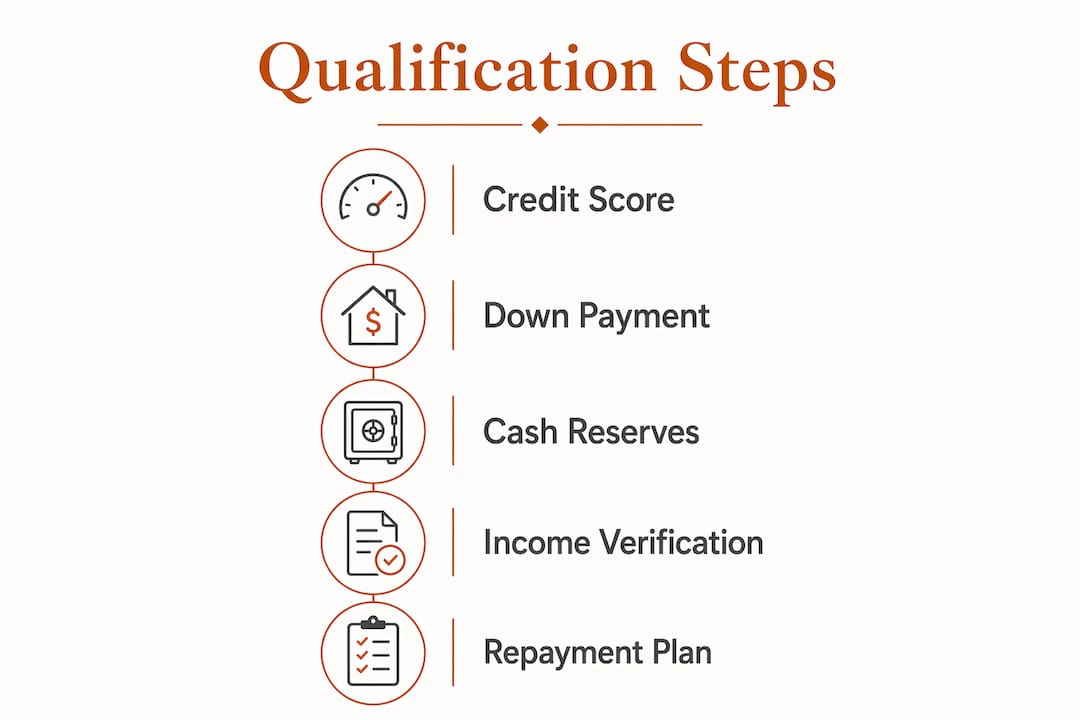
An interest-only real estate loan is defined as a mortgage where you pay only the interest for a set period, typically 5–10 years, before principal repayment begins. To qualify for an interest-only real estate loan, you need a credit score of at least 680, a down payment of 20% or more, and either documented personal income or strong property cash flow. Two distinct qualification pathways exist: DSCR-based loans for investors who rely on rental income, and traditional residential interest-only mortgages that require personal income verification. Knowing which path fits your situation is the first decision that shapes every other part of your application.
What are the key qualification criteria for interest-only real estate loans?
Lenders treat interest-only loans as higher risk than conventional mortgages. They compensate by tightening credit, reserve, and equity requirements across the board.
Credit score and down payment thresholds
DSCR interest-only loans require a credit score between 680 and 720, with down payments ranging from 20% to 30%. Traditional residential interest-only mortgages often push that credit floor closer to 740, especially for longer IO periods. A higher score signals lower default risk, which is the single factor lenders weight most heavily when approving these products.
Down payment size directly controls your loan-to-value ratio. LTV limits for residential interest-only loans typically range from 50% to 75%, stricter than conventional amortizing mortgages. That tighter cap forces you to bring more equity upfront, which protects the lender if property values dip during the IO period.
Cash reserves and liquidity
Lenders require 6–12 months of PITIA in cash reserves for interest-only loans. PITIA stands for principal, interest, taxes, insurance, and association dues. That reserve buffer exists because no equity builds during the IO period, so the lender needs proof you can weather income gaps or vacancies without defaulting.

Pro Tip: Calculate your full PITIA amount before applying, then multiply by 12. That number is your minimum liquidity target. Falling short of it is one of the fastest ways to get denied.
DSCR loans vs. traditional income verification
DSCR loans skip W-2s and tax returns entirely. Qualification rests on whether the property's rental income covers the debt service, typically at a coverage ratio of 1.1 or higher. Traditional residential interest-only mortgages work the opposite way: lenders scrutinize your personal income, employment history, and debt-to-income ratio. Understanding loan customization options for each pathway helps you choose the structure that matches your financial profile before you apply.
How do lenders verify repayment plans and exit strategies?
Repayment realism and documented exit strategies are the central pillars of lender acceptance for interest-only loans in 2026. Lenders no longer accept vague assumptions about future appreciation. They want a written, credible plan for how the principal gets repaid when the IO period ends.
Accepted repayment vehicles
Common exit strategies lenders approve include:
- Pension lump sum: A formal pension statement showing projected payout that covers the outstanding balance.
- Planned property sale: A documented timeline and realistic valuation supporting a future sale.
- Investment portfolio liquidation: Brokerage statements showing liquid assets sufficient to retire the principal.
- Refinance into a conventional mortgage: Evidence of equity growth and income trajectory that supports future qualification.
For DSCR loans, the repayment vehicle is the property itself. Rental income must cover debt service at a DSCR coverage ratio of 1.1 or above, and lenders verify this with signed leases, rent rolls, and market rent analysis.
"Lenders require documented proof of how the principal will be repaid to reduce risk, especially for longer IO periods. The shift is toward evidence-based repayment plans emphasizing equity or liquid assets, not future appreciation assumptions."
For residential interest-only mortgages, the documentation bar is high. A pension statement must show projected figures, not just current balances. A planned sale must include a credible property valuation, not just an optimistic estimate. Lender scrutiny on exit plans has intensified in 2026, making preparation the difference between approval and rejection.
Aligning repayment timing with lender policy
Age policies matter more than most investors realize. Some lenders cap the loan term so that repayment completes before the borrower reaches a set age, often 70 or 75. If your IO period plus the repayment window pushes past that threshold, the lender will decline regardless of your credit score. Confirm age and term policies before selecting a product.
How to prepare and apply for an interest-only real estate loan
A strong application is built before you contact a lender. Preparation determines whether you qualify on the first submission or spend months fixing gaps.
-
Pull your credit report. Review all three bureaus through AnnualCreditReport.com. Dispute errors, pay down revolving balances below 30% utilization, and avoid new credit inquiries for at least 90 days before applying.
-
Calculate your down payment and reserves. Confirm you have 20%–30% of the purchase price available plus 6–12 months of PITIA in liquid accounts. These two numbers are non-negotiable for most IO loan products.
-
Choose your qualification pathway. If you own or are buying a rental property, a DSCR loan likely fits better. If you are purchasing a primary or secondary residence, traditional income verification applies. The wrong pathway wastes time and generates unnecessary credit inquiries.
-
Gather your documentation package. For DSCR loans: signed leases or market rent analysis, property financials, and bank statements showing reserves. For traditional IO mortgages: two years of tax returns, W-2s or 1099s, bank statements, and your formal repayment vehicle documentation.
-
Consult with a lender about IO period length. Requesting the maximum IO term upfront at origination avoids costly re-underwriting later. Lenders treat IO period extensions as new loan events, which triggers fees and fresh qualification checks.
-
Submit a complete application. Lead with your strengths. If your credit score is 720 and your DSCR is 1.25, put those numbers front and center. Lenders approve files that tell a clear, low-risk story quickly.
Pro Tip: Ask your lender whether they run shadow underwriting on the fully amortizing payment. If they do, calculate what your payment becomes after the IO period ends and confirm your property cash flow still covers it. Failing that test is a common reason DSCR applications get denied.
What mistakes cause investors to fail interest-only loan qualification?
Most qualification failures trace back to preparation gaps, not fundamental financial weakness. Knowing where applications break down lets you fix problems before they cost you a deal.
-
Vague repayment plans. Saying you plan to sell the property someday is not an exit strategy. Lenders require a documented timeline, a credible valuation, and evidence the sale proceeds cover the outstanding balance.
-
Underestimating reserve requirements. Investors often calculate reserves based on the IO payment, not the full PITIA. The lender uses PITIA. That gap can leave you $20,000–$40,000 short of the required liquidity threshold.
-
Requesting an IO period the credit profile cannot support. A 10-year IO period on a 680 credit score is a mismatch at most lenders. Longer IO terms require stronger credit because the lender carries more risk for a longer window.
-
Failing the fully amortizing payment test. DSCR underwriting checks both the interest-only DSCR ratio and the full amortization payment ability. A property that cash-flows well during the IO period may fail the post-IO stress test if rents are thin.
-
Over-leveraging without an equity cushion. Pushing LTV to the maximum limit leaves no buffer if property values decline. Lenders notice high-LTV applications and apply additional scrutiny to income and reserves.
-
Ignoring rate adjustment risk. Interest-only mortgages often carry adjustable rates, meaning your payment can rise significantly once the IO period ends and principal repayment begins. Investors who do not model the post-IO payment often find themselves unable to refinance or service the debt.
Reviewing your bridge loan approval strategies can also sharpen your understanding of how lenders evaluate short-term financing risk, since many of the same credit and reserve criteria apply.
Key Takeaways
Qualifying for an interest-only real estate loan requires meeting credit, down payment, reserve, and repayment documentation standards that are stricter than conventional mortgages.
| Point | Details |
|---|---|
| Credit score minimum | Aim for 680–720 for DSCR loans; 740+ for traditional residential IO mortgages. |
| Down payment and LTV | Bring 20%–30% down; LTV caps typically range from 50% to 75% for IO products. |
| Cash reserves required | Hold 6–12 months of PITIA in liquid accounts before applying. |
| Repayment documentation | Provide formal evidence of your exit strategy, not assumptions about appreciation. |
| Choose the right pathway | DSCR loans use rental income; traditional IO mortgages require personal income verification. |
Why I think most investors approach interest-only loans backwards
Most investors I talk to focus on the interest-only payment first and the exit strategy last. That is exactly backwards. Lenders in 2026 approve or reject IO applications based on repayment realism before they even finish reviewing the credit file.
The investors who qualify cleanly are the ones who treat the exit strategy as the foundation of the application, not an afterthought. They arrive with a pension statement, a signed lease roll, or a documented sale timeline. They have already run the post-IO payment calculation and confirmed the property still cash-flows after the IO period ends.
DSCR-based interest-only loans are genuinely powerful tools for investors who want to maximize monthly cash flow during a hold period. But they only work if you negotiate the longest possible IO term at origination. Trying to extend it later costs money and triggers a full re-underwriting process. Get it right the first time.
The other thing most investors underestimate is the reserve requirement. Six to twelve months of PITIA is not a suggestion. It is a hard floor. Investors who show up with exactly the down payment and nothing else get declined, then wonder why. Build your liquidity before you build your offer.
My honest advice: treat the IO loan application like a business plan presentation. Know your numbers cold, document every assumption, and show the lender a clear path from today's interest-only payment to full repayment at term end. That approach closes deals.
— Brian
Gannlending's approach to interest-only real estate financing
Real estate investors who need fast, flexible financing without the paperwork burden of traditional lenders have a direct path through Gannlending.

Gannlending focuses on the asset, not endless documentation. The approval process closes in as few as 5–7 business days, with financing covering up to 75% LTV on residential and commercial properties. Gannlending has funded over $50 million in real estate loans, and its private hard money structure supports interest-only terms for qualified investors. If you are ready to put your qualification criteria to work, visit Gannlending and connect with a lending specialist who can match your deal to the right loan structure.
FAQ
What credit score do I need for an interest-only real estate loan?
Most lenders require a minimum credit score of 680 for DSCR interest-only loans and 720–740 for traditional residential interest-only mortgages. Higher scores unlock longer IO periods and better rate terms.
Can I qualify for an interest-only mortgage without W-2 income?
Yes. DSCR loans qualify you based on the property's rental income rather than personal income, so W-2s and tax returns are not required. The property's cash flow must cover debt service at a ratio of 1.1 or higher.
How much do I need to put down for an interest-only loan?
Down payments for interest-only loans typically range from 20% to 30%, depending on the loan type and your credit profile. Investment properties generally require the higher end of that range.
What happens when the interest-only period ends?
Your payment increases because you begin repaying principal on top of interest. If the loan carries an adjustable rate, the rate may also reset, compounding the payment increase. Model this scenario before you commit to the loan.
What counts as an accepted repayment vehicle for an interest-only mortgage?
Lenders accept pension lump sums, planned property sales with documented valuations, investment portfolio liquidation, and refinancing into a conventional mortgage. Vague plans based on future appreciation are not accepted.