
Loan customization options in real estate are specialized financing structures that adapt to your investment goals, asset types, and cash flow needs rather than forcing you into a one-size-fits-all product. Standard bank loans follow rigid Qualified Mortgage (QM) guidelines that exclude many investors, particularly those with non-traditional income or large mixed portfolios. Non-QM products, portfolio loans, and interest-only structures fill that gap. Gannlending has funded over $50 million using asset-focused underwriting, closing deals in as few as 5–7 business days. The right custom loan solution protects your capital and keeps your pipeline moving.
1. What are the primary loan customization options real estate investors use?
Tailored real estate loans give you control over the variables that matter most: rate type, repayment schedule, amortization length, and down payment size. Each variable affects your monthly cash flow and your long-term equity position differently.
The most common customizable features include:
- Rate structure: Fixed, variable, or hybrid rates. Fixed rates lock your payment for the loan term. Variable rates start lower but shift with market indexes. Hybrid rates combine both, typically fixed for 3–7 years then adjusting annually.
- Amortization schedule: Standard 30-year, shortened 15-year, or interest-only periods that reduce near-term payments while preserving cash for other acquisitions.
- Loan-to-value (LTV) adjustments: Down payment flexibility changes your risk exposure. Gannlending finances up to 75% LTV across residential and commercial properties.
- Repayment timing: Flexible schedules align payments with rental income cycles and operational reserve needs rather than arbitrary calendar dates.
- Escrow management: Automated tax and insurance payments built into the loan structure reduce administrative burden on large portfolios.
- Blended and portfolio structures: Multiple properties bundled under one loan agreement for simplified management.
Pro Tip: Before comparing rates, map your cash flow calendar for the next 12 months. The rate that looks cheapest often costs more when its payment schedule conflicts with your rental income timing.
2. How do Non-QM and Foreign National loans expand your financing choices?

Non-QM loans are mortgages that fall outside the Consumer Financial Protection Bureau's Qualified Mortgage standards. That exclusion is not a flaw. It is the feature. Non-QM products are built for investors whose income, credit history, or documentation does not fit conventional underwriting boxes.
Foreign National loans require a foreign passport, 25–30% down, and bank statements in place of U.S. tax returns. That structure opens U.S. real estate to international investors who hold no American credit history. Bank Statement loans verify income through 12–24 months of deposit records, making them the right tool for self-employed investors and business owners whose tax returns understate actual earnings.
Key Non-QM product categories worth knowing:
- Bank Statement loans: Income verified by deposits, not W-2s or tax returns.
- DSCR loans: Debt Service Coverage Ratio loans qualify based on property income, not personal income.
- Asset depletion loans: Lenders calculate income from liquid assets rather than employment records.
- Foreign National loans: Designed for non-U.S. residents purchasing American investment properties.
Pro Tip: If a conventional lender has already declined your application, do not assume the deal is dead. Specialized lenders structure loans around unique income profiles and property mixes, even after traditional denials.
The tradeoff with Non-QM products is cost. Interest rates run higher than conventional loans, and terms are shorter. Build that spread into your underwriting before you commit.
3. What is portfolio lending and how does it work for large holdings?
Portfolio lending combines multiple properties into a single financing structure managed under one agreement. The lender holds the loan on its own books rather than selling it to the secondary market. That distinction matters because it gives the lender full authority to customize terms without conforming to Fannie Mae or Freddie Mac guidelines.
Portfolio loans can include integrated escrow for automated tax and insurance payments alongside 5-year fixed interest-only periods. That combination maximizes operational cash flow during the hold period while keeping administration simple. Investors managing 10 or more properties gain the most from this structure because it replaces a stack of individual loan files with one consolidated agreement.
| Feature | Standard Individual Loans | Portfolio Loan |
|---|---|---|
| Properties covered | One per loan | Multiple under one agreement |
| Underwriting standard | Agency guidelines (Fannie/Freddie) | Lender's own criteria |
| Rate type options | Fixed or ARM | Fixed, interest-only, hybrid |
| Escrow management | Per property | Consolidated |
| Refinancing flexibility | Refinance each property separately | Segment and refinance selectively |
Segmenting a large portfolio into smaller, mixed loans improves cash flow agility and simplifies partial refinancing when market conditions shift. Rather than refinancing all properties at once, you can restructure one segment while leaving the rest untouched.
Pro Tip: Ask your lender whether the portfolio loan allows partial releases. That clause lets you sell one property without triggering a full loan payoff, which protects your flexibility as the portfolio evolves.
4. How do adjustable loan terms and repayment schedules support tailored financing?
Adjustable loan terms let you match debt service to the actual income your properties generate. That alignment is the core mechanic behind effective real estate financing choices. When payments and income move together, you carry less liquidity risk.
Interest-only loans reduce monthly payments during the hold period by deferring principal repayment. That structure works well for value-add acquisitions where you are renovating before refinancing or selling. Principal-and-interest loans build equity faster but demand higher monthly payments from day one.
Balloon payment structures set a fixed term of 5–10 years with a lump sum due at maturity. They carry lower rates than fully amortizing loans, but they require a clear plan for the balloon date. Lenders assess exit strategies for interest-only and balloon loans carefully because maturity repayment risk is the primary concern in custom-structured deals.
Bridge loans provide short-term funds to purchase a property before your current asset sells. They close fast, carry higher rates, and are designed to be replaced by permanent financing within 6–24 months. For investors moving quickly on acquisitions, a bridge loan guide is worth reviewing before you commit to terms.
Situational uses for adjustable parameters:
- Interest-only: Value-add projects, short hold periods, high-yield markets where cash flow matters more than equity buildup.
- Balloon payments: Investors confident in a near-term refinance or sale event.
- Bridge loans: Time-sensitive acquisitions, foreclosure prevention, or gap financing between transactions.
- Variable amortization: Portfolios with seasonal rental income that fluctuates quarter to quarter.
5. What factors should investors consider when choosing among custom loan solutions?
The right custom loan solution depends on three variables: your investment type, your financial profile, and your exit plan. Getting one wrong creates problems the other two cannot fix.
Matching loan features to property type is the starting point. Residential single-family rentals support longer amortization schedules and lower rates. Commercial and multifamily assets often require DSCR underwriting because lender focus shifts to property income rather than personal income. Mixed portfolios benefit from portfolio lending structures that consolidate management without sacrificing flexibility.
Evaluating lender flexibility matters as much as evaluating rates. Consultative lenders match loan structures to your liquidity needs, expansion plans, and tax strategy rather than defaulting to their most common product. A lender who asks about your 3-year plan before quoting a rate is more useful than one who leads with the lowest number.
Key factors to evaluate before committing:
- LTV and down payment: Higher LTV preserves capital but increases rate and risk. Review LTV ratio examples before finalizing your structure.
- Rate vs. term tradeoff: Lower rates on shorter terms can cost more if you need to refinance before maturity.
- Exit strategy clarity: Every interest-only or balloon loan needs a documented plan for the maturity date. Lenders require it, and you should want it.
- Prepayment penalties: Custom loans sometimes include yield maintenance or step-down prepayment clauses that penalize early payoff.
- Broker vs. direct lender: Specialized real estate financing brokers access products across multiple lenders and can structure deals that a single institution cannot offer.
Working with a broker who specializes in investment properties gives you access to Non-QM, portfolio, and private lending products in one conversation rather than three separate applications.
Key takeaways
Loan customization options in real estate give investors the tools to align financing with property income, hold periods, and portfolio scale rather than accepting whatever a standard bank offers.
| Point | Details |
|---|---|
| Match loan type to investment goal | Interest-only fits value-add projects; DSCR fits income properties; bridge fits time-sensitive deals. |
| Portfolio loans consolidate large holdings | One agreement covers multiple properties with integrated escrow and flexible rate terms. |
| Non-QM expands eligibility | Bank Statement and Foreign National loans qualify investors outside conventional income documentation. |
| Exit strategy is non-negotiable | Every custom loan needs a documented repayment or refinance plan before the lender will approve it. |
| Consultative lenders outperform rate shopping | Lenders who structure around your goals deliver better long-term outcomes than those who lead with the lowest rate. |
Why I think most investors shop for loans the wrong way
Most investors I have worked with start the financing conversation by asking for the lowest rate. That instinct is understandable, but it is the wrong first question. Rate is one variable in a structure that has at least six. Optimizing one while ignoring the others produces a loan that looks cheap on paper and creates cash flow problems in month four.
The investors who use personalized financing plans most effectively start with a different question: what does this property need to generate, and when? From that answer, the right amortization schedule, rate type, and term length become obvious. The rate follows the structure, not the other way around.
The other misconception I see constantly is the belief that a conventional denial ends the conversation. Specialized brokers build loans around income profiles and property mixes that standard banks cannot touch. A denial from one institution is not a verdict on the deal. It is a signal to find a lender whose product set matches your situation.
My practical advice: before you contact any lender, write down your hold period, your monthly income target from the property, and your plan for the loan at maturity. That document turns a rate conversation into a structure conversation, and structure is where real money is made.
— Brian
Gannlending: fast, flexible financing for real estate investors
Real estate moves fast. Waiting 45 days for a conventional approval means losing deals to buyers who close in two weeks.
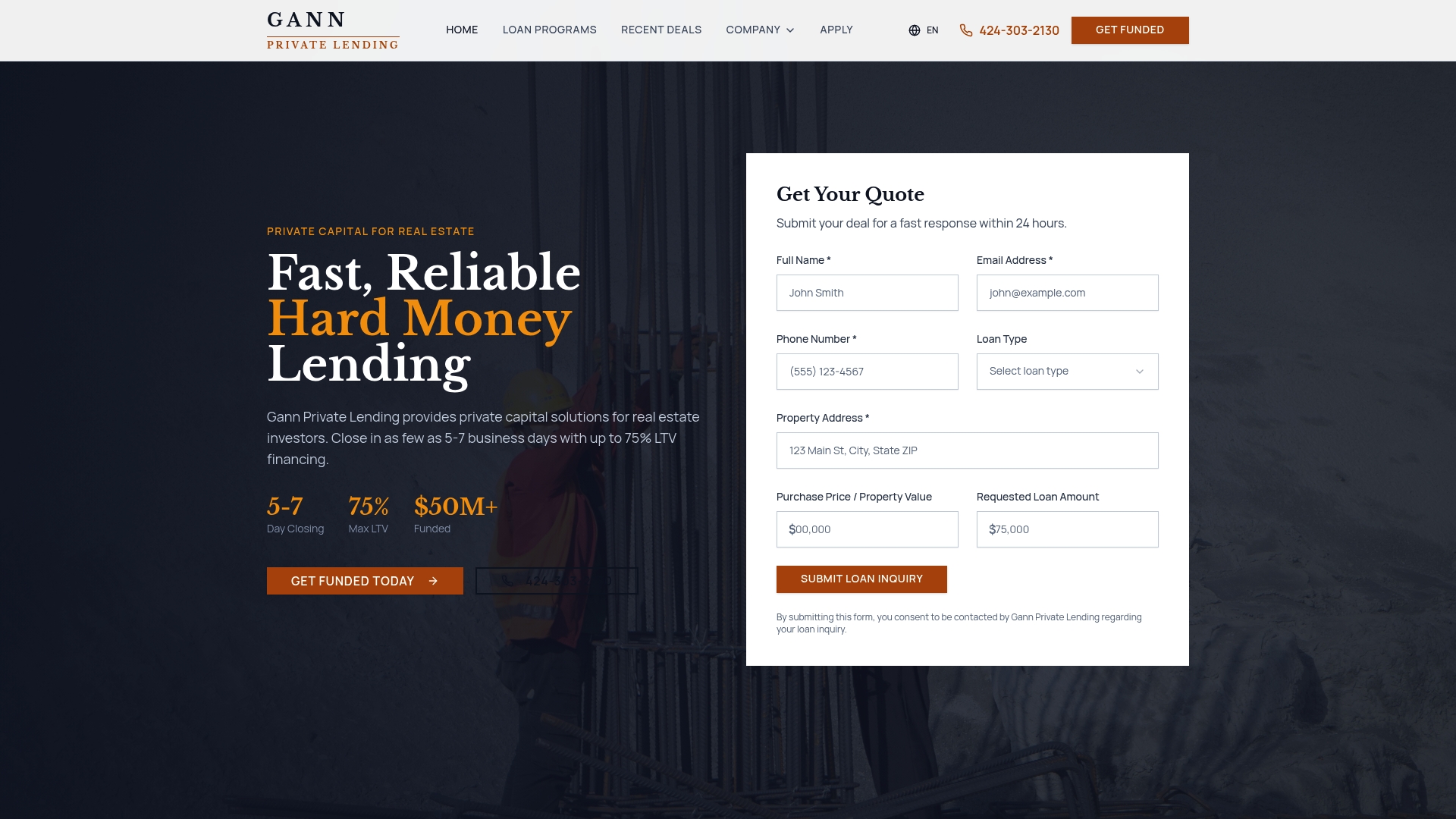
Gannlending focuses on the asset, not the paperwork. Approval is based on property value and investor plan, not tax returns and credit committee delays. Gannlending funds up to 75% LTV across residential and commercial properties and closes in as few as 5–7 business days. With over $50 million funded, the track record speaks for itself. Investors facing foreclosure or tight acquisition timelines can reach Gannlending directly at gannlending.com for a consultation on private hard money loans built around your specific deal.
FAQ
What are loan customization options in real estate?
Loan customization options are adjustable financing features including rate type, amortization schedule, LTV, and repayment timing that investors tailor to match their property income and investment goals.
What is a Non-QM loan and who qualifies?
A Non-QM loan is a mortgage that falls outside standard Qualified Mortgage guidelines. Self-employed investors, foreign nationals, and borrowers with non-traditional income typically qualify using bank statements or asset documentation instead of tax returns.
How does a portfolio loan differ from individual property loans?
A portfolio loan covers multiple properties under one agreement held by the lender rather than sold to the secondary market. That structure allows custom terms, consolidated escrow, and selective refinancing of individual property segments.
When does an interest-only loan make sense for investors?
Interest-only loans work best for short hold periods, value-add projects, or high-yield markets where preserving monthly cash flow matters more than building equity quickly. A clear exit strategy is required before any lender will approve the structure.
How fast can a private lender close a customized real estate loan?
Private lenders like Gannlending close customized real estate loans in as few as 5–7 business days by focusing on asset value rather than extensive documentation requirements.