
An anchor tenant is the single largest determinant of value in a commercial property. Not the location, not the square footage, not the cap rate you negotiated at acquisition. The anchor tenant. Its credit profile underwrites your debt, its foot traffic sets every inline rent in the building, and its departure can cut property value by 20–30% before you've had time to call a broker. If you're underwriting a retail center or anchored strip without modeling the anchor first, you're pricing the wrong asset.
How anchor tenants shape commercial property value
An anchor tenant is the largest, highest-profile occupant in a commercial property, typically a national retailer, grocery chain, or big-box brand that draws shoppers to the site. Smaller tenants depend on that draw to survive. Without it, most inline shops cannot generate enough foot traffic on their own marketing alone.
The economic model works like this: the anchor pays well below market rent per square foot, and in exchange, it delivers a measurable volume of visitors that the landlord then resells to inline tenants at a markup. Inline shops pay premium rent per square foot on multi-year leases; the anchor behind them pays substantially lower rent per square foot on longer primary leases. That 3–5x rent premium on inline space is the foot-traffic externality the anchor generates. Anchor tenants generally pay 30–60% less rent per square foot than inline tenants, reflecting their role in underwriting foot traffic and property finance risk.

Anchors also make the property financeable. Lenders routinely require a signed anchor lease before approving construction loans on new retail developments. An investment-grade anchor effectively underwrites the lender's debt service coverage, producing better interest rates and more favorable loan terms for the developer.
Key functions and value contributions of an anchor tenant:
- Generates significantly more foot traffic than an average inline store in the same center
- Underwrites lender confidence through long-dated, investment-grade credit
- Enables landlords to charge several times higher rent to inline tenants than the anchor pays
- Stabilizes cash flow through long-term lease terms with renewal options
- Sets the floor for property valuation by anchoring net operating income (NOI)
Types of anchor tenants you'll encounter in commercial real estate
Anchors are not a monolithic category. The type of anchor shapes the property's tenant mix, its foot traffic profile, and ultimately its valuation.
Primary anchors occupy the largest footprint, typically 40,000–80,000+ square feet, and carry the strongest brand draw. Grocery chains like Kroger, Publix, and Whole Foods are the dominant primary anchors in grocery-anchored centers. Walmart and Target anchor power centers and super-regional malls. Department stores like Macy's historically anchored enclosed malls, though that model has contracted sharply.
Junior anchors run 10,000–25,000 square feet and typically include off-price and discount retailers. TJ Maxx, Ross, and Burlington are the clearest examples. They generate meaningful foot traffic at a lower rent than primary anchors and often co-anchor a center alongside a grocery tenant.
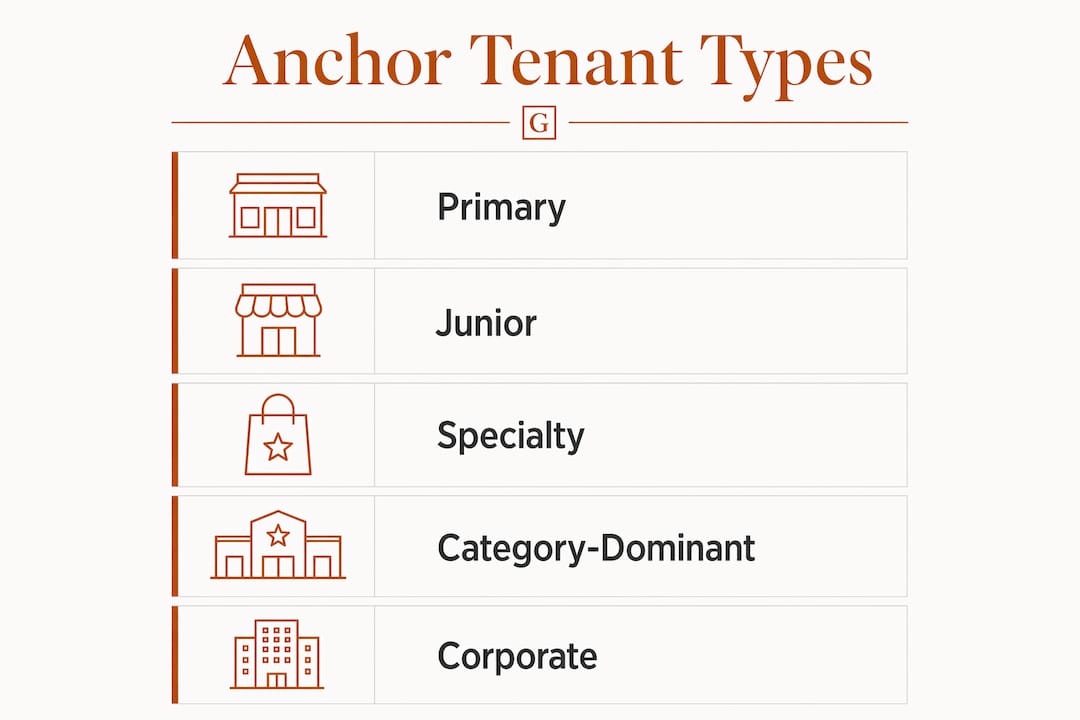
Experiential and modern anchors are the fastest-growing category. Fitness concepts, food halls, urgent care clinics, and entertainment venues now fill the gravitational role that department stores once held. Grocery, fitness, and experiential formats consistently outperform traditional department stores on foot-traffic metrics, which is why institutional landlords are actively repositioning older centers around these formats.
Common anchor types by property format:
- Grocery-anchored strip centers: Kroger, Publix, Whole Foods, Sprouts
- Power centers: Walmart, Target, Home Depot, Costco
- Enclosed malls: department stores, now increasingly replaced by fitness and F&B clusters
- Neighborhood centers: junior anchors like TJ Maxx, Ross, or a regional grocery brand
- Mixed-use and lifestyle centers: experiential anchors including fitness, dining, and medical
Why anchor tenants matter for your investment returns
The importance of anchors to commercial real estate investing comes down to three things: income stability, financing access, and NOI growth through inline rent premiums.
On income stability, anchor leases run long terms with multiple renewal options, sometimes extending total possible occupancy to several decades. That duration gives lenders and investors a predictable revenue stream that stabilizes the property's valuation. A Walmart or Publix on a 25-year lease is a fundamentally different risk profile than a cluster of 5-year inline tenants.

On financing, anchor creditworthiness directly influences loan terms. A national retailer with an investment-grade rating underwrites the project's risk in the lender's eyes. That translates to lower interest rates and higher loan proceeds. For investors using retail property financing, the presence of a strong anchor is often the difference between a bankable deal and one that stalls in underwriting.
On NOI, the anchor's below-market rent is not lost revenue. It's the cost of generating the inline premium. Consider a 120,000 SF grocery-anchored center: the anchor's rent, typically 30–60% below inline tenant rates, generates the foot traffic that supports much higher inline rents. Without the anchor, comparable unanchored strip retail in the same submarket achieves notably lower rents. The anchor's cheap rent pays for itself across the entire rent roll.
Investment benefits anchors deliver:
- Long-dated leases that stabilize debt service coverage and property valuation
- Investment-grade credit that improves lender confidence and loan terms
- Foot-traffic externalities that support inline rent premiums of 3–5x anchor rent per square foot
- Percentage rent upside when anchor sales exceed the negotiated breakpoint
- CAM recovery contributions proportional to the anchor's large footprint
How anchors affect other tenants and your leasing strategy
The relationship between an anchor and its surrounding tenants is not passive. It's contractual, measurable, and carries real financial consequences when it breaks down.
Inline tenants pay a premium precisely because the anchor delivers a built-in customer base. A unit beside a busy grocery anchor that pulls substantial weekly visitors is worth more than the same unit in a less active center. That dependency is written directly into most specialty leases through co-tenancy clauses.
Co-tenancy clauses let inline tenants reduce rent, switch to percentage-rent-only arrangements, or in some cases terminate their leases if a named anchor goes dark or if center occupancy falls below an agreed threshold, typically high occupancy levels. These clauses exist because both parties understand the rent was priced on the assumption the anchor would be there. When it isn't, the contractual machinery kicks in fast.
For landlords, the negotiation around anchor concessions requires balancing two competing pressures: giving the anchor enough financial incentive to sign a long-term lease, while protecting the inline rent roll from co-tenancy exposure. Anchor tenant improvement allowances are often significantly higher than standard retail TI packages, reflecting the anchor's negotiating leverage. That upfront cost is the price of securing the foot-traffic engine.
When an anchor departs, the cascade is fast and nonlinear. Inline tenants invoke co-tenancy clauses, rents compress, occupancy falls, and the property's NOI drops before a replacement tenant is even identified. Backfilling a departed anchor is treated as an emergency, not a routine re-leasing exercise.
Pro Tip: Use high-resolution visitor analytics to measure anchor draw and spillover before renewing or renegotiating anchor leases. Knowing what share of anchor visitors cross into inline units gives you a defensible number at the negotiating table, rather than an argument from gut feel.
Key leasing effects and strategies to track:
- Co-tenancy thresholds typically trigger at specified occupancy levels held for several months
- Anchor departure can reduce inline rents significantly across a large portion of gross leasable area
- Cure periods of several months to about a year give landlords a window to replace the anchor before termination rights vest
- Visitor data replaces assumption with measurement in anchor performance monitoring
What anchor tenants actually do to your property's financial metrics
The role of anchor tenant property value impact is best understood through the five-step cascade that links anchor rent to overall asset value: anchor rent sets the inline premium, the inline premium determines NOI, co-tenancy clauses set the downside exposure, and cap rate movement amplifies every change in NOI.
Research on smaller and mid-sized shopping centers in Florida and Georgia found that non-anchor rents decline approximately 25% following an anchor departure. That figure captures only the direct rent effect. The cap rate widening on a lower NOI base is what produces the full 20–30% value drop, because investors price a distressed, partially vacant center at a wider spread than a stabilized one.
Following anchor loss, rents for non-anchor tenants typically decline by about 25% due to reduced foot traffic and co-tenancy triggers, with total property value decreasing by 20–30% as NOI drops and cap rates widen. Successful replacement with a comparable anchor restores most of that value.
Key metrics anchors influence:
- NOI: anchor foot traffic supports inline rent premiums that comprise the majority of total NOI
- Cap rate: anchor quality and lease term directly affect investor yield expectations
- Occupancy cost ratio: anchors run 1–5% of sales; above 10%, exit risk rises sharply
- Debt service coverage: anchor credit underwrites lender DSCR requirements
- Gross potential rent: anchor-to-inline rent ratio determines the property's rent ceiling
Understanding how these metrics interact is part of sound commercial property appraisal practice for any investor underwriting an anchored center.
Strategic considerations for landlords and investors
Managing anchor tenant relationships is active work, not a set-and-forget exercise. The decisions you make at lease signing, and the monitoring you do over the lease term, directly determine the property's long-term value trajectory.
Assess anchor credit before you close. Investment-grade anchors like Target (S&P A-rated) and Publix (S&P A-rated private) carry materially different risk profiles than a regional chain with no public credit rating. The anchor's occupancy cost ratio, total rent plus CAM plus marketing levies divided by sales, is the early warning signal. When this ratio runs 1–5% of sales, the risk is low, but above 10%, exit risk rises sharply.
Build co-tenancy protections into every inline lease. Cure periods of 180–365 days give you time to replace a departing anchor before termination rights vest across the inline rent roll. The specific cure period and the definition of a "comparable replacement" are the two most negotiated terms in any co-tenancy clause. A broad replacement definition, one that includes fitness, medical, or off-price in addition to a like-for-like grocer, gives you more flexibility to cure without triggering mass terminations.
Diversify anchor types to reduce format risk. A center anchored entirely by a single department store format carries concentrated exposure to that retail category's secular decline. Centers that combine a grocery anchor with a junior anchor and an experiential component spread foot-traffic risk across formats that respond differently to economic cycles.
Pro Tip: Model the anchor exit scenario before you acquire any anchored property. Run the five-step cascade: anchor rent loss, co-tenancy rent abatement, occupancy drop, NOI decline, and cap rate widening. The gap between your stabilized value and your stress-case value is the risk you're actually buying. If that gap is too wide to absorb, financing gap solutions and deal structure can help, but they can't fix a fundamentally mispriced acquisition.
Anchor management checklist:
- Monitor anchor occupancy cost ratio annually; flag anything above 8%
- Use visitor data to quantify anchor draw and inline spillover at least quarterly
- Negotiate broad replacement definitions in co-tenancy clauses at lease signing
- Maintain a pipeline of replacement anchor candidates for each anchor in your portfolio
- Model anchor exit scenarios as part of annual property underwriting reviews
Empirical evidence on anchor tenant impact
The academic record on anchor tenant influence is consistent across markets and methodologies. The foundational work by Gatzlaff, Sirmans, and Diskin, using data from Florida and Georgia shopping centers, established the 25% inline rent decline following anchor departure as the baseline estimate. Subsequent research confirmed that stores in the same shopping center are more likely to close after an anchor shutdown, extending the impact beyond rent to occupancy and business survival.
The University of Chicago Journal of Political Economy published research establishing that mall developers internalize anchor externalities by offering rent subsidies to anchors and charging rent premiums to other tenants. That study estimated anchors receive a per-foot rent subsidy of no less than 72% of what nonanchor stores pay, confirming the structural rent asymmetry that practitioners observe in every anchored center.
Turkish shopping mall data covering 1,170 stores across nine centers over 2013–2016 found measurable anchor and competition externalities, with both showing distance decay effects within the mall. Stores closer to the anchor captured more of the foot-traffic benefit than stores at the periphery. That distance decay is why pad sites and outparcels fronting the anchor entrance command premium ground lease rents despite being outside the main building.
Co-tenancy provisions, the contractual mechanism that translates anchor departure into rent abatement, have been shown to function as real options that enhance value in stable markets but accelerate rent concessions and lower resale prices during downturns. The practical implication is that co-tenancy clauses are not just tenant protections. They are embedded options that affect the property's sale price and must be modeled as such in any serious underwriting.
How anchor tenant impact differs across commercial property types
The anchor tenant dynamic plays out differently depending on the property format. Understanding those differences helps you calibrate risk and return expectations before you commit capital.
Grocery-anchored strip centers carry the most stable anchor profiles in today's market. Grocery is an e-commerce-resistant category with high visit frequency, and chains like Kroger, Publix, and Whole Foods carry investment-grade or near-investment-grade credit. A typical grocery anchor runs thousands of weekly visitors at a standard store, which sustains inline rents even during economic downturns. These centers tend to trade at tighter cap rates precisely because the anchor's foot-traffic profile is predictable.
Power centers and big-box retail anchor around category-dominant retailers like Home Depot, Costco, or Target. The foot-traffic draw is strong, but the tenant mix is shallower than a grocery-anchored center, and the inline rent roll is smaller relative to the anchor's footprint. Anchor exit risk is concentrated because there are fewer replacement options at the required scale.
Enclosed regional malls present the most complex anchor picture. The traditional department store anchor model has contracted sharply, and many enclosed malls now operate with dark anchor boxes or converted anchor spaces. Centers that have successfully repositioned around fitness, entertainment, and food hall anchors have maintained occupancy and value; those that haven't have seen the co-tenancy cascade play out in real time at scale.
Office parks and mixed-use developments use anchor tenants differently. A major employer or a high-profile corporate headquarters functions as an anchor by drawing workers who support surrounding retail, food service, and amenity tenants. The creditworthiness and lease duration logic is identical to retail, but the foot-traffic externality operates through employee density rather than shopper draw. Medical office buildings anchored by a hospital system or a large physician group follow the same structural logic.
For investors evaluating any of these formats, the commercial rental property fundamentals remain consistent: anchor credit, lease duration, co-tenancy exposure, and the measurable foot-traffic spillover to surrounding tenants are the four variables that determine how much of the property's value the anchor actually underwrites.
Gannlending can fund your next anchored property acquisition
Anchored commercial properties move fast, and traditional lenders rarely keep pace. Gannlending funds asset-based hard money loans in as few as 5–7 business days, with financing up to 75% LTV across retail, mixed-use, and commercial property types. With over $50 million funded, Gannlending underwrites the asset, not the paperwork, making it the right partner when a well-anchored center comes to market and you need to close before someone else does. Get funded fast and secure the deal.
Key Takeaways
Anchor tenants are the single largest driver of commercial property value, and modeling their impact accurately is the difference between sound underwriting and a mispriced acquisition.
| Point | Details |
|---|---|
| Anchor rent sets the inline premium | Inline tenants pay several times the anchor's rent per square foot, funded by the foot-traffic externality the anchor generates. |
| Anchor exit triggers nonlinear value loss | A departed anchor can drop NOI notably and total property value significantly through combined rent abatement and cap rate widening. |
| Creditworthiness determines financing terms | Investment-grade anchors underwrite lender debt service coverage, producing better interest rates and higher loan proceeds. |
| Inline rent declines roughly 25% after anchor loss | Research on Florida and Georgia centers found non-anchor rents fall approximately 25% following an anchor departure. |
| Modern anchors extend beyond department stores | Grocery, fitness, and experiential formats now generate foot traffic that matches or exceeds traditional department store draws. |