
A commercial appraisal is a formal, independent assessment that objectively determines a commercial property's market value based on detailed income, market, and cost analyses. Lenders require this assessment before approving any significant real estate loan. Investors rely on it to verify that a purchase price reflects actual market conditions. Understanding how commercial appraisals work separates investors who negotiate from a position of knowledge from those who simply accept a number they don't fully understand. Certified appraisers, lenders, and buyers each use the appraisal report differently, but the underlying process follows a consistent, evidence-based structure governed by the Uniform Standards of Professional Appraisal Practice (USPAP).
What valuation methods do commercial appraisers use?
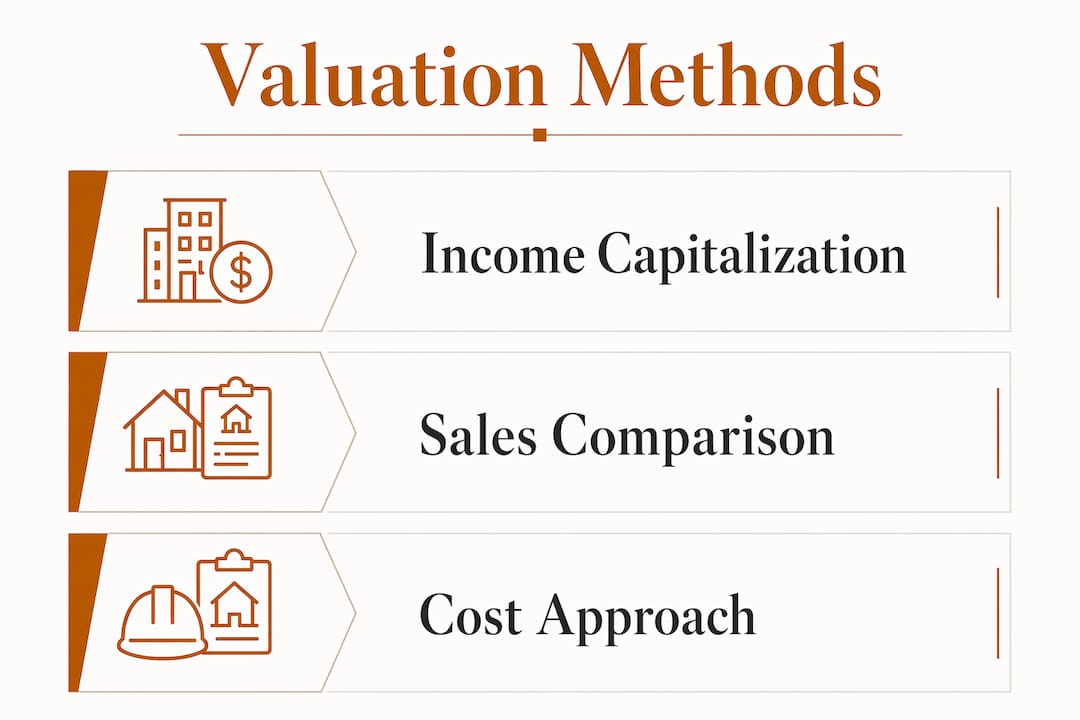
Commercial appraisals rely on three core valuation methods, with the Income Capitalization Approach as the primary tool for income-producing assets. Each method serves a specific property type and situation. Appraisers rarely rely on just one approach. They typically apply two or three methods and then reconcile the results into a final value conclusion.
Income capitalization approach
The Income Capitalization Approach values a property by dividing its Net Operating Income (NOI) by the market capitalization rate. The formula is straightforward: Value = NOI / Cap Rate. A property generating $200,000 in annual NOI at a 6% cap rate carries an indicated value of roughly $3,333,000. This method is the standard for office buildings, retail centers, apartment complexes, and any asset where rental income drives value. For income-producing commercial properties, the quality of the NOI figure is everything. Inflated or incomplete income data produces a misleading value.

For transitional or non-stabilized assets, appraisers use a Discounted Cash Flow (DCF) model instead of a simple cap rate. DCF projects income and expenses over 7–10 years to reflect a property's changing income profile. Applying a simple cap rate to a property still filling vacancies would overstate its current value.
Sales comparison approach
The Sales Comparison Approach benchmarks the subject property against recent sales of comparable properties. Appraisers adjust for differences in size, location, condition, and lease terms. This method works best for properties with an active sales market, such as small retail buildings or owner-occupied office space. It is less reliable for specialized assets where few comparable sales exist.
Cost approach
The Cost Approach estimates value by calculating what it would cost to replace the building at current construction costs, then subtracting depreciation and adding land value. Appraisers apply this method to new construction, special-use properties like churches or schools, and assets where income data is thin. It rarely stands alone as the primary method for investment properties.
| Method | Best use case | Key input | Limitation |
|---|---|---|---|
| Income capitalization | Stabilized income properties | NOI and cap rate | Requires accurate income data |
| Sales comparison | Properties with active sales market | Recent comparable sales | Limited by comparable availability |
| Cost approach | New or special-use properties | Replacement cost, depreciation | Less relevant for investment assets |
Pro Tip: If you are buying a stabilized retail center, ask the appraiser which cap rate source they used. Market cap rates vary by submarket and data vintage, and a stale cap rate can shift value by hundreds of thousands of dollars.
How does the commercial appraisal process work step by step?
The commercial appraisal process follows a structured sequence from property inspection to final report delivery. Each stage builds on the last. Skipping or rushing any step compromises the accuracy of the final value conclusion.
-
Property inspection. The appraiser physically inspects the building, noting condition, layout, deferred maintenance, and any features that affect value. They photograph the property inside and out.
-
Zoning and legal use research. The appraiser confirms the property's current zoning classification and verifies that its existing use is legally permitted. A property operating outside its permitted use carries significant risk.
-
Financial records review. The appraiser collects rent rolls, operating statements, lease agreements, and expense records. Appraisers verify CAM recovery completeness, lease expirations, and operating expense accuracy. Gaps in this data directly reduce appraisal reliability.
-
Highest and Best Use analysis. This step determines the most valuable legally permitted and physically possible use of the property. Highest and Best Use must be physically possible, legally permitted, financially feasible, and maximally productive. A warehouse sitting on land zoned for mixed-use development may carry a higher value than its current income suggests.
-
Market analysis. The appraiser studies local vacancy rates, absorption trends, comparable lease rates, and recent sales. This context anchors the property's value within its specific market.
-
Valuation and reconciliation. The appraiser applies the appropriate methods, weighs the results, and reconciles them into a single value conclusion.
-
Report preparation. The final USPAP-compliant report includes property description, zoning analysis, Highest and Best Use findings, income and expense analysis, comparable sales, and a documented value conclusion.
Pro Tip: Provide the appraiser with a clean, organized financial package before the inspection. Appraisers who receive complete rent rolls and operating statements on day one produce faster, more accurate reports than those who spend weeks chasing documents.
What are the common pitfalls in interpreting commercial appraisals?
Misreading an appraisal report is one of the most expensive mistakes a real estate investor can make. The number on the report is not the seller's asking price, the broker's opinion of value, or a prediction of future performance. It is a defensible, evidence-based estimate of current market value, and it comes with specific limitations you need to understand.
-
Lender-ordered appraisals are intentionally conservative. Bank appraisal values frequently come in lower than the purchase price or buyer's internal valuation. This is by design. Lenders mandate downside-protected appraisals to minimize their collateral risk. A "low" appraisal does not automatically mean the appraiser made an error.
-
NOI accuracy determines everything. A $60,000 annual CAM under-recovery at a 7% cap rate reduces property value by approximately $857,000. Sellers who present inflated or incomplete income figures produce appraisals that fall apart under scrutiny. Buyers who audit CAM recovery gaps before closing gain real negotiation power.
-
Method selection errors produce misleading values. Applying a simple cap rate to a property with unstabilized occupancy overstates its current value. Transitional assets require a DCF model that accounts for lease-up periods and changing cash flows.
-
Appraisals are backward-looking. They reflect market conditions at a specific point in time. A property in a rapidly appreciating submarket may be worth more than the appraisal indicates by the time the report is delivered. Investors who understand this limitation can use it to their advantage in negotiations.
-
Comparable selection matters. An appraiser who selects weak or distant comparables produces a less reliable value conclusion. Review the comparables section of any report carefully. If the sales used are more than 12 months old or located in a different submarket, the conclusion deserves scrutiny.
Understanding appraiser role limitations is not about distrust. It is about knowing what the report can and cannot tell you.
How do commercial appraisals affect financing and investment decisions?
A commercial appraisal sits at the center of every major financing decision. Lenders use it to set the loan-to-value ratio, which directly controls how much capital they will advance against a property. The LTV ratio determines both loan size and interest rate terms. A lower appraised value means a smaller loan, which can force a buyer to bring more equity to the table or renegotiate the purchase price.
-
Loan approval depends on appraised value, not purchase price. If you agree to pay $4,000,000 for a property but the appraisal comes in at $3,600,000, the lender bases the loan on $3,600,000. The $400,000 gap is your problem to solve.
-
Appraisals create negotiation leverage. A low appraisal gives a buyer documented grounds to renegotiate the purchase price. Sellers who want to close have to respond to an independent third-party report, not just a buyer's opinion.
-
Investment strategy depends on accurate value. An investor underwriting a value-add deal needs to know the as-is value and the stabilized value. These are two different appraisal assignments. Ordering the right one matters.
-
Private lenders weigh appraisals differently. Traditional banks require full USPAP-compliant appraisals before approving any commercial loan. Private and hard money lenders often focus more on the asset's collateral value and the borrower's exit strategy, which can accelerate the financing timeline significantly.
Commercial appraisal compliance with USPAP is not just a regulatory formality. It is the foundation that makes the report defensible in court, in negotiations, and in front of a lender's credit committee.
Key Takeaways
A commercial appraisal is an independent, evidence-based value conclusion that drives financing terms, investment decisions, and negotiation outcomes for every major commercial real estate transaction.
| Point | Details |
|---|---|
| Three core methods | Income capitalization, sales comparison, and cost approach each serve specific property types. |
| NOI accuracy is critical | A $60,000 CAM gap at a 7% cap rate erases roughly $857,000 in appraised value. |
| Lender appraisals are conservative | Bank-ordered valuations protect collateral, not buyer expectations. |
| Highest and Best Use drives accuracy | This analysis determines the legally permitted use that produces maximum value. |
| Appraisals shape loan terms | Lenders base LTV ratios on appraised value, not the agreed purchase price. |
What I've learned from watching investors misread appraisals
Most investors treat the appraisal report as a pass/fail test. Either the number supports the deal or it kills it. That framing misses most of the value the report actually contains.
The comparables section alone can tell you where the market is moving. The income and expense analysis reveals whether the seller's financials hold up under independent scrutiny. The Highest and Best Use section sometimes identifies a repositioning opportunity the current owner never pursued. I have seen investors walk away from deals where the appraisal came in low, only to watch another buyer close, fix the CAM recovery gaps, and refinance at a significantly higher value six months later.
The best practice is to engage with the appraiser before the inspection, not after. Provide clean documentation. Ask which valuation method they plan to weight most heavily and why. If the report comes back lower than expected, request a reconsideration of value with specific comparable evidence. Appraisers are not infallible, and USPAP allows for formal reconsideration when a borrower or buyer presents documented evidence of error.
Treat the appraisal as an analytical tool, not a verdict. The investors who do this consistently make better acquisition decisions and negotiate from a stronger position every time.
— Brian
When speed matters more than the appraisal timeline

Traditional appraisals take weeks, and in a competitive market, that timeline costs deals. Gannlending funds commercial and residential real estate loans in as few as 5–7 business days, focusing on the asset's collateral value rather than a lengthy appraisal and underwriting process. With financing up to 75% LTV and over $50 million funded, Gannlending gives investors the speed to close before competitors catch up. If you are working a time-sensitive acquisition or need to protect a property from foreclosure, explore fast hard money lending with Gannlending and keep your deal moving.
FAQ
What is a commercial appraisal?
A commercial appraisal is an independent, evidence-based assessment that establishes a commercial property's objective market value. It is required by lenders and investors and must comply with USPAP standards.
How long does a commercial appraisal take?
Commercial appraisals typically take two to four weeks from inspection to final report delivery, depending on property complexity and data availability.
Who pays for a commercial appraisal?
Appraisal fees are generally paid by the borrower, though lenders often order the appraisal directly and may include the cost on the closing statement.
Why did the bank's appraisal come in lower than the purchase price?
Lenders mandate conservative valuations to protect their collateral position. A bank appraisal reflects downside-protected value, not the market's ceiling price.
What is Highest and Best Use in a commercial appraisal?
Highest and Best Use identifies the legally permitted, physically possible, and financially feasible use of a property that produces the maximum value. It is a required component of every USPAP-compliant appraisal report.