
Value-add commercial property is defined as an income-producing asset that trades below its potential value due to physical deterioration, operational inefficiency, or poor management. Investors acquire these properties at a discount, execute a targeted improvement plan, and sell or refinance at a higher valuation once the asset performs at or near market levels. The strategy sits between passive core investing and high-risk opportunistic development on the risk-return spectrum. Expected returns run 12%–16% IRR over a typical hold period of 3–7 years. That return range reflects the active work required: value-add is not a buy-and-hold play. It rewards investors who can diagnose underperformance, price the fix accurately, and execute on schedule.
What characteristics define a value-add commercial property?
The clearest signal of a value-add asset is a measurable gap between current performance and market potential. Rents running 10%–30% below market and vacancy rates between 15%–30% are the two most common indicators. For context, healthy commercial markets typically run 5%–8% vacancy. A property sitting at 25% vacancy is not just underperforming. It is leaving a large portion of its income potential uncollected every month.
Physical and operational deficiencies compound the income gap. Deferred maintenance, outdated unit interiors, poor curb appeal, and weak property management all suppress rents and push tenants toward better-managed buildings. These deficiencies are the opportunity. Each one represents a specific, fixable problem with a calculable cost and a projected income benefit.

The distinction between cosmetic and structural problems matters enormously. Cosmetic issues, such as dated flooring, aging fixtures, and poor landscaping, are addressable with predictable budgets and short timelines. Structural problems, including foundation issues, roof failures, or outdated electrical systems, carry higher costs and longer disruption periods. Both can qualify a property as value-add, but structural deficiencies require a larger contingency budget and a more conservative underwriting model.
Key indicators that a property qualifies as value-add:
- Rents materially below comparable properties in the same submarket
- Vacancy above the local market average for the asset class
- Deferred maintenance visible in common areas, mechanical systems, or unit interiors
- Weak or absent property management with no formal leasing process
- Lease structures that are below market or expiring without renewal plans
- Utility costs billed to the owner rather than passed through to tenants
Pro Tip: Before signing a letter of intent, pull rent comps for the immediate submarket, not the broader metro. A property can look 20% below market on a metro-wide basis but be priced correctly for its specific block.
How does improving a property increase NOI and market value?
Commercial property valuation is driven by net operating income, or NOI, divided by the capitalization rate. This formula means every dollar of NOI improvement multiplies directly into property value. Increasing annual NOI by $200,000 at a 5% cap rate adds $4 million in property value. That is the core financial mechanic behind every value-add strategy.
NOI grows through two levers: revenue increases and expense reductions. Revenue increases come from raising rents to market after renovations, filling vacant units, and adding income streams such as parking fees or storage charges. Expense reductions come from replacing inefficient management, renegotiating vendor contracts, and converting utilities to tenant billing. Many value-add deals achieve NOI gains through expense management rather than capital improvements alone. This is the "free" value that sophisticated investors prioritize before committing to major renovation budgets.
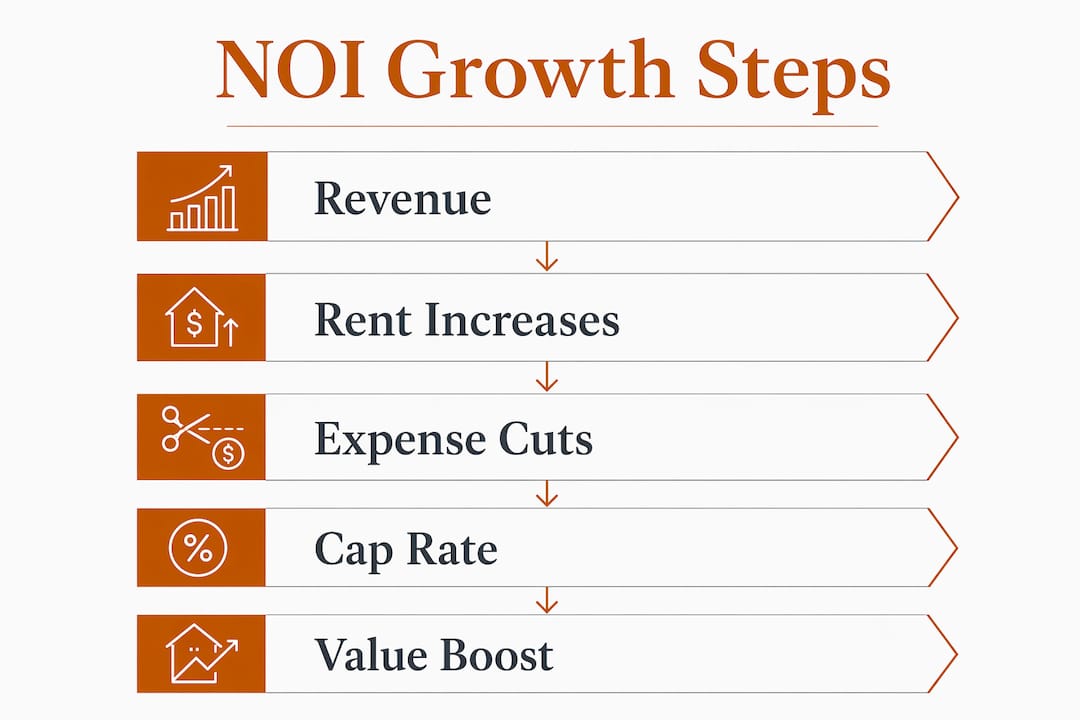
Cap rate compression on exit adds a second layer of return. When a property moves from distressed to stabilized, buyers price it at a lower cap rate because the risk profile has improved. An investor who buys at a 7.5% cap rate and sells at a 6.5% cap rate captures both the NOI growth and the valuation multiple expansion.
| Improvement Type | NOI Impact | Timeline |
|---|---|---|
| Rent increases post-renovation | High | 12–24 months |
| Vacancy lease-up | High | 6–18 months |
| Expense reduction via management | Moderate | 3–6 months |
| Utility billing conversion | Moderate | 3–9 months |
| Amenity upgrades | Low to moderate | 6–12 months |
Pro Tip: Model your exit at a cap rate 50–75 basis points higher than your target. If the deal still works, you have real margin. If it does not, the return depends entirely on market conditions you cannot control.
What risks and challenges come with value-add commercial investments?
Value-add investing is not passive income. The primary risk difference between core and value-add is execution risk, requiring active oversight and capital investment throughout the hold period. Investors who underestimate this reality often find that the gap between projected and actual returns is not a market problem. It is an execution problem.
Underestimating renovation vacancy and cost overruns is the most common cause of value-add deal underperformance. Units or suites taken offline for renovation stop generating income. Construction timelines slip. Material costs rise. Each delay extends the period before stabilized cash flow begins, which directly erodes projected returns.
The most common execution risks, in order of frequency:
- Cost overruns. Renovation budgets routinely run 10%–20% over initial estimates when structural surprises emerge. Budget a contingency of at least 10% on every capital expenditure line.
- Extended lease-up timelines. Filling vacant space after renovation takes longer than most pro formas project. A 12-month lease-up assumption often becomes 18 months in slower markets.
- Renovation vacancy drag. Every unit or suite offline during construction is lost income. Model this explicitly in your cash flow projections, not as a footnote.
- Exit cap rate risk. Modeling a 50–100 basis point cushion on the exit cap rate protects against market softening at the time of sale. Deals that only work at the entry cap rate are not value-add investments. They are bets on market appreciation.
- Hope-based underwriting. A real value-add deal requires a specific NOI gap, clear costs to close that gap, and a defensible exit plan. Deals that lack any one of these three elements are speculative, not strategic.
How to evaluate and underwrite a value-add commercial property
Underwriting a value-add deal starts with two NOI figures: current NOI and stabilized NOI. The gap between them is the value you are buying. Every assumption that bridges that gap must be specific, priced, and time-bound.
Start with current performance. Pull actual rent rolls, operating statements for the past two to three years, and a current rent comp analysis for the submarket. Identify every line item where the property underperforms relative to comparable stabilized assets. This becomes your improvement checklist.
Build your stabilized pro forma from the bottom up. Assign a renovation cost and a timeline to each improvement. Model the income impact of each change separately so you can stress-test individual assumptions. Renovation vacancy and construction cost overruns must be built into the underwriting model as explicit line items, not absorbed into a general contingency.
Key metrics to track in your underwriting model:
- Current NOI vs. stabilized NOI and the percentage improvement required
- Total capital expenditure budget including a 10%–15% contingency
- Lease-up timeline from renovation completion to full occupancy
- Debt service coverage ratio at both current and stabilized NOI
- Projected IRR at base, conservative, and stress-case exit cap rate assumptions
- Commercial appraisal factors that will drive the post-renovation valuation
Model at least three exit scenarios: a base case, a conservative case with a higher exit cap rate, and a stress case with extended lease-up. If the stress case produces a loss, the deal carries more risk than the projected return justifies. Understanding how commercial appraisals work after improvements are complete helps you set realistic exit price expectations before you close on the acquisition.
Pro Tip: Prioritize operational fixes in the first 90 days of ownership. Replacing a weak management company or converting utilities to tenant billing costs little capital and can improve NOI immediately, before a single renovation dollar is spent.
Examples and common value-add strategies in commercial real estate
Value-add strategies vary by property type, but the underlying logic is consistent: identify a specific underperformance, fix it at a known cost, and capture the income and valuation improvement. The most effective strategies address multiple deficiencies simultaneously to accelerate the move from current to stabilized performance.
Common value-add plays across commercial property types include:
- Interior renovations. Updating unit interiors in multifamily properties with new flooring, appliances, and fixtures typically supports rent premiums of $100–$300 per unit per month in most markets.
- Management replacement. Replacing an underperforming property management company is often the fastest NOI improvement available. Better leasing, tighter expense controls, and proactive maintenance reduce vacancy and operating costs within the first two quarters.
- Lease restructuring. Renegotiating below-market leases at renewal, adding escalation clauses, and converting gross leases to net leases shifts operating cost risk to tenants and increases NOI predictability.
- Repositioning and repurposing. Converting a dated office building to medical office, flex industrial, or mixed-use space captures demand from growing tenant categories. Mixed-use repositioning often unlocks the largest valuation gains but carries the highest execution complexity.
- Utility billing conversion. Installing submeters and billing tenants directly for utilities removes a significant operating expense from the owner's income statement and improves NOI without raising rents.
- Technology and amenity upgrades. Adding package lockers, high-speed internet infrastructure, or keyless entry systems supports rent premiums and reduces tenant turnover in multifamily and flex office assets.
Value-add investing also acts as an inflation hedge because rent growth is tied to property-specific improvements rather than broad market cycles. This gives investors direct control over income growth in ways that passive core investments do not.
Key Takeaways
Value-add commercial property investing generates above-market returns by closing the gap between a property's current NOI and its stabilized potential through targeted physical improvements, operational fixes, and disciplined underwriting.
| Point | Details |
|---|---|
| Core definition | Value-add properties trade below potential due to physical or operational underperformance. |
| Return profile | Expected IRR runs 12%–16% over a 3–7 year hold period, reflecting active management requirements. |
| NOI leverage | A $200,000 NOI increase at a 5% cap rate adds $4 million in property value. |
| Biggest risk | Renovation cost overruns and extended lease-up timelines are the most common causes of underperformance. |
| Underwriting discipline | Model exit cap rates with a 50–100 basis point cushion to protect against market softening at sale. |
What I have learned from watching value-add deals succeed and fail
The investors who consistently win on value-add deals share one habit: they underwrite the downside before they model the upside. Most deal sponsors spend 80% of their analysis time building the best-case pro forma and 20% stress-testing it. The best operators I have seen do the opposite.
The second pattern I have noticed is that operational wins get undervalued at acquisition. A property with a bad management company is often priced as if the bad management is permanent. Replace the management in the first quarter, tighten the leasing process, and you can add meaningful NOI before a single renovation begins. That "free" value is real, and it rarely shows up in the seller's asking price.
The third lesson is harder to accept: most rent projections are too optimistic. Investors look at the top of the comp range and assume their renovated product will achieve it. The market does not care about your renovation budget. It cares about what comparable tenants are actually paying right now. Build your rent assumptions from the median of current signed leases, not the top of the asking rent range.
Value-add investments require active management throughout the hold period. Investors who treat them as semi-passive after acquisition consistently underperform. The value does not create itself. It requires ongoing attention to leasing, maintenance, and expense control every quarter until the exit.
— Brian
Financing your value-add deal with Gannlending
Value-add acquisitions move fast. Sellers of distressed or underperforming assets rarely wait for a 45-day bank approval process.

Gannlending provides hard money loans built for exactly this situation. With closings in as few as 5–7 business days, no appraisal requirement, and financing up to 75% LTV on commercial and residential properties, Gannlending has funded over $50 million in real estate transactions. If you have identified a value-add opportunity and need capital that moves at the speed of the deal, Gannlending structures financing around the asset, not the paperwork. Reach out directly to discuss your project and get a decision without the delays that cost investors deals.
FAQ
What is a value-add commercial property?
A value-add commercial property is an income-producing asset that trades below its market potential due to physical deterioration, high vacancy, or poor management. Investors acquire it at a discount, improve it, and sell or refinance at a higher valuation.
What returns can investors expect from value-add commercial real estate?
Value-add commercial real estate typically targets an IRR of 12%–16% over a hold period of 3–7 years, reflecting the active management and capital investment required.
How does NOI improvement increase property value?
Property value in commercial real estate equals NOI divided by the cap rate. A $200,000 increase in annual NOI at a 5% cap rate adds $4 million in property value, making NOI growth the primary driver of returns.
What is the difference between value-add and core commercial real estate?
Core properties are stabilized, fully leased assets with predictable income and low risk. Value-add properties carry execution risk because returns depend on successfully improving operations and physical condition, not just collecting existing rents.
What is the biggest risk in value-add investing?
Renovation cost overruns and extended lease-up timelines are the most common causes of underperformance. Underwriting models must include explicit line items for renovation vacancy and a contingency budget of at least 10%–15% on capital expenditures.