
For most rescue and bridge loans, lenders will accept a recent as-is appraisal as the gold standard, or, when speed is the priority, a credible Broker Price Opinion (BPO) or Automated Valuation Model (AVM) paired with interior and exterior photos, a current rent roll, a mortgage payoff statement, and a one-page executive summary explaining the distress event and exit strategy. The CFPB confirms that lenders commonly rely on three valuation categories: appraisals, BPOs, and AVMs, and the lender decides which carries the most weight for credit risk purposes. Gannlending funds rescue loans quickly using an asset-based underwriting model focusing on protective equity that focuses on protective equity, not your credit score.
The fastest path to approval, assembled in priority order:
- As-is appraisal report (if available within your timeline) or a BPO/AVM printout
- Interior and exterior photos with timestamps
- Current rent roll and copies of active leases
- Mortgage payoff statement(s) and recorded lien documentation
- One-page executive summary: what caused the distress, how the loan resolves it, and your exit plan
- Recent property tax bill and title report or commitment
- Operating statements or bank statements (if the property is income-producing)
Bottom line: If you can produce a full as-is appraisal within a short timeframe, that is your strongest evidence. If not, a BPO or AVM combined with a tight property data packet and a clear rescue plan will get most private lenders to an LOI within 24–48 hours.
Table of Contents
- Which valuation methods do lenders actually accept for rescue financing?
- What documents do you need to prove property value for a rescue loan?
- How documented property value determines your loan amount
- How to prepare your property and paperwork before valuation
- What are your options when a full appraisal is not possible in time?
- What timelines and fees should you expect for each valuation route?
- What do regulations say about appraisal requirements and exceptions?
- How Gannlending documents and accepts property value quickly
- Worked example: calculating a rescue loan from an as-is appraisal
- Key Takeaways
- The tradeoff most borrowers underestimate in rescue financing
- Gannlending can fund your rescue loan in 5–7 days
- Useful sources for further reading
Which valuation methods do lenders actually accept for rescue financing?
Rescue and bridge lenders operate on a spectrum, and which valuation they accept depends on loan size, property type, and how fast you need to close. Understanding where each method sits on that spectrum lets you choose the fastest viable route without sacrificing lender confidence.

Full appraisal. A licensed appraiser physically inspects the property, analyzes comparable sales, and delivers a certified report. It carries the highest evidentiary weight and is typically required when loan size is large, the property is unusual, or the loan will be sold to secondary-market investors. The tradeoff is time: expect 7–14 days and fees ranging from a few hundred dollars for a simple residential property to well over $1,000 for commercial assets.
Desktop and hybrid appraisals. Fannie Mae's valuation framework includes both desktop appraisals (no physical inspection; appraiser works from data and photos) and hybrid appraisals (a trained data collector visits the property and reports facts; an appraiser completes the valuation opinion separately). These options compress timelines to a few days. Fannie Mae's property data collection model explicitly separates fact reporting from valuation opinion, meaning the collector documents what exists and the appraiser interprets it. Private rescue lenders have adopted similar logic: they will accept structured property data paired with an appraiser's desk review when the collateral is straightforward.
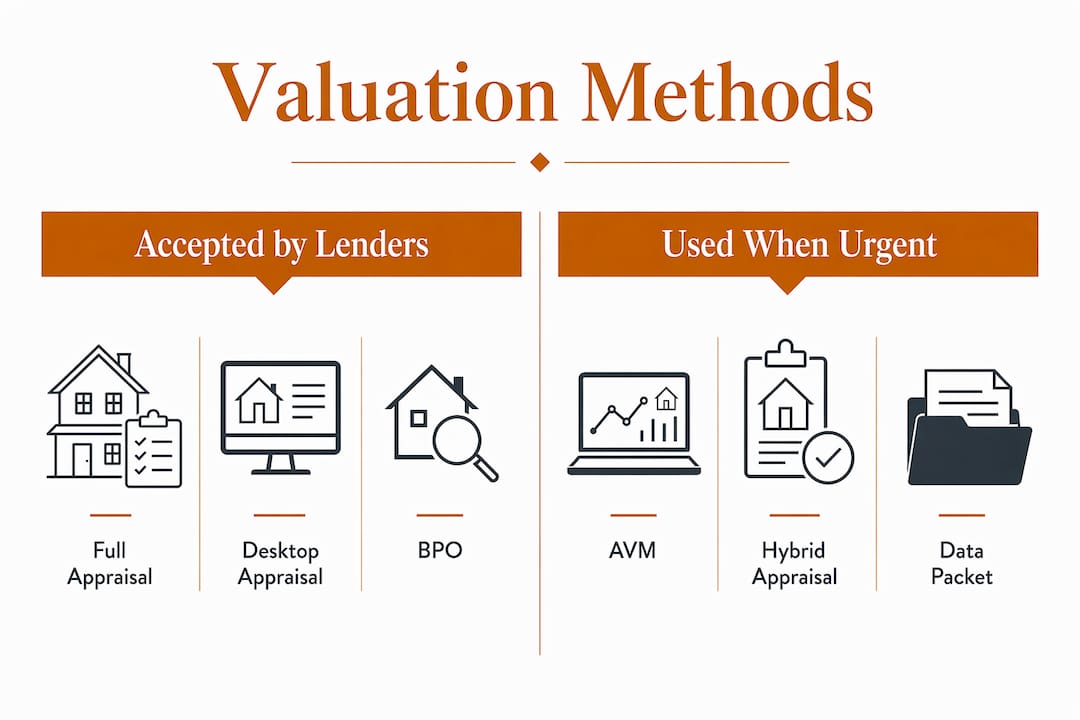
Broker Price Opinion (BPO). A licensed real estate professional estimates value based on comparable sales and a drive-by or interior inspection. BPOs are faster than full appraisals, typically delivered within a few days, and cost significantly less. Private lenders use them routinely for rescue scenarios where time is the constraint. The limitation is that BPOs carry less regulatory weight than certified appraisals, so some lenders cap the loan size or LTV they will approve on a BPO alone.
Automated Valuation Model (AVM). A computer-generated estimate using mathematical models, comparable sales data, and property attributes. Lenders often run an AVM the same day a loan application arrives, just to confirm the property value is in a reasonable range. As the CFPB notes, an AVM is typically an initial reasonableness check before a full appraisal is ordered. For rescue loans, an AVM alone is rarely sufficient, but with supporting documentation it may satisfy lender requirements. An AVM cross-validated with photos, a rent roll, and recent comparable sales can satisfy a private lender's underwriting threshold when the equity cushion is strong.
Industry direction: Fannie Mae's expanding use of value acceptance and property data collection shows the broader market moving toward standardized, faster evidence gathering. Private rescue lenders have followed suit, accepting structured property data packets to accelerate decisions when collateral quality is clear.
The practical rule: the more protective equity in the deal, the more flexibility a lender has on valuation method. A property with 40% equity and a clean rent roll may close on a BPO plus photos. A thin-equity deal almost always requires a full appraisal.
What documents do you need to prove property value for a rescue loan?
Think of this as a lender packet, not a pile of paperwork. The goal is to give an underwriter everything needed to confirm as-is value and protective equity without a single back-and-forth email. Organize it as a single PDF with a cover page and labeled sections.
Core valuation evidence:
- As-is appraisal report (full, desktop, or hybrid) if available
- BPO report from a licensed real estate professional
- AVM printout or provider report (Zillow, CoreLogic, or lender-ordered)
- Desktop or hybrid appraisal report where applicable
Property condition and income evidence:
- Interior and exterior photos (timestamped, well-lit, covering all major rooms and the exterior perimeter)
- Floor plans or property sketch
- Current rent roll showing unit, tenant, lease term, and monthly rent
- Copies of active leases
- Proof of occupancy (utility bills, certificate of occupancy)
- Recent property tax bill
- HOA documents if applicable
Title and payoff documentation:
- Recent mortgage statement(s) with current payoff amount
- Recorded liens (mechanics liens, judgment liens, tax liens)
- Current title report or title commitment if already ordered
Financial and narrative context:
- Operating statements for the trailing 12 months (income-producing properties)
- Recent bank statements (2–3 months)
- One-page executive summary: the distress event, how the rescue loan resolves it, and the exit strategy (refinance, sale, or stabilization timeline)
Packaging tips: Name files clearly ("123MainSt_AppraisalReport.pdf", "123MainSt_RentRoll_June2026.pdf"). Combine everything into one organized PDF packet with a table of contents. A lender who can open one file and find everything in 90 seconds is a lender who moves faster on your deal. For income-producing properties, understanding commercial rental property documentation requirements before you assemble the packet saves significant back-and-forth.
How documented property value determines your loan amount
The math here is straightforward, but the haircuts are where borrowers get surprised. Rescue lenders do not lend against the number on your appraisal. They lend against a discounted version of it.
The basic LTV formula:
Maximum loan = Documented as-is value × LTV cap
A lender offering a certain percentage LTV on a property appraised at a given value will lend up to the corresponding loan amount, regardless of what you owe or what the property might be worth after repairs.
As-is vs. as-stabilized value. As-is value is what the property is worth today, in its current condition, with current occupancy. As-stabilized value is what it would be worth once repairs are complete and the property is fully leased. Rescue lenders almost always lend against as-is value. They may reference as-stabilized value to understand the exit strategy, but they will not lend against projected future value in a short-term rescue scenario. Expect a lender to apply a haircut to as-is value to account for distressed-sale risk and carrying costs.
DSCR interplay for income-producing properties. Debt Service Coverage Ratio (DSCR) measures whether the property's net operating income covers the loan payment. Even in asset-based rescue lending, a lender reviewing an income-producing property will check DSCR to confirm the property can carry the debt during the loan term. A DSCR below 1.0 does not automatically disqualify the deal, but it will prompt questions about the exit plan and may tighten the LTV offer. You can explore LTV ratio examples to see how these calculations play out across different property types.
Illustrative worked example:
- As-is appraised value: $600,000
- Lender LTV cap: 65%
- Maximum loan before haircut: $390,000
- Lender applies 10% distressed-sale haircut to appraised value: effective value = $540,000
- Maximum loan at 65% of effective value: $351,000
- Outstanding payoff on existing mortgage: $280,000
- Available net proceeds after payoff: $71,000 (covers closing costs, arrears, and reserves)
A 10% drop in appraised value, from $600,000 to $540,000, reduces the maximum loan by roughly $35,000 at 65% LTV. That gap can mean the difference between covering a payoff and coming to the table short.
How to prepare your property and paperwork before valuation
Speed in rescue lending comes from preparation, not luck. An underwriter who receives a complete, clean packet on Monday can issue an LOI by Wednesday. One who has to chase photos and a rent roll loses three days minimum.
Physical preparation. Clear access to all areas of the property, including the basement, attic, and any outbuildings. Fix obvious deficiencies that a BPO agent or appraiser will flag: a broken window, a visibly damaged roof section, or a non-functioning HVAC unit all create value deductions that are often cheaper to address than absorb. Take your own high-quality interior and exterior photos before the appraiser arrives. Timestamped photos from your phone work fine; what matters is coverage and clarity, not professional photography.
Documentation preparation. Update the rent roll to reflect current occupancy and rents, not what you hope to collect. Get all leases into a consistent PDF format. Collect recent utility bills as proof of occupancy. Pull a current mortgage payoff statement directly from your servicer, not a statement from three months ago. Payoff figures change daily with interest accrual, and a stale number will slow underwriting.
Underwriter conveniences. Supply your own comparable sales. Pull three to five recent closed sales within a half-mile radius and include the addresses, sale dates, sale prices, and square footage. A lender who can cross-check your comps against the AVM or BPO in 10 minutes is a lender who trusts the valuation faster. Include the property manager's contact information and tenant contact details if the lender needs to verify occupancy directly. Reviewing commercial property appraisal factors before your valuation appointment helps you anticipate what the appraiser will scrutinize.
Pro Tip: Include a one-page executive summary at the front of your packet. Answer three questions: what caused the distress, how this loan resolves the immediate problem, and what the exit looks like (refinance date, sale timeline, or stabilization plan). Lenders in rescue scenarios expect this document. Borrowers who include it close faster than those who do not.
What are your options when a full appraisal is not possible in time?
Sometimes the auction date is in five days and a full appraisal simply cannot be ordered, completed, and delivered in time. Private rescue lenders have built their entire model around this reality. Here are the alternatives, with honest tradeoffs.
Acceptable alternatives:
- BPO: Licensed real estate professional, drive-by or interior, 24–72 hour turnaround, lower cost. Most private lenders accept BPOs for rescue loans under a certain loan size.
- AVM: Instant to same-day, lowest cost, weakest standalone evidence. Acceptable to many private lenders when cross-validated with photos and a rent roll.
- Desktop/hybrid appraisal: 2–7 days, moderate cost, strong evidence weight. Fannie Mae's value acceptance + property data framework uses trained data collectors to gather property facts, which an appraiser then uses to complete a desk review. Private lenders have adopted similar workflows.
- Property data collection (PDC): Fact-only report from a trained collector, no valuation opinion. Used in conjunction with a desk appraisal or AVM, not as a standalone valuation.
Tradeoffs at a glance:
| Method | Typical turnaround | Relative cost | Evidence weight | LTV impact |
|---|---|---|---|---|
| Full appraisal | 7–14 days | Highest | Strongest | 65% LTV typically available |
| Hybrid/desktop appraisal | 2–7 days | Moderate | Strong | Slightly below full LTV |
| BPO | 24–72 hours | Low | Moderate | Modest LTV reduction |
| AVM | Hours to 1 day | Lowest | Weakest standalone | Meaningful LTV haircut |
| AVM + photos + rent roll | Hours to 1 day | Low | Moderate (combined) | Reduced but workable |
Practical threshold rules. Most private rescue lenders will accept a BPO or AVM-plus-data-packet for loans under roughly $1–2 million on straightforward residential or small commercial properties. Larger loans, unusual property types, or thin equity positions almost always require a full appraisal or hybrid at minimum. When an AVM and a BPO disagree materially, the lender will typically order additional inspection or a desk review. You can reduce that friction by proactively supplying recent comps, timestamped photos, and a current rent roll before the lender asks.
A bridge loan calculator can help you quickly model how different appraised values and LTV caps affect the loan amount you can realistically request, which is useful before you decide which valuation route to pursue.
What timelines and fees should you expect for each valuation route?
Rescue lending is a race against a deadline, whether that deadline is a foreclosure sale, a tax auction, or a maturing loan. Knowing exactly how long each valuation takes, and what it costs, lets you pick the right path without wasting days on an option that will not arrive in time.
Valuation timelines and typical costs:
| Valuation method | Typical turnaround | Typical fee range |
|---|---|---|
| AVM | Hours to same day | $0–$50 (often lender-absorbed) |
| BPO (drive-by) | 24–48 hours | — |
| BPO (interior) | 48–72 hours | $150–$400 |
| Desktop/hybrid appraisal | 2–7 days | $400 |
| Full appraisal (residential) | 7–10 days | $400 |
| Full appraisal (commercial) | 10–14 days | — |
Expedited fees are real. Many appraisers charge a rush premium of 25–50% for turnarounds under five days. Budget for it rather than be surprised.
How timelines affect rescue scenarios. If a foreclosure sale is scheduled in eight days, a full commercial appraisal is not a viable path. A BPO ordered Monday morning can be in a lender's hands by Wednesday, leaving time for underwriting, an LOI, and title coordination before the deadline. Private lenders who specialize in rescue financing, including Gannlending, have built their processes around exactly this math: lite-doc underwriting using photos, a rent roll, and a payoff statement enables funding in 5–7 business days for deals where the collateral is clear.
What lenders accept as proof of imminent funding. When a borrower needs to demonstrate to a court or servicer that financing is in process, a signed Letter of Intent (LOI) from the lender and a proof-of-funds letter are typically sufficient. These documents do not require a completed appraisal; they require a lender who has reviewed the preliminary packet and committed to the deal in principle.
Key cost considerations:
- Appraisal fees are almost always paid by the borrower, upfront or at closing
- BPO fees are sometimes absorbed by the lender for smaller rescue loans
- Title search and insurance costs are separate and typically run $500–$2,500 depending on property complexity
- Expedited title searches are available in most markets for an additional fee
What do regulations say about appraisal requirements and exceptions?
Regulatory guidance shapes what lenders can and cannot accept, even in fast rescue scenarios. Knowing the rules helps you understand why a lender insists on certain documents and when exceptions are genuinely available.
Fannie Mae's valuation spectrum. Fannie Mae offers a range of options from traditional appraisals to value acceptance (formerly appraisal waivers) and value acceptance plus property data. These options are available for eligible transactions delivered to Fannie Mae and are determined through Desktop Underwriter (DU). They reflect the industry's broader move toward data-enabled valuation alternatives. Private rescue lenders have adopted similar logic, accepting structured property data when collateral quality is evident.
OCC collateral documentation expectations. The OCC's Residential Real Estate Lending handbook requires that loan files contain collateral valuation documentation sufficient to support the lending decision. This means every lender, including private rescue lenders, must retain the appraisal or evaluation in the loan file. That regulatory expectation is why lenders ask for documentation even when they trust the deal: they need a defensible file.
Borrower right to copies: Federal regulation requires lenders to provide borrowers with copies of every valuation obtained during a loan transaction. If your lender orders an AVM, a BPO, and a full appraisal, you are entitled to all three. Use this right to understand how the lender is thinking about value and to identify any discrepancies worth addressing.
When a full appraisal is legally required. Transactions above certain dollar thresholds, loans delivered to secondary-market investors, and federally regulated transactions typically require a certified appraisal. Private rescue lenders operating outside the secondary market have more flexibility, but they still maintain file documentation standards consistent with OCC guidance. Always confirm the specific valuation requirement with your prospective lender before ordering anything.
This article is general information, not legal or financial advice. Confirm current valuation requirements and regulatory thresholds with your lender or a qualified professional for your specific transaction.
How Gannlending documents and accepts property value quickly
Gannlending's underwriting model is built around one question: is there enough protective equity in this asset to support the loan, and can we verify it fast? The answer to that question determines whether a deal closes in five days or stalls for two weeks.
The Gannlending process flow:
- Submission: Borrower sends the property data packet (photos, rent roll, payoff statement, executive summary, and any available valuation)
- Rapid AVM/BPO check: Gannlending runs or orders an AVM immediately to confirm the value range is reasonable; a BPO may follow for additional confidence
- Lite-doc underwriting: Underwriter reviews photos, rent roll, payoff math, and the one-page executive summary to assess protective equity and exit viability
- LOI issuance: A signed Letter of Intent is typically issued within 24–48 hours of a complete submission
- Title coordination: Title search and commitment are ordered in parallel with underwriting, not sequentially
- Table funding: Closing in 5–7 business days from a complete submission for qualifying deals
What Gannlending typically requires upfront:
- Interior and exterior photos (timestamped)
- Current rent roll (for income-producing properties)
- Mortgage payoff statement (current, from the servicer)
- One-page executive summary (distress event + exit plan)
- Any available appraisal, BPO, or AVM report
- Recent property tax bill
- Recorded lien documentation
The asset-based focus means personal tax returns and extensive financial statements are not the primary underwriting inputs. Gannlending's tolerance for limited personal documentation is a deliberate feature of the rescue lending model, not a gap in diligence. The property's equity position carries the deal. For investors managing multiple assets, understanding short-term real estate loan types helps clarify where rescue financing fits within a broader portfolio strategy.
Pro Tip: When you send your packet to Gannlending, lead with the executive summary. One page, three paragraphs: what happened, what the loan accomplishes, and how you exit. Underwriters who read that first understand the deal in 60 seconds. Underwriters who have to piece together the story from documents take much longer, and ask more questions.
Worked example: calculating a rescue loan from an as-is appraisal
Walk through this math before you call a lender. Knowing your numbers cold makes every conversation faster and more credible.
Starting facts:
- As-is appraised value: $750,000
- Outstanding mortgage payoff: $420,000
- Lender LTV cap: 65%
- Lender distressed-sale haircut applied to appraised value: 10%
Step-by-step calculation:
- Apply haircut to appraised value: $750,000 × 0.90 = $675,000 (effective collateral value)
- Maximum loan at 65% LTV: $675,000 × 0.65 = $438,750
- Subtract mortgage payoff: $438,750 − $420,000 = $18,750 net proceeds
- Subtract estimated closing costs ($12,000): $18,750 − $12,000 = $6,750 remaining
In this scenario, the deal barely works. The borrower stops the foreclosure but has almost no cushion for arrears or reserves. Now run the sensitivity.
Sensitivity: what a 5–10% appraisal drop does:
- If the appraised value comes in at $712,500 (5% lower): effective value = $641,250; max loan = $416,813; net after payoff = −$3,187. The deal no longer covers the payoff.
- If the appraised value comes in at $675,000 (10% lower): effective value = $607,500; max loan = $394,875; net after payoff = −$25,125. The borrower needs to bring cash to the table.
This is why updating or supplementing a stale valuation matters in a volatile market. A six-month-old appraisal in a declining market can turn a workable deal into a shortfall. Ordering a fresh BPO to confirm the value range before submitting costs $150–$400 and can save a deal.
Accounting for ancillary costs. Closing costs, prepaid interest, title insurance, and any arrears payments must all be covered by the net loan proceeds or brought in as cash. Build a simple sources-and-uses table before you submit: total loan amount on one side, payoff plus all costs on the other. If the numbers do not clear, address the gap before the lender finds it.
Key Takeaways
Documenting property value for a rescue loan comes down to assembling the right evidence fast: a credible as-is valuation, a complete property data packet, and a clear one-page exit plan give lenders everything they need to move quickly.
| Point | Details |
|---|---|
| Lead with as-is valuation | A recent appraisal, BPO, or AVM cross-validated with photos and a rent roll is the minimum lenders need to assess collateral. |
| Assemble a single PDF packet | Combine all documents into one organized file with a cover page; lenders who find everything immediately move faster on your deal. |
| Know your LTV math before you call | Apply the lender's LTV cap and a 10% distressed-sale haircut to your appraised value to confirm the loan covers your payoff and costs. |
| Include a one-page executive summary | Explain the distress event and exit plan upfront; rescue lenders expect this and move faster when they understand the deal in 60 seconds. |
| Gannlending funds in 5–7 days | Gannlending's asset-based model accepts lite-doc packets and issues LOIs within 24–48 hours, focusing on protective equity rather than credit scores. |
The tradeoff most borrowers underestimate in rescue financing
Speed in rescue lending is not free, and the borrowers who understand that upfront make better decisions than those who discover it at the closing table.
The core tension is this: every day you spend waiting for a better valuation or a lower rate is a day closer to a foreclosure sale, a tax auction, or a loan maturity default. A full appraisal might support a 65% LTV offer at a better rate. A BPO-supported deal might come in slightly lower, with a modest LTV haircut, and at a higher rate. If the difference between those outcomes is three weeks, and your auction date is in ten days, the math is obvious.
What borrowers consistently underestimate is the cost of delay, not the cost of the loan. A rescue loan at 12% annualized for six months costs far less than losing a property worth $750,000 to a foreclosure sale that clears $400,000 after fees and deficiency. The rate is not the number to optimize. The number to optimize is whether the loan closes before the deadline.
That said, not every distressed situation is a genuine emergency. If you have 90 days before a maturity default and 40% equity in the property, waiting two weeks for a full appraisal to secure better terms is a reasonable choice. The exit plan matters here too. A lender evaluating rescue risk wants to see a credible path out of the short-term loan, whether that is a conventional refinance, a sale, or a stabilized property that qualifies for permanent financing. A borrower who can articulate that path clearly, with realistic timelines and supporting data, will consistently get better terms than one who cannot. Understanding loan customization options available in private lending can help you negotiate structure, not just rate, when time allows.
Gannlending can fund your rescue loan in 5–7 days
When a foreclosure date is approaching or a bridge loan is maturing, the difference between losing and keeping a property often comes down to which lender can move fastest. Gannlending has funded over $50 million in hard money loans for real estate investors across residential and commercial properties, with an underwriting model built specifically for situations where time is the constraint.
The process is direct: send a property data packet, get an LOI within 24–48 hours, and close in as few as 5–7 business days. Gannlending lends on qualifying properties with an asset-based underwriting focus that does not require exhaustive personal financial documentation. The primary inputs are the property's as-is value, protective equity, and a clear exit plan.
Send this packet to start underwriting immediately:
- Interior and exterior photos (timestamped)
- Current rent roll and active leases
- Mortgage payoff statement (current)
- One-page executive summary (distress event + exit strategy)
- Any available appraisal, BPO, or AVM report
- Recent property tax bill
Contact Gannlending to submit your packet and get a same-day response on whether your deal fits the lending criteria. An LOI typically follows within 24–48 hours of a complete submission.
Useful sources for further reading
The following primary authorities and industry resources were cited in this article. Each covers a specific aspect of property valuation and rescue loan documentation.
-
CFPB: Why did I receive different valuations? Explains the three main valuation types (appraisal, BPO, AVM), how lenders choose between them, and your federal right to copies of all valuations ordered during your transaction.
-
OCC Residential Real Estate Lending, Comptroller's Handbook The regulatory standard for what lenders must retain in loan files, including collateral valuation documentation. Directly shapes what rescue lenders request even in fast-close scenarios.
-
Fannie Mae: Property Valuation Overview of Fannie Mae's full valuation spectrum, from traditional appraisals to value acceptance and hybrid options. Useful for understanding how secondary-market standards influence private lender practices.
-
Fannie Mae: Value Acceptance + Property Data Fact Sheet Details the property data collection (PDC) process, eligibility rules, and how data collectors and appraisers interact in hybrid workflows. Relevant when evaluating desktop and hybrid appraisal alternatives.
-
Platinum Capital Advisors: Bridge Loan Calculator Interactive tool for modeling bridge loan scenarios, including how different LTV caps and appraised values affect the loan amount available. Useful for running sensitivity analysis before submitting a rescue loan application.