
For most rental investors, the three highest-impact moves are a cash-out refinance for long-term holds, a HELOC for flexible bridge capital, and a hard-money or bridge loan when speed is the priority. Each one taps the equity you have already built and puts it to work acquiring the next property before a conventional lender can even schedule an appraisal.
Here is when each makes sense:
- Cash-out refinance: Best when you are holding a stabilized rental with at least 6–12 months of seasoning, want a fixed rate, and can absorb a reset of your amortization clock. Typical LTV: up to around three quarters on investment property. Close time: about one to one and a half months.
- HELOC on a primary residence or rental: Best for investors who need a revolving credit line to fund down payments or light rehab. Variable rate means it works best as short-term bridge capital, not permanent debt. Close time: two to four weeks.
- Bridge or hard-money loan: Best when the deal is time-sensitive, the property is non-standard, or you need to close in under two weeks. Gann Private Lending funds deals in as few as 5–7 business days at up to 75% LTV. Higher cost, but the speed premium is often worth it on a competitive acquisition.
Your immediate next step: calculate your accessible equity using the formula in the next section, then run a DSCR check at 1.25x to confirm the new debt load is serviceable before you contact a lender.
Table of Contents
- How do you calculate the equity you can actually access?
- What are the main ways to tap your rental property equity?
- Which equity tool fits your investment strategy?
- How to calculate accessible equity and deploy it to buy another rental
- What are the real risks of leveraging rental property equity?
- What does it actually cost and how long does it take?
- When does private or hard-money lending fit your equity strategy?
- A three-step playbook for using equity to grow your rental portfolio
- Key Takeaways
- The part most investors learn too late
- Gann Private Lending: fast funding when the deal won't wait
- Further reading and tools
How do you calculate the equity you can actually access?
Gross equity is simple: current market value minus all outstanding liens. What lenders will actually release to you is a different number, and it is almost always smaller.

The lender-accessible equity formula is:
(Max LTV × Appraised Value) − Current Loan Balance = Accessible Cash

On an investment property, most conventional lenders cap LTV at around three quarters. So a rental appraised at $350,000 with a $180,000 balance and a 75% LTV cap gives you: ($350,000 × 0.75) − $180,000 = $82,500 in accessible cash. Your gross equity is $170,000. The number you can actually deploy is less than half of that.
What moves that number up or down
Appraisal is the biggest variable. Lenders order their own appraisal, and if the appraiser comes in below your estimate, the accessible cash shrinks proportionally. For value-add properties, lenders may use current as-is value rather than after-repair value (ARV), which can significantly reduce what you can pull before the rehab is complete. Lien priority also matters: a second mortgage or HELOC already drawn against the property counts against your available equity.
DSCR underwriting adds another layer. On investment properties, many lenders require a DSCR of at least around 1.2x after the new debt is added. If the property's net rental income does not cover 1.25 times the new monthly payment, the lender may reduce the loan amount or decline the cash-out entirely. This is why running the DSCR math before you apply saves time.
Seasoning rules are the most commonly overlooked constraint. Lenders typically require several months of ownership before they will allow a cash-out refinance, whether you just acquired the property or just completed a rehab. You cannot buy a distressed property in January, finish the rehab in March, and pull cash out in April with a conventional lender. That gap is exactly where bridge and hard-money lenders earn their premium.
Worked example: single-family rental
| Variable | Value |
|---|---|
| Current appraised value | $300,000 |
| Outstanding mortgage balance | $165,000 |
| Gross equity | $165,000 |
| Lender max LTV (75%) | $250,000 |
| Accessible cash (LTV cap − balance) | $85,000 |
| Net deployable cash after reserves | ~$73,000 |
That $73,000 is a realistic down payment on a $250,000–$300,000 rental at 25% down. The gap between gross equity ($165,000) and what you can actually deploy ($73,000) is where most investors get surprised.
Pro Tip: Always get a broker price opinion or a preliminary appraisal before you apply for a cash-out refinance. A $20,000 appraisal shortfall can wipe out your entire deployment plan.
What are the main ways to tap your rental property equity?
Each access method has a different risk profile, cost structure, and ideal use case. Matching the right tool to the right situation is the core of any sound real estate equity strategy.
Cash-out refinance
You replace your existing mortgage with a new, larger loan and receive the difference in cash. The rate resets, the amortization clock restarts, and you now carry a higher monthly payment. On a stabilized rental with strong rent coverage, this is the cleanest way to pull equity at a fixed rate for long-term deployment.
The main downside: closing takes 30–45 days, and the rate reset can hurt cash flow if current rates are higher than your original mortgage. Lenders will also require full income documentation, a current appraisal, and lease agreements proving occupancy.
HELOC and home equity loan
A HELOC gives you a revolving credit line secured by your property's equity. You draw what you need, pay it back, and draw again. A home equity loan is a fixed lump sum at a fixed rate. Both are commonly used to fund down payments on the next acquisition.
The critical caveat: HELOCs carry variable rates, and banks often restrict them on investment properties. Primary residence HELOCs are far easier to obtain. Chase and similar lenders note that HELOC availability on rentals varies significantly by lender and property type. Treat a HELOC as bridge capital only, and plan to replace it with fixed-rate long-term debt after the new property stabilizes.
Portfolio and DSCR loans
Portfolio lenders hold loans on their own books rather than selling them to the secondary market, which means they can write their own underwriting rules. DSCR loans qualify you based on the property's rental income rather than your personal W-2 or tax returns. This is a significant advantage for investors who own multiple properties and whose personal income documentation looks complex.
Typical DSCR threshold for cash-out: around 1.2x or higher. LTVs run around 70–75% on most investment properties. Rates are slightly higher than conventional, but the flexibility on documentation and property count makes portfolio loans the right tool for scaling past four or five doors.
Bridge and hard-money loans
These are asset-based loans: the lender cares primarily about the property's value and your exit plan, not your tax returns. Approval is fast, close times run 5–14 days, and LTVs typically reach 65–75% of as-is or ARV depending on the lender. The cost is higher: rates commonly run in the 9–13% range with 1–3 points in origination fees.
The right use case is a time-sensitive acquisition, a property that needs rehab before it qualifies for conventional financing, or a deal where a conventional lender's 30-day timeline would cost you the contract. Short-term real estate loans like these are designed to be replaced, not held.
Cross-collateralization
Some portfolio lenders will cross-collateralize multiple properties, using the combined equity across your portfolio to secure a single loan or line of credit. This can unlock capital you cannot access on any single property. The risk is proportional: a default on one loan can trigger a lien on every property in the cross-collateral pool.
Pro Tip: Use a HELOC for acquisition bridge capital only. Once the new property is stabilized and seasoned, refinance into a fixed-rate DSCR or conventional loan. Carrying variable-rate debt long-term on a rental is one of the fastest ways to erode cash flow when rates move.
| Method | Typical LTV | Close Time | Documentation | Best For |
|---|---|---|---|---|
| Cash-out refinance | 75–80% | 30–45 days | Full (income, appraisal, leases) | Stabilized holds, fixed-rate preference |
| HELOC | 80–85% CLTV | 2–4 weeks | Moderate | Bridge capital, revolving access |
| Portfolio/DSCR loan | 70–75% | 3–4 weeks | Rental income focus | Scaling past 4–5 properties |
| Bridge/hard-money | 65–75% | 5–14 days | Asset-based, minimal | Speed, rehab, non-standard property |
| Cross-collateralization | Varies | 3–5 weeks | Portfolio-level | Unlocking equity across multiple assets |
Which equity tool fits your investment strategy?
Investment strategy should drive debt selection, not the other way around. Using a short-term bridge loan to fund a 10-year hold creates a maturity mismatch that forces a refinance at an unknown future rate. Using a 30-year fixed mortgage on a property you plan to flip in 18 months means paying origination costs twice.
Core strategy: stable income, low risk tolerance
Core investors buy quality, well-located assets and hold them for the long term. The right debt profile is conservative: fixed-rate, 30-year amortization, LTV in the 30–50% range. A cash-out refinance at a conservative LTV is the natural equity tool here. You pull capital at a fixed rate, the new payment is covered by existing rent, and you deploy the proceeds into another stabilized asset. No variable-rate exposure, no maturity pressure.
Value-add strategy: forced appreciation, medium risk
Value-add investors buy properties below their potential, improve them, and either sell or refinance after stabilization. The BRRRR method (Buy, Rehab, Rent, Refinance, Repeat) is the canonical value-add equity cycle. Purchasing at 65–70% of ARV minus rehab costs can allow a 75% LTV refinance that returns most of the original capital to the investor. Debt up to 75–80% LTV is common in this strategy, with a bridge or hard-money loan funding the acquisition and rehab, then replaced by a DSCR or conventional loan after seasoning.
Opportunistic strategy: maximum upside, maximum risk
Opportunistic deals involve development, major repositioning, or distressed acquisitions where the property may not qualify for conventional financing at all. Bridge loans and private lending are the primary tools. Leverage can run to about three quarters LTV, hold periods are short (typically under five years), and the exit plan is everything. If the refinance or sale does not happen on schedule, the cost of carrying high-rate short-term debt compounds quickly.
Investor checklist: picking your primary tool
Before committing to a financing method, work through these four questions:
- Time to stabilize: How long before the property generates stable, documentable rental income? If more than 6 months, a bridge loan is likely the entry point.
- Rehab budget: Does the property need significant work before it will appraise at target value? If yes, hard-money or a private lender is the practical choice.
- Need for speed: Is the deal competitive enough that a 30-day conventional close loses the contract? Private lending at 5–14 days solves this.
- Variable-rate tolerance: Can your cash flow absorb a 200–400 basis point rate increase on a HELOC or bridge loan? If not, prioritize fixed-rate instruments.
How to calculate accessible equity and deploy it to buy another rental
This is the worksheet most investors skip, and it is the one that prevents the most expensive mistakes.
Step-by-step process
- Verify current market value. Order a broker price opinion or a full appraisal. Do not use Zillow's Zestimate as your planning number; lenders will not.
- List all liens. Include your first mortgage, any second mortgage, outstanding HELOC balance, and any tax liens. Total them.
- Apply the lender's LTV cap. For most investment property cash-out refinances, use about 75%. Multiply appraised value by 0.75.
- Subtract the total lien balance. The result is your gross accessible cash before reserves.
- Subtract lender reserve requirements. Most lenders require 6 months of PITI (principal, interest, taxes, insurance) in reserves per property. Budget this before counting deployable cash.
- Subtract closing costs. Appraisal, origination, title, and recording fees typically run 2–4% of the loan amount on a refinance.
- What remains is your deployable capital. This is the realistic number to use for down payment planning.
Three scenario calculations
Assume a rental property appraised at $300,000 with a $140,000 outstanding balance.
| Scenario | LTV Used | Gross Accessible Cash | Reserves + Costs | Deployable Capital | Down Payment on rental property |
|---|---|---|---|---|---|
| Conservative | 70% | $70,000 | — | — | — |
| Moderate | 75% | $85,000 | — | $70,000 | — |
| Aggressive | 80% | $100,000 | — | $85,000 | — |
The moderate scenario funds a full 25% down payment on a $280,000 acquisition. The conservative scenario requires either a lower purchase price or supplemental capital. The aggressive scenario is only available on certain loan products and requires strong DSCR.
Sensitivity: what happens when things go wrong
Run your numbers under two stress conditions before you commit:
- Appraisal comes in 10% below estimate: On the $300,000 property, a $270,000 appraisal at 75% LTV drops accessible cash from $85,000 to $62,500. Your deployable capital falls by roughly $22,500.
- Vacancy rises 15% or interest rates increase 200 basis points: Model the new DSCR. If it drops below 1.0x, the property cannot service its debt from rental income alone. That is the line you do not cross.
Documents lenders will request
Gather these before you apply to avoid delays:
- Current appraisal or broker price opinion
- Signed lease agreements and rent roll
- 12 months of bank statements showing rental deposits
- Proof of reserves (brokerage or savings account statements)
- Homeowners/landlord insurance declarations page
- Entity documents if the property is held in an LLC
For fast rental property acquisition, having this package ready before you identify the deal can cut two weeks off your close timeline.
What are the real risks of leveraging rental property equity?
Leverage magnifies both returns and losses. A 5% decline in property value on a 75% LTV loan wipes out a disproportionate share of your equity. That math is not hypothetical; it played out across entire portfolios during the 2008 downturn.
Principal risks
- Over-leverage: Carrying LTV above 80% on investment properties leaves almost no buffer for value declines or forced sales.
- Negative leverage: When your net operating income falls and debt service stays fixed, the property starts costing you money every month. This can cascade across a portfolio if one property's cash flow was subsidizing another's mortgage.
- Appraisal shortfall: A lower-than-expected appraisal can collapse a refinance plan mid-execution, leaving you with a bridge loan you cannot replace on schedule.
- Seasoning rules: Buying a distressed property and expecting to refinance in 90 days is a plan that conventional lenders will not support. The 6–12 month seasoning window is real and must be funded.
- Variable-rate shock: A HELOC or bridge loan at a variable rate can see its payment increase significantly if the Fed moves rates. A 200 basis point increase on a $100,000 HELOC adds $2,000 per year in interest.
- Cascading vacancy risk: If a property goes vacant and you were using its cash flow to service debt on other properties, the domino effect can threaten the whole portfolio. Vacancy reduction is not just an operational concern; it is a leverage risk.
- Recourse exposure: Many conventional loans are recourse, meaning the lender can pursue your personal assets if the property goes into default. Know whether your loan is recourse or non-recourse before you sign.
Mitigation tactics
The recommended LTV bands for investment properties are roughly 70–80% for growth-oriented portfolios and about 50–65% for stability-focused ones. Staying within those bands is the single most effective risk control.
Beyond LTV, maintain a minimum of 6 months of PITI in liquid reserves per property. Stagger your loan maturities so you are not refinancing multiple properties in the same rate environment. Prefer fixed-rate debt on long-term holds. Use professional property management on properties you cannot actively supervise; a single bad tenant in a leveraged portfolio can trigger a chain of missed payments.
For rehab projects, build a 10–15% capex contingency into your budget. Rehabs almost always run over, and a cost overrun on a bridge loan compounds at a high rate.
Pro Tip: Before pulling equity from any property, stress-test your entire portfolio under two conditions simultaneously: 15–20% vacancy across all units and a 200–400 basis point increase in variable-rate debt. If your portfolio DSCR drops below 1.0x under that scenario, you are carrying too much leverage to pull more equity safely.
What does it actually cost and how long does it take?
Timeline and cost vary significantly by method. Investors who plan around best-case timelines routinely get caught short.
Typical timelines
- Cash-out refinance: 30–45 days from application to close. Delays come from appraisal scheduling, title issues, and lender underwriting queues. In a busy rate environment, 45–60 days is realistic.
- HELOC: 2–4 weeks for a primary residence HELOC. Investment property HELOCs can take longer and are harder to obtain.
- Portfolio/DSCR loan: 3–4 weeks, sometimes faster with a lender who specializes in investor loans.
- Bridge/hard-money loan: 5–14 days. Asset-based lenders move faster because they are not waiting on income verification or secondary market approval. Gann Private Lending closes in as few as 5–7 business days.
Fees and hidden costs
- Appraisal: $400–$800 for a single-family rental; more for multifamily or commercial.
- Origination fee: 0.5–2% on conventional/DSCR loans; 1–3 points on bridge/hard-money.
- Title and escrow: $1,000–$2,500 depending on loan size and state.
- Prepayment penalties: Some portfolio loans carry prepayment penalties of 3–5% in the first few years. Read the note before you sign.
- Amortization reset: A cash-out refinance restarts your 30-year clock. If you were 7 years into a mortgage, you are now paying mostly interest again on a larger balance.
- Interest carry during rehab/seasoning: On a bridge loan at 10–12%, carrying $200,000 for 8 months costs $13,000–$16,000 in interest alone before you can refinance. Budget this as a project cost.
Calculating your true cost of capital
Add up origination points, appraisal, title, and interest carry for the full hold period before the refinance. Divide by the capital deployed. That is your real cost of accessing equity, not just the stated interest rate. On a bridge loan with 2 points and 10% interest held for 9 months, the all-in cost of a $150,000 loan runs approximately $14,250 in interest plus $3,000 in points, totaling $17,250 before you even close the refinance.
When does private or hard-money lending fit your equity strategy?
Private and hard-money lenders operate on a fundamentally different approval model. They lend against the asset, not the borrower's income history. That single difference opens doors that conventional underwriting closes.
How it works
Approval is based on the property's current or after-repair value, your exit plan, and the lender's assessment of execution risk. You do not need two years of tax returns showing consistent W-2 income. You need a credible deal and a clear path to repayment, whether that is a sale or a refinance into long-term debt.
Typical terms: roughly 9–13% interest, 1–3 origination points, 6 months to 2 years terms, LTV up to about two thirds to three quarters of as-is or ARV. These loans are designed to be short. The exit plan is not optional; it is part of the underwriting.
Where Gann Private Lending fits
Gann Private Lending specializes in exactly this model: fast, asset-based approvals for real estate investors who need to move quickly or whose deals do not fit conventional boxes. With over $50 million funded and a close timeline of 5–7 business days, Gann is built for the value-add and opportunistic investor who cannot afford to lose a deal to a 45-day conventional process.
The typical Gann scenario: an investor identifies a distressed single-family or commercial property, needs to close in under two weeks, and plans to rehab, stabilize, and refinance into a DSCR loan after the 6–12 month seasoning period. The bridge-to-refinance path is the most common exit, and it works cleanly when the ARV math supports the refinance LTV.
What to ask any private lender before you commit
Before signing a term sheet with any private lender, get clear answers to these questions:
- What is your actual close timeline, and what can delay it?
- Is this loan recourse or non-recourse?
- What are the prepayment terms? Is there a penalty for early payoff?
- Do you lend on the as-is value, ARV, or both?
- What documentation do you require at application?
- What happens if the rehab runs over budget or the refinance is delayed?
- Are there extension options if the loan matures before the exit is ready?
A lender who cannot answer these questions clearly is not a lender you want to be in a deal with.
A three-step playbook for using equity to grow your rental portfolio
Most investors overcomplicate this. The framework is three steps, and the discipline is in executing each one before moving to the next.
Step 1: Measure your accessible equity accurately
Use the formula from the earlier section. Get a real appraisal or a credible broker price opinion. List every lien. Apply the lender's actual LTV cap for your property type and loan program. Subtract reserves and closing costs. The number you are left with is your planning capital.
If that number does not fund a full down payment on a target property, you have three options: find a lower-priced target, bring in a joint venture partner to cover the gap, or wait and build more equity before pulling.
Step 2: Match the financing tool to your strategy and stress-test it
Use the strategy framework from earlier: Core investors use fixed-rate cash-out at conservative LTV; Value-Add investors use bridge-to-DSCR refi via the BRRRR path; Opportunistic investors use private lending with a clear exit.
Before you apply, run the stress test. Model your portfolio DSCR at 15–20% higher vacancy and 200–400 basis points higher on any variable-rate debt. If the portfolio stays above 1.0x DSCR under that scenario, the leverage is defensible. If it does not, reduce the loan amount or delay the pull until reserves are stronger.
Step 3: Execute with contingency reserves and a documented exit plan
Close the loan. Deploy the capital. But do not deploy every dollar. Keep a minimum of 6 months of PITI per property in liquid reserves, plus a 10–15% rehab contingency if the new acquisition needs work.
Document your exit plan before you close the bridge loan. "I will refinance into a DSCR loan after 9 months of seasoning" is a plan. "I will figure it out" is not. Know the refinance lender, the approximate rate environment you are underwriting to, and the DSCR the stabilized property will need to hit.
Red flags that stop the plan
- Portfolio DSCR falls below 1.0x under stress-test conditions
- Reserves drop below 3 months of PITI on any property
- Appraisal comes in more than 10% below your planning number with no buffer in the deal
- No clear refinance path or sale exit before the bridge loan matures
When to bring in specialists
A 1031 exchange requires a qualified intermediary and strict timeline compliance; do not attempt it without a tax advisor who specializes in real estate. Portfolio loans and cross-collateralization structures benefit from a commercial mortgage broker who knows which lenders are actively writing those products. For entity structuring and recourse exposure, a real estate attorney is worth the cost.
Key Takeaways
Using the right equity-leverage tool for your specific investment strategy, with accurate accessible-equity math and a stress-tested exit plan, is what separates investors who scale from those who stall.
| Point | Details |
|---|---|
| Accessible equity formula | (Max LTV × appraised value) minus loan balance, then subtract reserves and closing costs. |
| Match tool to strategy | Cash-out refi for Core holds; bridge-to-DSCR refi (BRRRR) for Value-Add; private lending for Opportunistic speed. |
| DSCR threshold | Target 1.25x minimum; stress-test at 15–20% vacancy and +200–400 bps before pulling equity. |
| Seasoning rules apply | Conventional lenders require 6–12 months before a cash-out refinance; budget bridge-loan carry costs accordingly. |
| Gannlending for speed | Gann Private Lending closes in 5–7 business days at up to 75% LTV for time-sensitive or nonstandard deals. |
The part most investors learn too late
There is a version of the equity-leverage conversation that sounds like a math problem: plug in your LTV, calculate your DSCR, and the right answer falls out. That version is incomplete.
The real discipline is not in the formula. It is in the moment when a deal looks good on paper and you have to decide whether the exit plan is actually executable or just optimistic. Investors who have been through a rate cycle know that a bridge loan with no confirmed refinance path is not a strategy. It is a bet on conditions staying favorable.
The investors who scale consistently share one habit: they underwrite the exit before they underwrite the entry. They know which DSCR lender will take the refinance, at what rate, and under what occupancy conditions, before they close the bridge loan. The acquisition is almost secondary. The refinance is the deal.
Speed matters. Private lending exists because sometimes a 45-day conventional close costs you the contract, and that cost is real. But speed is a tool, not a strategy. The investors who use hard-money well are the ones who treat it as a temporary instrument with a specific, funded exit. The ones who get into trouble are the ones who close fast and figure out the rest later.
Gann Private Lending's track record of over $50 million funded reflects what happens when asset-based underwriting is done with discipline on both sides of the table. Fast does not have to mean reckless. It just means the lender is evaluating the asset and the exit, not your W-2.
Gann Private Lending: fast funding when the deal won't wait
Some acquisitions cannot survive a 45-day conventional timeline. A distressed property with three competing offers, a time-sensitive portfolio purchase, a rehab deal that needs to close before the seller walks — these are the situations where the speed of your financing is the difference between getting the deal and watching someone else close it.
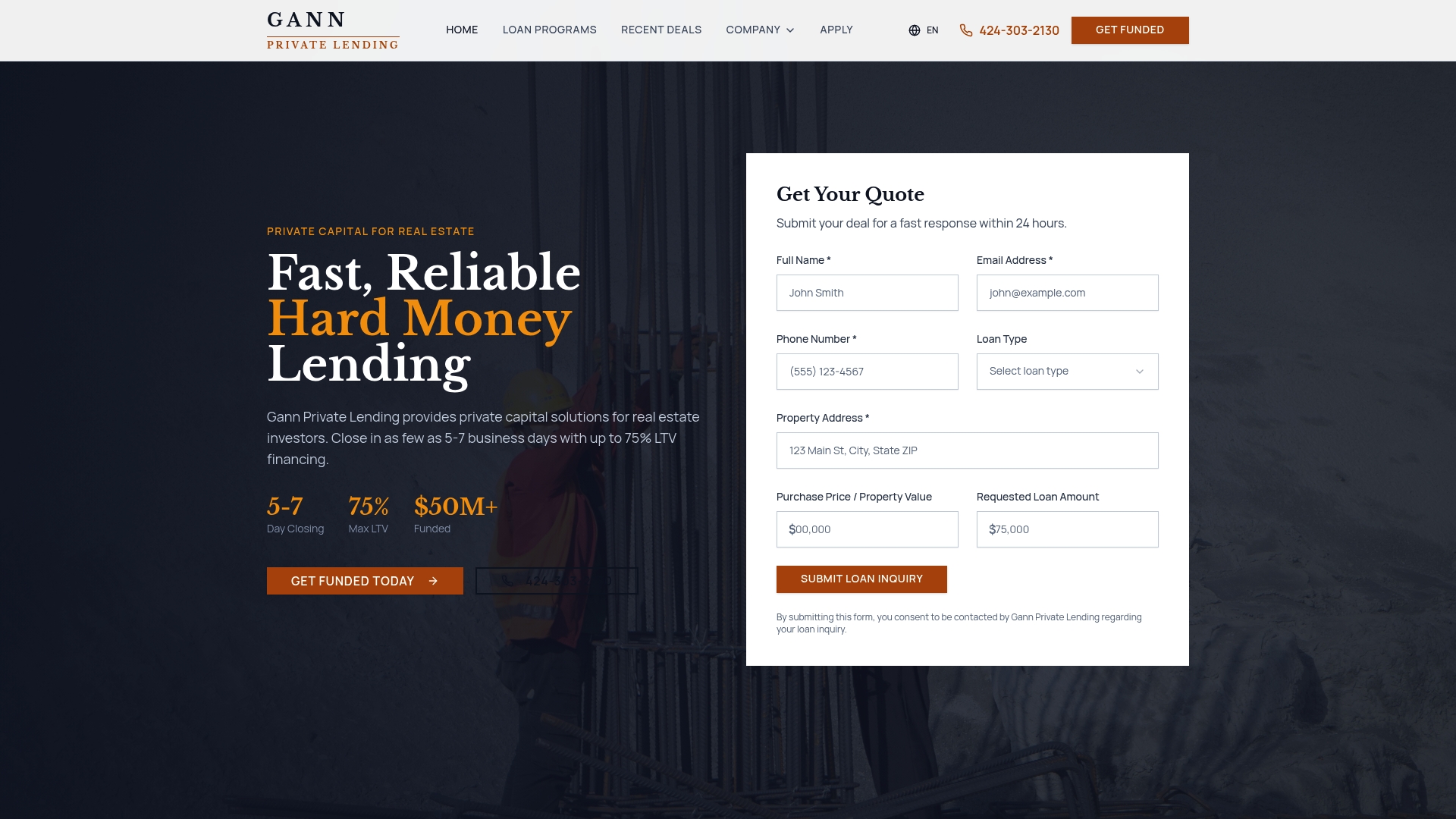
Gann Private Lending is built for exactly those moments. Asset-based approvals, minimal paperwork, and a close timeline of 5–7 business days at up to 75% LTV on residential and commercial properties. The focus is on the deal's value and your exit plan, not on running your tax returns through a 60-day underwriting queue. With over $50 million funded, the process is proven.
The typical path: close fast with Gann, complete the rehab or stabilization, season the property for 6–12 months, then refinance into long-term debt at a conventional or DSCR rate. Have your appraisal, rent roll, insurance, and proof of reserves ready before you reach out, and the process moves even faster.
If your next acquisition needs to close in under two weeks, contact Gann Private Lending to get a bridge quote and confirm your deal qualifies.
This article is general information for educational purposes. Consult a licensed lender, tax advisor, or real estate attorney for guidance specific to your situation and current market conditions.
Further reading and tools
These resources support the strategies covered in this article. The citation markers indicate sources referenced in the body.
- What Is Equity in Real Estate? A Clear Guide — Gann's primer on measuring and unlocking equity; a good starting point before running your own accessible-equity calculation.
- BRRRR Strategy Guide (cited above) — Detailed walkthrough of the Buy-Rehab-Rent-Refinance-Repeat cycle, including seasoning rules and DSCR underwriting thresholds.
- How to Leverage Property to Buy Another (cited above) — AAOA's comparison of HELOC, home equity loan, and cash-out refinance for investors.
- Using a HELOC to Buy an Investment Property (cited above) — Chase's explanation of HELOC availability rules and lender variance on investment properties.
- How to Use Leverage in Real Estate Investing (cited above) — Covers recommended LTV bands (70–80% growth, 50–65% stability) and DSCR targets.
- Commercial Real Estate Investment Strategies (cited above) — J.P. Morgan's framework for matching debt instruments to Core, Value-Add, and Opportunistic strategies.
- Increase Real Estate Net Worth Through Leverage (cited above) — Investopedia's overview of leverage mechanics, risk scenarios, and mitigation strategies.
- How to Secure a Bridge Loan for Real Estate — Step-by-step guide to bridge financing, including what lenders evaluate and how to prepare your application.
- Real Estate Portfolio Financing Strategies — Portfolio-level metrics, DSCR guidance, and strategies for financing multiple properties simultaneously.
- Rental Vacancy Reduction Strategies (cited above) — Operational tactics for reducing vacancy risk, which directly affects DSCR and portfolio leverage capacity.