
What is a private lender, and who actually uses them?
A private lender is any individual or entity that provides loans directly to borrowers without operating as a traditional bank or credit union. They fund deals using their own capital or money pooled from investors, and they set their own terms. No federal deposit insurance, no rigid underwriting matrix, no six-week approval queue.
In real estate, private lenders are everywhere. Fix-and-flip investors, landlords acquiring distressed properties, and developers bridging a gap between construction and permanent financing all turn to them when banks say no or move too slowly. Private mortgage lenders use their own funds or investor capital to offer flexible real estate loans with terms set by the lender rather than a regulatory committee.
Who actually fills this role?
- High-net-worth individuals lending personal capital, often seeking returns above what bonds or savings accounts pay
- Private credit funds pooling institutional money from pension funds, endowments, and insurance companies to lend at scale
- Investor groups or syndicates co-funding deals through shared agreements
- Hard money lenders specializing in short-term, asset-secured real estate loans
The core distinction from a bank is structural. Private credit lenders do not rely on deposits to fund their loans. That single fact explains nearly every difference in how they operate: their flexibility, their speed, their higher rates, and their willingness to finance deals a bank's compliance department would reject outright.
Borrower requirements vary by lender, but most private lenders want a meaningful down payment, a property appraisal or valuation, and a credible plan for repaying the loan. Credit scores matter less than the asset's value and the borrower's exit strategy; lenders focus on these factors when underwriting.

Table of Contents
- How private lending actually works
- Key terms you need to know before signing anything
- Pros and cons of private lending: an honest look
- Risks and regulation of private lending in the US
- Why exit strategies and documentation define the deal
- Gannlending: fast private capital for real estate investors
- Key Takeaways
How private lending actually works
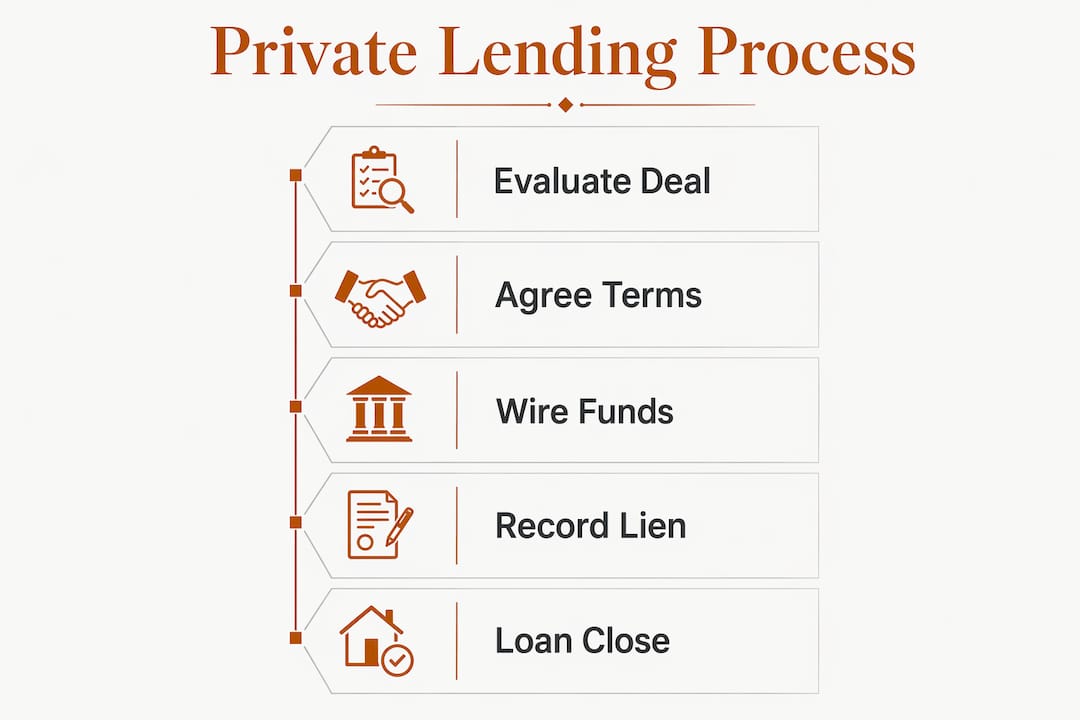
The mechanics are simpler than most borrowers expect. A private lender evaluates a deal, agrees on terms, and wires funds. The borrower repays principal plus interest, usually within a short window of a few months to a couple of years. What happens between agreement and wire transfer is where the details matter.

Loan origination. The lender sources capital from their own accounts or from investors who have committed funds to the lender's pool. Unlike a bank syndicating a loan across dozens of institutions, private loans are usually originated and held by a single lender. That concentration is why decisions happen fast.
Underwriting. Forget the debt-to-income ratios and two years of tax returns that banks require. Private lenders underwrite primarily on two things: the property's current or after-repair value, and the borrower's exit strategy. A borrower with a 620 credit score and a solid plan to sell a renovated property in four months will often get funded where a bank would decline.
Approval and closing. Once a lender is satisfied with the asset and the exit plan, closing moves quickly. Steps typically include:
- Independent appraisal or broker price opinion (BPO)
- Title search and title insurance
- Review of the promissory note and mortgage or deed of trust
- Recording the lien with the county recorder's office
- Wire transfer of funds
Loan terms. Interest rates on private loans run higher than conventional mortgages, often significantly depending on the deal, lender, and state. Terms are short. Origination fees (called "points") of 1–3% are standard. Some loans carry prepayment penalties; others allow early payoff without penalty.
Collateral and lien position. The property secures the loan. Most private lenders insist on a first lien position, meaning they get paid before any other creditor if the borrower defaults. Second-lien private loans exist but carry higher rates to compensate for the added risk.
Private mortgage lenders provide faster closings and flexible terms, but they charge higher interest and have shorter loan periods than conventional banks. That trade-off is the whole ballgame.
Pro Tip: Your exit strategy is the underwriting. Before you approach any private lender, write out exactly how you will repay the principal at loan maturity: a sale, a refinance into conventional financing, or documented cash flow from the property. Lenders who see a vague answer here will pass, regardless of the property's value.
Key terms you need to know before signing anything
Private lending has its own vocabulary. Getting these wrong costs money.
- Promissory note. The borrower's written promise to repay. It specifies the loan amount, interest rate, repayment schedule, and what happens on default. This document is the legal backbone of the loan.
- Deed of trust / mortgage. The instrument that ties the loan to the property. It gives the lender the right to foreclose if the borrower defaults. Which document is used depends on the state.
- Lien position. Where the lender sits in the repayment hierarchy. First lien gets paid first in a foreclosure. Second lien gets whatever is left, if anything.
- Loan-to-value (LTV). The loan amount divided by the property's appraised value, expressed as a percentage. A $150,000 loan on a $200,000 property is 75% LTV. Most private lenders cap at 75% LTV.
- After-repair value (ARV). The estimated value of a property after planned renovations. Fix-and-flip lenders often base their loan on ARV rather than current value.
- Exit strategy. The borrower's documented plan for repaying the loan at maturity. Sale, refinance, or stabilized rental cash flow are the three most common. Exit strategy is the critical underwriting factor for private lenders; they require a credible, actionable repayment plan before committing capital.
- Hard money vs. private money. These terms overlap but carry a distinction in practice. Hard money typically refers to institutional private lenders with standardized programs and faster, more transactional processes. Private money often describes individual lenders with more flexible, relationship-based terms. Both are asset-secured and non-bank.
- Points / origination fee. Upfront cost charged by the lender, expressed as a percentage of the loan amount. One point equals 1%. On a $200,000 loan, two points is $4,000 paid at closing.
- Usury laws. State statutes that cap the maximum interest rate a lender can legally charge. These vary significantly by state and by whether the loan is classified as consumer or business-purpose. More on this in the risks section.
Understanding short-term note structures before you sign helps you compare offers accurately and spot terms that don't work in your favor.
Pros and cons of private lending: an honest look
Private lending is not universally better or worse than bank financing. It solves a specific problem: fast, flexible capital for deals that don't fit conventional criteria. Whether that trade-off makes sense depends entirely on your situation.
Where private lending wins:
- Speed. Banks routinely take 30–60 days to close. Private lenders can fund in days. For a competitive acquisition or a time-sensitive distressed deal, that speed is the difference between getting the property and losing it.
- Asset-based underwriting. If your income is irregular, your credit is recovering, or you hold the deal in an LLC, private lenders can still say yes based on the property's value and your exit plan.
- Unconventional deals. Properties that need significant rehab, mixed-use buildings, or land with development potential often fall outside bank guidelines. Private lenders evaluate the deal on its merits.
- Flexible structures. Interest-only payments, custom draw schedules for construction, and negotiable prepayment terms are all possible in ways that bank products rarely allow.
Where private lending costs you:
- Higher rates. The premium for speed and flexibility is real. Expect to pay several percentage points above conventional mortgage rates.
- Short terms. Most private loans mature in 12–24 months. If your project runs long or your refinance falls through, you face extension fees or, worse, default.
- Less regulatory protection. Consumer lending laws offer borrowers significant protections. Many private real estate loans are structured as business-purpose loans, which carry fewer of those safeguards.
- Prepayment penalties. Some lenders charge a fee if you repay early, which can eat into profits on a quick flip.
Private lending provides quick, flexible financing suited for unconventional projects; banks offer cheaper, longer-term loans with stricter rules. Neither is the right answer for every deal. The question is which one fits the specific project in front of you.
Risks and regulation of private lending in the US
Private lending operates in a real legal framework, even if it feels less formal than bank financing. Ignoring that framework is how borrowers and lenders end up in court.
Key risks for borrowers:
- Default and foreclosure if the exit strategy fails or the project runs over budget
- Documentation disputes when loan terms were agreed informally
- Balloon payments at maturity with no refinance option lined up
- Predatory terms buried in loan documents that weren't reviewed by an attorney
Key risks for lenders:
- Borrower default leaving the lender to foreclose and manage or sell the property
- Title defects that complicate lien enforcement
- Misclassification of a business-purpose loan as a consumer loan, triggering consumer protection liability
Usury laws. Every state sets its own interest rate caps. State usury laws impose strict interest rate limits, and misclassified loans risk enforcement under consumer protection statutes, including loan nullification or criminal liability for the lender. A loan that is legal in one state may violate usury caps in another. Business-purpose loan exemptions vary widely, and courts have applied consumer protections to loans that were labeled business-purpose but functioned as consumer loans.
Consumer vs. business-purpose loans. This distinction matters enormously. Consumer mortgage loans trigger federal protections under TILA (Truth in Lending Act), RESPA, and state equivalents. Business-purpose loans, where the borrower is using the property for investment rather than personal residence, generally fall outside those rules. Lenders who misclassify a loan to avoid compliance requirements face serious legal exposure.
Documentation. Proper documentation with a recorded lien and promissory note is the foundation of a legally enforceable private loan. An unrecorded mortgage is nearly impossible to enforce in foreclosure. A promissory note without clear default remedies invites litigation.
Working with a real estate attorney on both sides of a private loan is not optional. It is the minimum standard for a deal that holds up.
Why exit strategies and documentation define the deal
Every experienced private lender will tell you the same thing: the property is the collateral, but the exit strategy is the loan. A lender who funds a deal without a credible repayment plan isn't underwriting, they're gambling.
What counts as a credible exit strategy?
- Sale. The borrower plans to sell the property, either as-is or after renovation, and repay the loan from sale proceeds. Lenders want to see comparable sales data supporting the projected sale price.
- Refinance. The borrower plans to replace the private loan with conventional or agency financing once the property stabilizes or their credit situation improves. Lenders want to know the borrower qualifies for that refinance.
- Cash flow. For rental properties, the borrower demonstrates that rental income covers debt service and can sustain the loan. This works for longer bridge periods but requires documented lease agreements or market rent analysis.
Practical considerations that experienced borrowers know:
- Using an LLC or corporate entity shields personal liability and simplifies tax handling. Most active real estate investors hold properties in LLCs, and private lenders are accustomed to lending to entities rather than individuals.
- Lenders who fund multiple deals with the same borrower build relationship-based terms over time. Your first deal with a lender is always the most expensive.
- Private credit funds have grown significantly in market share since the late 2010s,, driven largely by banks pulling back from riskier real estate loans after the 2008 financial crisis. That growth means more competition among lenders, which generally benefits borrowers.
Pro Tip: Never close a private loan on a handshake. The most common source of private lending disputes is informal agreements that weren't documented. Every term, every fee, every default remedy needs to be in writing, signed, and recorded. Hire a real estate attorney to review the promissory note and deed of trust before you sign. The cost is trivial compared to a litigation bill.
For investors looking to build a rental portfolio with private lending, having a documented exit strategy for each property is what separates a fundable deal from one that stalls at the lender's desk.
Understanding how loan applications work in real estate also helps borrowers prepare the right documentation before approaching any lender, private or conventional.
Gannlending: fast private capital for real estate investors
When a deal has a tight timeline and a bank's 45-day process isn't an option, the lender you choose matters as much as the terms.

Gann Private Lending funds hard money loans for real estate investors across residential and commercial properties, with closings in as few as 5–7 business days. The underwriting focuses on the asset and the borrower's exit plan, not on tax returns and credit score thresholds. Financing covers up to 75% LTV, and Gann has funded over $50 million in real estate transactions.
For investors facing foreclosure, Gann's speed is particularly relevant. A lender who can close in a week can stop a foreclosure that a conventional lender would still be processing paperwork for. That's not a marketing claim; it's the structural advantage of asset-based private lending done by a team that does it every day.
If you're ready to move on a deal or want to understand what your project qualifies for, get started with Gannlending and get a direct answer without the runaround.
Key Takeaways
Private lenders offer real estate investors speed and flexibility that banks structurally cannot match, but higher rates and short terms mean every deal needs a documented exit strategy before you borrow.
| Point | Details |
|---|---|
| Private lender definition | A non-bank individual or entity that lends capital directly, using own funds or investor capital, secured by real estate. |
| Underwriting focus | Asset value and exit strategy drive approval, not credit scores or income documentation alone. |
| LTV and rates | Most private lenders cap loan-to-value ratios at 75%; rates typically run higher than conventional mortgages, with standard origination fees. |
| Legal and documentation risk | Unrecorded liens and informal agreements are the leading cause of private lending disputes; always use a real estate attorney. |
| Gannlending | Funds hard money real estate loans up to 75% LTV, closing in 5–7 business days, with over $50 million funded. |