
A Section 8 rental property is a privately owned home, apartment, or townhouse where the tenant pays rent using a federal housing voucher. The Housing Choice Voucher program, commonly called Section 8, is a federal initiative overseen by the U.S. Department of Housing and Urban Development (HUD) that helps low-income families, elderly individuals, veterans, and people with disabilities afford housing in the private market. The landlord owns and manages the property just like any other rental. The government simply covers a portion of the monthly rent on the tenant's behalf.
The most persistent myth about Section 8 is that it means government-owned housing. It does not. Section 8 is a private rental subsidy administered by roughly 2,000 local Public Housing Agencies (PHAs) across the country on behalf of HUD. The government never owns or operates the property. It pays part of the rent directly to the landlord each month.
Here is how the core arrangement works:
- The tenant holds a Housing Choice Voucher issued by their local PHA.
- The tenant finds a private rental unit whose landlord agrees to participate.
- Tenants pay approximately 30% of their adjusted monthly income toward rent and utilities.
- The PHA pays the remaining balance, called the Housing Assistance Payment (HAP), directly to the landlord up to a local payment standard.
- The landlord signs a HAP contract with the PHA and agrees to meet HUD's property standards.
The program does not cap what a landlord can charge in absolute terms, but it does limit how much the subsidy will cover based on local fair market rents.
How the Housing Choice Voucher program operates

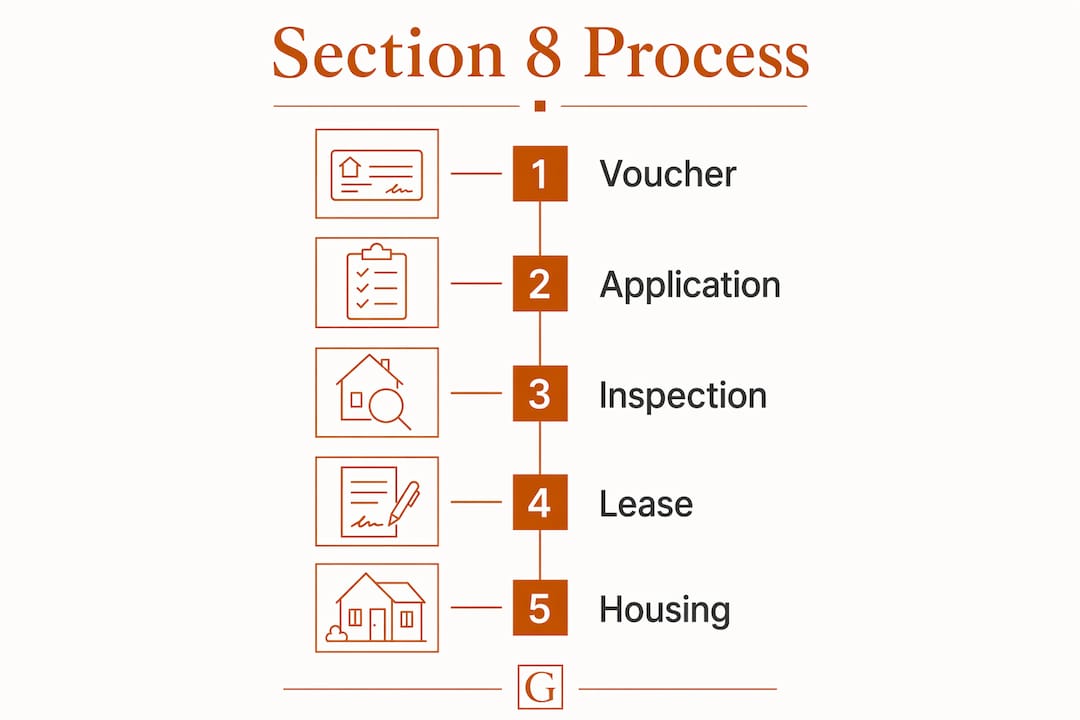
The process starts when a PHA issues a voucher to an eligible household. That voucher is essentially a spending authorization: it tells landlords and tenants how much the government will contribute toward rent in that area. The tenant then has a set window, typically 60–120 days, to find a qualifying unit before the voucher expires.

Once a tenant finds a willing landlord, the PHA inspects the property. If the unit passes, the landlord and PHA sign a HAP contract, and the lease begins. The PHA pays its share directly to the landlord each month, and the tenant pays their portion separately.
Key mechanics of the program:
- Payment standard: Each PHA sets a local payment standard based on HUD's fair market rent data for the area. The subsidy covers up to that amount.
- Tenant rent share: Tenants pay roughly 30% of adjusted income toward rent and utilities. If the unit's gross rent exceeds the local payment standard, the tenant covers the difference, which can push their share up to 40% of income in the first year.
- Lease requirements: The tenant signs a standard lease with the landlord, just like any other rental. The PHA is not a party to the lease itself.
- Portability: Voucher holders can move their subsidy between jurisdictions served by different PHAs, which gives tenants real geographic flexibility rather than locking them into one building or neighborhood.
The portability feature is one of the program's most underappreciated aspects. A family that receives a voucher in one city can transfer it when they relocate for work or family reasons, carrying their housing assistance with them.
Who qualifies for Section 8 housing assistance?
Eligibility is based primarily on income. HUD sets income limits by family size and local area median income (AMI). To qualify, a household's gross annual income generally must fall at or below 50% of the AMI for their area, though PHAs are required to direct at least 75% of new vouchers to households at or below 30% of AMI.
Priority groups typically served first include:
- Low-income families with children
- Elderly individuals (generally age 62 and older)
- People with disabilities
- Veterans and their families
- Households experiencing homelessness or living in substandard housing
Citizenship and immigration status also matter. Applicants must be U.S. citizens or non-citizens with eligible immigration status to qualify for assistance.
The application process runs through the local PHA. Most PHAs maintain multi-year waiting lists, and many close their lists entirely for extended periods when demand outpaces available vouchers. Applicants need to monitor their local PHA's website regularly, because list openings are often announced with short notice and fill quickly.
Two types of vouchers exist under the program:
- Tenant-based vouchers: The tenant holds the voucher and can use it at any qualifying private rental. This is the standard Housing Choice Voucher.
- Project-based vouchers: The subsidy is tied to a specific unit or property, not the tenant. If the tenant moves, they leave the subsidy behind.
Pro Tip: If you are on a waiting list, update your contact information with the PHA every time it changes. Failing to respond to a status inquiry can result in removal from the list.
What landlords gain and what they take on
Landlord participation in Section 8 is entirely voluntary. The main draw is financial predictability. The program offers consistent, government-guaranteed monthly payments, which reduces the vacancy risk and late-payment risk that come with standard market rentals. For landlords in areas with high tenant turnover, that stability has real value.
Benefits for landlords:
- Guaranteed monthly HAP payments from the PHA, regardless of whether the tenant pays their share on time
- Access to a large pool of pre-screened, income-verified tenants
- Reduced vacancy periods, since voucher holders are actively searching for housing
Obligations and considerations:
- Landlords must maintain properties to HUD standards and submit to annual inspections to stay in the program.
- Rent increases require PHA approval and advance notice, typically 60 days.
- Landlords retain the right to screen tenants using standard criteria, including credit checks, rental history, and background checks. Holding a voucher does not exempt a tenant from a landlord's normal screening process.
- Lease violations, including nonpayment of the tenant's rent share, can still result in eviction through normal legal channels.
One practical reality: some landlords find the inspection and paperwork requirements more time-consuming than standard rentals. Others find the trade-off worthwhile given the payment reliability. The decision usually comes down to property type, local market conditions, and how the landlord manages their portfolio.
What rental properties must meet to qualify
Not every rental unit automatically qualifies for Section 8. The property must meet HUD's Housing Quality Standards (HQS), which cover 13 key areas of safety and sanitation, including structural condition, heating and plumbing systems, electrical safety, and freedom from lead-based paint hazards. HUD is transitioning to a newer inspection protocol called NSPIRE (National Standards for the Physical Inspection of Real Estate), which applies a more detailed scoring system.
Property requirements at a glance:
- Must be located within the PHA's jurisdiction or an area where the voucher can be ported
- Must pass an initial HQS or NSPIRE inspection before the lease begins
- Rent must be "reasonable" compared to similar unassisted units in the local market, as evaluated by the PHA
- Landlord must sign a HAP contract with the PHA and agree to program terms
- Annual inspections are required to confirm the unit continues to meet standards
Failing an inspection does not automatically end the tenancy. The landlord typically receives a notice with a deadline to correct deficiencies. Repeated failures or uncorrected violations can result in suspension of HAP payments or removal from the program. Understanding habitability standards in real estate is useful context for any landlord considering participation.
How to apply for Section 8 housing assistance
The application process has several distinct stages, and the timeline can stretch from months to years depending on local demand.
Step 1: Find your local PHA. HUD maintains a national PHA directory on its website. You apply through the PHA that serves the area where you want to live, not necessarily where you currently live.
Step 2: Submit an application when the waitlist opens. Applications are only accepted when the PHA's waitlist is open. Watch for announcements on the PHA's website or local housing authority social media channels.
Step 3: Wait and maintain your application. Waiting lists often remain closed for multiple years. Keep your contact information current and respond promptly to any PHA correspondence.
Step 4: Attend a briefing. When your name reaches the top of the list, the PHA will schedule a briefing explaining program rules, your rights and responsibilities, and how to find a qualifying unit.
Step 5: Search for housing. You have a set period, typically 60–120 days, to find a unit whose landlord agrees to participate. The unit must pass inspection and meet rent reasonableness standards.
Step 6: Complete the inspection and sign the lease. The PHA inspects the unit. If it passes, you sign a lease with the landlord and the PHA executes the HAP contract. Assistance begins on the lease start date.
One important cost note: the voucher does not cover security deposits, application fees, or renters insurance. Some PHAs partner with local nonprofits to help with these upfront costs, but availability varies by location.
Common rules and restrictions that govern Section 8 tenancies
Both tenants and landlords operate under a specific set of rules once a HAP contract is in place. Violating them can result in termination of assistance or removal from the program.
For tenants, the key rules include:
- The unit must be the tenant's primary residence. Subletting or using the unit for business purposes is prohibited.
- Household composition changes, such as adding a new family member, must be reported to the PHA promptly.
- Criminal activity, drug-related offenses, or lease violations can result in termination of the voucher.
- Annual recertification of income and family composition is required to maintain eligibility.
- Tenants cannot own the property they are renting under the voucher.
For landlords, the restrictions are equally clear. Rent increases require PHA approval and cannot take effect mid-lease without consent. Landlords cannot charge Section 8 tenants fees or surcharges that are not charged to unassisted tenants for the same unit type. Discrimination against voucher holders is prohibited in many states and cities, even though federal law does not currently mandate it nationwide.
How Section 8 affects property management and tenant screening
Participating in the Section 8 program changes how a landlord manages a property in a few concrete ways. The PHA becomes a third party in the financial relationship, which adds administrative steps but also adds payment security. Landlords receive two separate rent payments each month: the HAP from the PHA and the tenant's share directly. Tracking both requires clear accounting.
Tenant screening remains the landlord's right and responsibility. A voucher does not guarantee a tenant's rental history, creditworthiness, or behavior. Landlords can and should run standard background and credit checks, verify references, and apply consistent screening criteria. The one constraint is that screening criteria must be applied equally to all applicants. Rejecting a voucher holder for reasons that would not apply to a market-rate applicant can create fair housing liability.
Property management under Section 8 also means planning for annual inspections. Proactive maintenance reduces the risk of inspection failures, which can pause HAP payments until deficiencies are corrected. Landlords who treat Section 8 properties the same as their other rentals, with regular upkeep and responsive repairs, tend to have fewer disruptions. Reviewing rental property financing options before acquiring a Section 8 unit helps landlords budget for both acquisition and ongoing maintenance costs.
How Section 8 differs from other subsidized housing programs
Section 8 is one of several federal housing assistance programs, but it works differently from the others in ways that matter to both tenants and landlords.
Public Housing is the program most often confused with Section 8. In public housing, the government owns and operates the buildings directly through local housing authorities. Tenants apply to live in government-owned units. Section 8, by contrast, uses private market housing. The tenant chooses the unit; the government pays part of the rent.
Project-Based Section 8 (also called Project-Based Rental Assistance, or PBRA) ties the subsidy to a specific unit in a specific building, usually a privately owned affordable housing development. The tenant cannot take the subsidy elsewhere. Standard Housing Choice Vouchers are tenant-based, meaning the subsidy follows the person, not the address.
Low-Income Housing Tax Credits (LIHTC) fund the construction or rehabilitation of affordable housing by giving tax credits to developers. LIHTC properties charge below-market rents to income-qualified tenants, but tenants do not receive individual vouchers. A tenant in an LIHTC property may or may not also hold a Section 8 voucher.
HOME Investment Partnerships Program provides block grants to states and localities to fund affordable housing development and rental assistance. It operates at the local level with more flexibility than Section 8 but serves a similar income range.
The practical difference for most renters is mobility. A Housing Choice Voucher gives you the ability to choose your neighborhood and move when your circumstances change. Project-based programs and public housing do not offer that flexibility.
Financing options for landlords investing in Section 8 properties

Acquiring or renovating a Section 8 rental property often requires fast, flexible financing, especially when a landlord is competing for a property in a tight market or needs to bring a unit up to HUD standards quickly. Traditional bank loans can take weeks or months to close, which is too slow for many investment opportunities.
Private lending fills that gap. Asset-based hard money loans focus on the property's value rather than the borrower's tax returns or credit score, which means approvals move faster. Gannlending, for example, funds real estate investment loans in as few as 5–7 business days and covers up to 75% loan-to-value across residential and commercial properties. For a landlord who needs to close quickly on a Section 8-eligible property or fund repairs before an HQS inspection, that speed is the difference between landing the deal and losing it.
Key financing considerations for Section 8 landlords:
- Stable rental income supports loan serviceability. Government-backed HAP payments provide predictable monthly cash flow, which private lenders view favorably when evaluating a deal.
- Renovation loans can bring properties into HUD compliance. If a unit fails inspection due to deferred maintenance, a short-term bridge loan can fund the repairs needed to qualify.
- Acquisition speed matters. Properties suitable for Section 8 tenants often attract multiple buyers. Fast-close financing keeps you competitive.
- Exit strategy planning. Whether you plan to hold long-term or refinance into conventional financing, understanding your rental property acquisition funding options before you make an offer puts you in a stronger position.
Pro Tip: Before applying for a hard money loan on a Section 8 property, get a preliminary HQS inspection or review the unit against HUD's 13 inspection categories. Knowing the repair scope upfront lets you borrow the right amount and avoid cost overruns that compress your returns.
The combination of government-backed rental income and private financing flexibility makes Section 8 properties a practical target for real estate investors who understand how the program works. The key is moving quickly when the right property appears and having financing lined up before you need it.
Key Takeaways
Section 8 rental properties are privately owned units where HUD subsidizes rent through the Housing Choice Voucher program, administered locally by PHAs. Tenants pay roughly 30% of their adjusted income—though this share may rise up to 40% in the first year if the rent exceeds the local payment standard.
| Point | Details |
|---|---|
| Section 8 is private housing | The government subsidizes rent but never owns the property; landlords remain in full control. |
| Tenants pay roughly 30% of income (up to 40% if rent exceeds the standard) | PHAs pay the remainder directly to the landlord up to the local payment standard each month. |
| Vouchers are portable | Tenants can transfer their subsidy across PHA jurisdictions, giving them genuine housing mobility. |
| Landlords must pass annual inspections | Properties must meet HUD's Housing Quality Standards each year to keep HAP payments active. |
| Waitlists can last years | Most PHAs have multi-year waitlists, and lists often close entirely when demand exceeds supply. |