
Commercial property depreciation is a federal tax deduction that lets you recover the cost of a nonresidential building over its IRS-assigned recovery period — 39 years, straight-line, under MACRS GDS. Land is never depreciable. Depreciation begins on the placed-in-service date, and you report it annually on Form 4562.
The bottom line: Depreciation is a paper deduction, not a reflection of market value. Your building can appreciate in the market while you're still writing off its cost on your tax return — the deduction is based on the structure's theoretical useful life, not what a buyer would pay today.
Three things every investor should know before reading further:
- Land is excluded. You must allocate your purchase price between land and building before you can calculate a single dollar of deduction.
- Timing is strict. Depreciation starts when the property is placed in service — ready and available for its intended use — not on the closing date.
- Sale triggers recapture. Under Section 1250, the IRS taxes previously claimed (or claimable) depreciation as ordinary income when you sell, even if you never actually took the deduction.
Table of Contents
- What parts of a commercial property can actually be depreciated?
- Recovery periods and depreciation methods you must apply
- How to calculate your depreciable basis and annual deduction
- Special rules that can change the size and timing of your deductions
- What happens to depreciation when you sell
- How to report depreciation and what records to keep
- Why depreciation matters beyond your tax return
- Common mistakes investors make with commercial property depreciation
- Key Takeaways
- Fast financing for investors who need to move quickly
- Authoritative sources and further reading
What parts of a commercial property can actually be depreciated?
Land is not depreciable — the IRS treats it as having an indefinite useful life. That means your first job as an investor is splitting the total purchase price into two buckets: land value and building value. Only the building side generates deductions.
The building structure itself — walls, roof, foundation, permanently attached plumbing, HVAC, and electrical systems — depreciates over 39 years. That's the baseline. But not everything inside a commercial building has to follow that 39-year schedule.

Shorter-life components matter. Personal property and certain fixtures that aren't permanently attached to the structure — carpeting, removable equipment, specialized lighting — may qualify for 5-year or 7-year recovery periods. Site improvements like parking lots and landscaping often fall into a 15-year category. Properly identifying these components is the whole point of a cost segregation study, which reclassifies building components to shorter lives and front-loads your deductions.
Leasehold and tenant improvements are a separate question. Improvements a tenant makes to leased space, or that a landlord makes specifically for a tenant, can qualify as Qualified Improvement Property (QIP) with a 15-year recovery period under current rules — a significant advantage over the standard 39-year building schedule.
Pro Tip: Order a cost segregation study in the first year of ownership, not five years in. The study is most valuable when you can accelerate deductions during early hold years, and retroactive studies, while possible, require amended returns.
Recovery periods and depreciation methods you must apply
The governing system for any commercial or residential property placed in service after 1986 is MACRS — the Modified Accelerated Cost Recovery System. Under MACRS, you choose between two sub-systems: the General Depreciation System (GDS) and the Alternative Depreciation System (ADS).
GDS is the default. For nonresidential commercial real property, GDS requires straight-line depreciation over 39 years. Residential rental property uses 27.5 years under the same system. You don't get to choose a faster method for the building itself — straight-line is mandatory for real property under GDS.
ADS is slower and sometimes required. ADS stretches the commercial recovery period to 40 years. You're required to use ADS in specific situations: property used predominantly outside the U.S., property used for tax-exempt purposes, and certain listed property. Some investors also elect ADS voluntarily for state tax reasons, though that's a decision for a CPA.
Placed in service means the date the property is ready and available for its intended income-producing use — not the purchase date, and not the date you signed the lease. A building undergoing substantial renovation is not yet placed in service. Internal records, certificates of occupancy, and lease commencement dates are the evidence the IRS expects.
The mid-month convention applies to all real property. Whatever month you place a commercial building in service, the IRS treats it as if you placed it in service at the midpoint of that month. A building placed in service in March gets 9.5 months of depreciation in year one (mid-March through December 31), not a full 12.
| Property Type | Recovery Period (GDS) | Method | Convention |
|---|---|---|---|
| Nonresidential (commercial) building | 39 years | Straight-line | Mid-month |
| Residential rental property | 27.5 years | Straight-line | Mid-month |
| Qualified Improvement Property (QIP) | 15 years | Straight-line | Half-year |
| 5-year personal property (carpeting, etc.) | 5 years | 200% DB / SL | Half-year |
| 7-year personal property (fixtures, etc.) | 7 years | 200% DB / SL | Half-year |
| 15-year site improvements | 15 years | 150% DB / SL | Half-year |
How to calculate your depreciable basis and annual deduction
The math itself isn't complicated. What trips investors up is getting the inputs right before they divide anything.
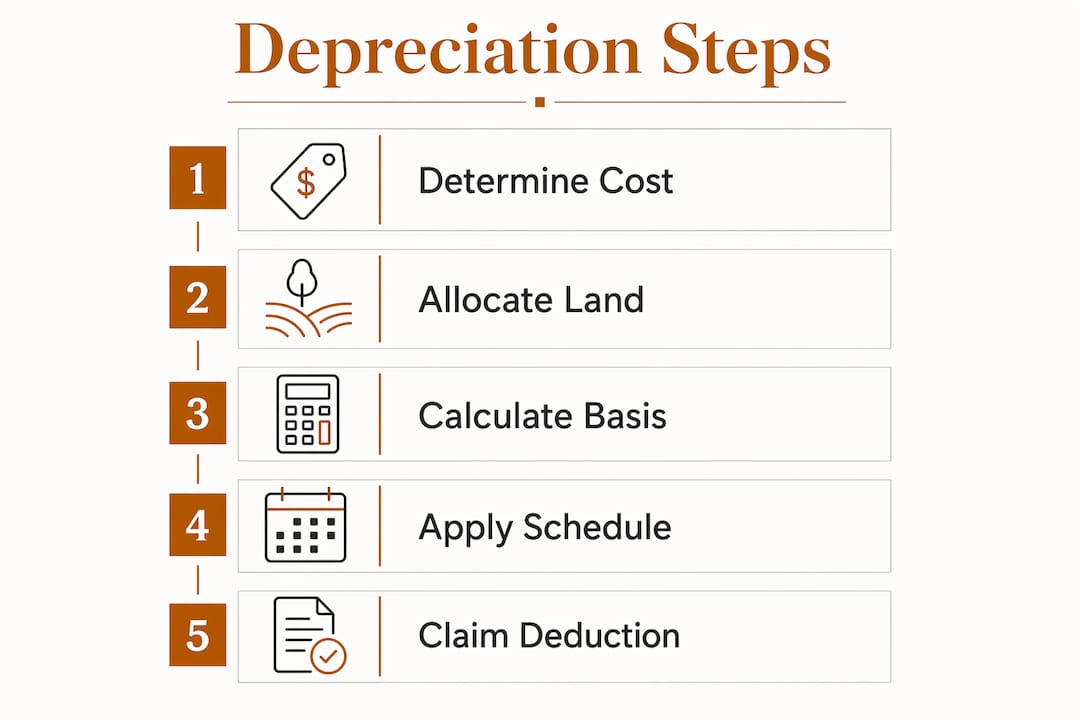
Step 1: Determine your cost basis. Start with the purchase price, then add capitalizable closing costs — title insurance, legal fees, recording fees, and transfer taxes paid by the buyer. Loan origination fees are not added to basis. Capital improvements made after purchase are added when they're placed in service.
Step 2: Allocate between land and building. The IRS requires this split, but doesn't prescribe one method. Common approaches include using the county tax assessor's land-to-improvement ratio, ordering an appraisal that separately values land and building, or relying on a purchase price allocation in the sale contract. A formal commercial property appraisal gives you the most defensible documentation.
Step 3: Subtract land to get depreciable basis. This is the number you'll divide by 39 (or a shorter period for reclassified components).
Step 4: Apply the recovery period and mid-month convention. Divide the depreciable basis by 39 for the full-year straight-line amount. Then adjust year one for the month placed in service.
Worked example:
| Item | Amount |
|---|---|
| Total cost basis | $1,015,000 |
| Depreciable basis (building) | $812,000 |
| Full-year straight-line deduction ($812,000 ÷ 39) | $20,821 |
The $20,821 annual deduction continues from year two through year 39, with a partial deduction in the final year. If a cost segregation study reclassifies $150,000 of the building to 5-year and 15-year components, those portions generate much larger early-year deductions, improving the net present value of the tax savings considerably.
Special rules that can change the size and timing of your deductions
The 39-year straight-line schedule is the floor, not the ceiling. Several provisions let you accelerate or increase deductions — each with its own eligibility rules and traps.
Bonus depreciation allows you to deduct a percentage of the cost of qualified property in the year it's placed in service, rather than spreading it over the recovery period. Bonus depreciation applies to personal property and QIP, not to the commercial building structure itself. The applicable percentage has changed over time under tax legislation, so confirm the current rate with your CPA before planning around it.
Section 179 lets businesses immediately expense the cost of qualifying property rather than depreciating it. The catch for commercial real estate investors: the building itself doesn't qualify. Section 179 can apply to tangible personal property inside the building — certain equipment, HVAC units that qualify as personal property, and some improvements — but not to the structural shell.
Qualified Improvement Property (QIP) covers improvements made to the interior of a nonresidential building after the building was first placed in service. QIP has a 15-year GDS recovery period and is eligible for bonus depreciation, making it one of the more valuable classifications for investors who renovate existing commercial buildings. Structural components, elevators, escalators, and enlargements of the building do not qualify as QIP.
Section 179D is a separate deduction for energy-efficient commercial buildings. Qualifying improvements to lighting, HVAC, or the building envelope can generate a per-square-foot deduction. The rules and deduction amounts have been updated by recent legislation — check current IRS guidance on Section 179D before assuming a specific dollar figure.
Pro Tip: Bonus depreciation elections and Section 179 elections are often irrevocable for the tax year in which they're made. If you're in a loss year, accelerating deductions may create a net operating loss with limited immediate benefit. Run the numbers with a CPA before electing.
What happens to depreciation when you sell
Every dollar of depreciation you claim reduces your adjusted basis in the property. When you sell, a lower basis means a larger taxable gain — and part of that gain gets taxed at rates higher than long-term capital gains rates.
Adjusted basis is simply your original cost basis minus all accumulated depreciation deductions taken (or allowable). If you bought a building for $1,015,000, allocated $812,000 to the depreciable building, and claimed $104,105 in depreciation over five years, your adjusted basis is $910,895.
Section 1250 depreciation recapture is the mechanism the IRS uses to tax that accumulated depreciation. On sale, the portion of your gain attributable to prior depreciation is characterized as ordinary income (up to the amount of depreciation taken), taxed at a maximum federal rate of 25% for real property. The remaining gain above that is taxed at long-term capital gains rates.
The "allowed or allowable" rule means recapture applies to depreciation you could have claimed, not just what you actually claimed. If you owned a commercial building for 10 years and never filed Form 4562, the IRS still calculates recapture as if you had taken every annual deduction. Skipping deductions doesn't reduce your recapture liability — it just means you paid more tax during the holding period for no benefit.
Short sale scenario:
| Item | Amount |
|---|---|
| Original cost basis | $1,015,000 |
| Accumulated depreciation (5 years) | $104,105 |
| Adjusted basis at sale | $910,895 |
| Portion taxed as ordinary income (recapture) | $104,105 |
Planning options exist. A 1031 exchange defers both the capital gain and the recapture by rolling proceeds into a like-kind replacement property. Installment sales spread the gain recognition over multiple years. Neither eliminates recapture — they defer it. Discuss timing and structure with a tax advisor before listing.
How to report depreciation and what records to keep
Depreciation is reported on Form 4562 (Depreciation and Amortization). Rental property owners carry the Form 4562 result to Schedule E, Part I, line 18 on their Form 1040. Commercial property used in a business reports through the appropriate business return. The IRS instructions for Form 4562 walk through each section, including Section 179 elections and bonus depreciation.
Records you must retain:
- Closing statement (HUD-1 or ALTA settlement statement) showing purchase price and closing costs
- Land allocation documentation — tax assessor records, appraisal, or purchase price allocation agreement
- Cost segregation study (engineer's report with component-level analysis)
- Placed-in-service documentation — certificate of occupancy, lease commencement date, or internal records
- Invoices and contracts for all capital improvements, with dates
- Prior-year Form 4562 filings showing accumulated depreciation
- Any Section 179 or bonus depreciation election statements
Timing details that matter:
- Depreciation begins in the month the property is placed in service, using the mid-month convention.
- Partial-year deductions apply in both the first and last year of ownership.
- You must claim depreciation every year you're entitled to it. The allowed or allowable rule means the IRS computes recapture based on what you could have claimed — so missing annual deductions costs you twice: once in higher current taxes, once in unchanged future recapture.
Keep depreciation records for as long as you own the property, plus at least three years after the year of sale. The IRS can audit the basis calculation on a sale return, which requires tracing back to the original purchase.
Why depreciation matters beyond your tax return
Depreciation functions as a non-cash tax shield — it reduces taxable income without requiring any cash outlay. For a commercial property generating $80,000 in net operating income, a $20,000 annual depreciation deduction reduces the taxable portion to $60,000. The cash is still in your account; only the tax bill shrinks.
That dynamic shows up in lender conversations too. When a lender evaluates debt service capacity, they typically add back non-cash expenses like depreciation to reconstruct actual cash flow. Accurate depreciation reporting on your tax returns gives lenders a cleaner picture of your property's income-generating ability. Investors who use a DSCR calculator to model cash flow should include depreciation as a line item to understand how it affects reported income versus actual cash available for debt service.
Accelerated deductions change early-hold-year metrics. A cost segregation study that front-loads $200,000 in deductions into years one through five can materially improve after-tax cash flow during the period when investors and lenders are most closely watching performance. That's not just a tax benefit — it's a deal-structuring consideration.
Gannlending works with real estate investors across residential and commercial property types, and the financing conversations we see most often involve investors who understand their depreciation position before they close, not after. Knowing your depreciable basis and your likely recapture exposure shapes how you structure financing, hold periods, and exit timing.
Common mistakes investors make with commercial property depreciation
Most depreciation errors fall into a handful of categories, and most of them are avoidable with basic process discipline.
Frequent errors:
- Failing to allocate land correctly. Using the full purchase price as the depreciable basis overstates deductions and creates audit exposure. Always document the land split with an appraisal or assessor records.
- Getting the placed-in-service date wrong. Claiming depreciation before a property is ready for its intended use — particularly during renovation — is a common audit trigger. The date must be supported by documentation.
- Misclassifying improvements as repairs. Repairs are deducted in the year incurred; improvements must be capitalized and depreciated. The IRS tangible property regulations draw a specific line between the two. Value-add renovations almost always involve capitalizable improvements, not deductible repairs.
- Ignoring cost segregation on larger properties. For buildings above $500,000 in value, the NPV benefit of accelerated deductions typically exceeds the cost of the study by a significant margin. Leaving that on the table is a missed opportunity.
- Poor recordkeeping. Missing closing statements, undocumented improvement invoices, and no contemporaneous placed-in-service records are the three most common reasons depreciation deductions get disallowed on audit.
IRS audit red flags:
- Large first-year deductions with no supporting cost segregation study or engineer's report
- Inconsistent land allocations across multiple years' returns
- Missing or late Form 4562 filings
- Depreciation claimed on a property that was not yet placed in service
If you've made errors: Amended returns (Form 1040-X for individuals) can correct missed deductions in prior years, subject to the statute of limitations. A CPA can also file a Form 3115 (Change in Accounting Method) to catch up on missed depreciation without amending every prior return. Don't try to navigate either option without professional guidance.
Key Takeaways
Commercial property depreciation reduces taxable income through a 39-year straight-line deduction on the building's depreciable basis, but land exclusion, placed-in-service timing, and Section 1250 recapture make accurate setup and annual reporting non-negotiable.
| Point | Details |
|---|---|
| 39-year straight-line is the standard | Nonresidential commercial buildings depreciate over 39 years under MACRS GDS; land is never included in the depreciable basis. |
| Depreciable basis requires a land split | Subtract the allocated land value from total cost basis before calculating any annual deduction. |
| Placed-in-service date controls timing | Depreciation begins when the property is ready and available for use, with the mid-month convention applied in year one. |
| Recapture applies to allowed or allowable depreciation | Section 1250 recapture is calculated on what you could have claimed, not just what you did — skipping deductions doesn't reduce future tax. |
| Gannlending supports investors at the financing stage | For investors who need fast capital to close, renovate, or bridge timing, Gannlending offers asset-based hard money loans closing in as few as 5–7 business days. |
A note from the publisher
This guide covers U.S. federal tax rules as they apply to commercial property depreciation — specifically the MACRS framework, Form 4562 reporting, and Section 1250 recapture. Tax law changes, and individual circumstances vary considerably. Before making depreciation elections, filing amended returns, or structuring a sale around recapture planning, consult a licensed CPA or tax attorney who knows your specific situation. The rules here are the foundation; your advisor applies them to your numbers.
Fast financing for investors who need to move quickly
Real estate investors often face a timing problem: the tax planning is clear, but the capital to execute — close on a property, fund a renovation, or bridge to permanent financing — isn't available fast enough through traditional lenders.

Gannlending provides asset-based hard money loans built specifically for real estate investors, with funding available on a fast timeline and financing up to 75% LTV across residential and commercial properties. The approval process focuses on the asset, not a stack of paperwork, which means investors who've identified a property and understand their basis can move without waiting weeks for a credit committee. Gannlending has funded a substantial volume of real estate transactions. If you're ready to act on a commercial opportunity, explore your financing options at Gannlending. Consult your tax counsel before making decisions based solely on depreciation or tax outcomes.
Commercial disclosure: this is a paid placement for Gannlending's lending services. Loan terms, rates, and availability vary by transaction.
Authoritative sources and further reading
Primary IRS sources:
- IRS Publication 946 — How To Depreciate Property: The definitive IRS guide covering MACRS, recovery periods, conventions, Section 179, bonus depreciation, and Form 4562 instructions.
- IRS Tax Topic 704 — Depreciation: Concise IRS summary confirming land exclusion and the basics of depreciable property.
- IRS Depreciation FAQs (Regulatory PDF): Official IRS FAQ document covering placed-in-service definitions and timing rules.
- IRS — Tips on Rental Real Estate Income, Deductions and Recordkeeping: IRS guidance on Schedule E reporting, Form 4562, and the distinction between repairs and improvements.
Practitioner commentary:
- Seneca Cost Segregation — Commercial Property Depreciation: Practitioner-level explanation of cost segregation mechanics, component reclassification, and the cash-flow impact of accelerated deductions.
- BiggerPockets — Depreciation in 2026: What Investors Need to Know: Investor-focused overview of the allowed or allowable rule, Section 1250 recapture, and 1031 exchange planning.
- Investopedia — Understanding Depreciation of Rental Property: Accessible explanation of MACRS recovery periods, the 39-year vs. 27.5-year distinction, and straight-line method basics.