
Landlords refinance rental properties for three core reasons: to lower their interest rate and cut monthly payments, to pull out built-up equity for reinvestment, or to restructure loan terms that no longer fit their financial goals. It is a deliberate capital decision, not a reflexive response to rate headlines. Done right, refinancing can meaningfully improve cash flow, fund the next acquisition, or reduce long-term debt exposure on a portfolio.
The most common motivations, at a glance:
- Lower the interest rate to reduce monthly mortgage payments and improve net cash flow
- Access equity through a cash-out refinance to fund renovations, pay down other debt, or acquire new properties
- Adjust loan terms by extending or shortening the repayment period to match current investment goals
- Switch loan types from an adjustable-rate mortgage to a fixed rate for payment predictability
- Reposition the portfolio by consolidating debt or freeing up capital tied in appreciated properties
Each of these is a financial strategy with a specific payoff. The decision to refinance should always start with a clear answer to one question: what problem does this solve?
What do lenders require to refinance a rental property?
Qualifying for a rental property refinance is harder than refinancing a primary residence. Lenders treat investment properties as higher risk, so the bar is set higher across the board.
The key requirements landlords typically face:
- Loan-to-value (LTV) limits: Conventional guidelines cap cash-out LTV at 75% for single-unit investment properties and 70% for 2–4 unit properties. Rate-and-term refinances may allow slightly higher LTVs, but 75% is the practical ceiling for most landlords.
- Seasoning period: Most lenders require you to have owned the property for at least 12 months before a cash-out refinance. Some programs allow 6 months for rate-and-term, but 12 months is the conventional standard.
- Credit score: Expect a minimum of 620 for conventional loans, though many lenders prefer 680 or higher for investment properties. A stronger score also unlocks better pricing.
- Debt-to-income (DTI) ratio: Lenders calculate your DTI using personal income and all existing debt obligations. For landlords with multiple properties or significant depreciation write-offs, this can be a real obstacle.
- Cash reserves: Most lenders require 6 months of mortgage payments in reserves per investment property, sometimes more for larger portfolios.
- Higher rates: Investment property refinance rates run 0.25%–0.75% higher than rates on primary residence loans, reflecting the added lender risk.
Pro Tip: If your personal income picture is complicated by depreciation, self-employment deductions, or multiple LLCs, a DSCR (Debt Service Coverage Ratio) loan may be your clearest path. DSCR loans qualify based on the property's rental income relative to its debt payments, not your personal tax returns, which makes approval far more straightforward for investors with complex financials.
DSCR loans have become a go-to refinancing option for landlords who hold properties in LLCs or whose Schedule E income looks thin on paper. The property has to carry its own weight, but that is exactly how most well-run rentals already operate.
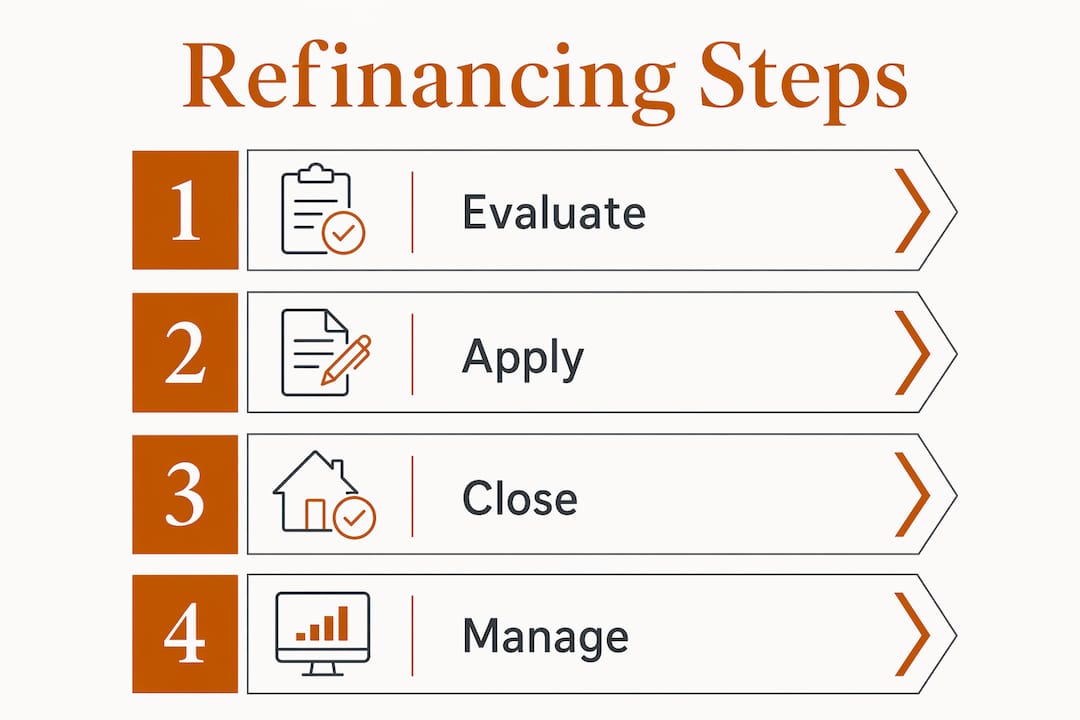
How to refinance a rental property step by step
The process from decision to closing typically takes 30–60 days with a conventional lender. Here is what to expect at each stage.
-
Evaluate your current loan and market conditions. Pull your existing loan statement and note the rate, remaining balance, and monthly payment. Compare that against current investment property rates. If the rate difference is less than 1 percentage point, run the break-even math carefully before moving forward.
-
Gather your financial documents. Lenders will want two years of personal tax returns (including Schedule E for rental income), recent bank statements, current rent rolls, lease agreements, and a current mortgage statement. Self-employed landlords should also prepare a year-to-date profit and loss statement.
-
Check your credit and address any issues. Pull your credit report from all three bureaus. Dispute errors, pay down revolving balances if possible, and avoid opening new credit lines in the 90 days before applying.
-
Order a property appraisal or prepare for one. The lender will order an appraisal to confirm current market value and verify the LTV falls within program limits. Make sure the property is in good condition and document any recent improvements that support a higher valuation.
-
Choose your loan product. Decide between a rate-and-term refinance (lower rate, same or adjusted term, no cash out) and a cash-out refinance (pull equity, higher loan balance). For landlords with complex income, also evaluate whether a DSCR loan fits better than a conventional product.
-
Submit your application and move through underwriting. The lender reviews your full file, verifies income and assets, and may request additional documentation. Respond quickly to any conditions to avoid delays.
-
Review the Closing Disclosure and close. The Consumer Financial Protection Bureau requires lenders to provide a Closing Disclosure at least three business days before closing. Review every line item, confirm the rate and terms match what you were quoted, and sign.
After closing, the new loan pays off the old one. Your first payment on the new loan typically begins 30–45 days later.

How should landlords prepare before refinancing?
Preparation before you apply can be the difference between a smooth approval and a frustrating denial. A few weeks of groundwork pays off.
- Improve your credit score first. Pay down credit card balances to below 30% utilization and resolve any derogatory marks. Even a 20-point score improvement can shift you into a better rate tier.
- Organize your property documentation. Lenders want to see current leases, rent rolls, insurance certificates, and maintenance records. Properties with documentation gaps raise underwriting flags.
- Calculate your break-even timeline before you apply. Divide total closing costs by your projected monthly savings. If it takes longer than 36 months to recoup the costs, the refinance may not make financial sense unless you plan to hold the property well beyond that point.
- Time it relative to property events. Avoid refinancing immediately after a vacancy or a major repair that has not yet been reflected in updated rent rolls. A lender who sees a recently vacant unit will underwrite it more conservatively.
- Review your portfolio-level debt. If you plan to acquire more properties in the next 12–18 months, a cash-out refinance now could free up capital for rental property acquisition without requiring new financing on the next deal.
Pro Tip: Run a stress test before committing. Model what happens to your cash flow if the property sits vacant for 60 days and you face a $5,000 repair in the same quarter. If the new loan payment still works under that scenario, you are in a solid position. If it does not, reconsider the loan amount or timing.
Timing matters more than most landlords realize. Refinancing into a higher loan balance right before a soft rental market can compress margins at exactly the wrong moment.
What does refinancing a rental property actually cost?
Closing costs on a rental property refinance typically run 2%–6% of the loan amount. On a $200,000 loan, that translates to roughly $5,000–$10,000 in upfront fees, often higher than what you would pay on a primary residence refinance because of stricter appraisal and underwriting requirements.
Cost reality check: Experts generally recommend recouping closing costs within 24–36 months of closing. If your break-even point stretches beyond that window, the refinance needs a stronger justification than a modest rate drop.
The main cost components landlords should budget for:
| Cost Component | Notes |
|---|---|
| Origination fee | Varies by lender and loan type |
| Appraisal | Higher for multi-unit properties |
| Title insurance and search | Required by most lenders |
| Recording fees | Set by local government |
| Prepaid interest | Covers days between close and first payment |
| Underwriting fee | Common on conventional and DSCR loans |
Beyond the upfront fees, there is a less-discussed cost that landlords often overlook: the amortization reset. Refinancing restarts the clock to year one of a new loan, which means early payments allocate less toward principal than they would on your existing, more seasoned loan. Even with a lower rate, total interest paid over the life of the loan can increase if you extend the term.
For rate-and-term refinances, the math works most clearly when the new rate is at least 1 percentage point lower than the current rate, allowing landlords to recover closing costs within 24–36 months. Cash-out refinances carry a different calculus: the equity drawn should fund investments that generate returns above the new borrowing cost, not cover operating shortfalls.
Cash-out and rate-and-term refinances also differ in LTV treatment. A cash-out refi on a single-unit property is capped at 75% LTV under conventional guidelines, while rate-and-term refinances may allow slightly more room. The cash-out refi structure delivers a one-time lump sum with fixed repayment terms, which gives landlords predictable debt service. A HELOC, by contrast, is a revolving line of credit that lenders can freeze, making it a less reliable tool for planned capital deployment.
What are the real benefits of refinancing for landlords?
The financial case for refinancing rental properties comes down to cash flow, capital access, and portfolio positioning. When the numbers work, the benefits compound over time.
- Improved monthly cash flow. A lower rate or extended term reduces the monthly mortgage payment, widening the gap between rental income and debt service. That margin is what makes a rental portfolio resilient through vacancies and repairs.
- Access to equity for reinvestment. Borrowing equity through a cash-out refinance lets landlords fund renovations that increase rents, pay down higher-cost debt, or put a down payment on the next property. The key is deploying that capital into something that earns more than the new borrowing rate.
- Locking in a fixed rate. Landlords on adjustable-rate mortgages face payment uncertainty as rates move. Refinancing into a fixed-rate loan eliminates that exposure and makes long-term cash flow projections more reliable.
- Adjusting the loan term. Shortening from a 30-year to a 15-year loan builds equity faster and reduces total interest, though it raises the monthly payment. Extending the term does the opposite, freeing up monthly cash at the cost of more interest over time. The right move depends on your current cash flow needs versus long-term payoff goals.
- Better cash-on-cash returns. Reducing debt service on a property that generates steady rent directly improves the cash-on-cash return, one of the most practical metrics for evaluating rental performance. For landlords building a real estate portfolio, even a modest improvement in per-property returns adds up across multiple assets.
- Portfolio resilience. Lower fixed payments give you more room to absorb unexpected costs without dipping into reserves or missing debt obligations. That buffer matters most when the market softens.
The benefits are real, but they only materialize when the refinance is structured around a specific financial goal with a clear payoff timeline. Refinancing to chase a marginally lower rate, without accounting for closing costs and the amortization reset, often produces a worse outcome than staying put.
Key Takeaways
Landlords who refinance with a clear financial goal and a calculated break-even timeline consistently get better outcomes than those who refinance reactively.
| Point | Details |
|---|---|
| Core motivations | Landlords refinance to lower rates, access equity, or adjust loan terms to match investment goals. |
| LTV and seasoning limits | Conventional cash-out refinances cap at 75% LTV for single-unit properties with a 12-month seasoning requirement. |
| Cost range | Closing costs run 2%–6% of the loan amount; recouping them within 24–36 months is the standard benchmark. |
| Amortization reset risk | Refinancing restarts the loan clock, which can increase total interest paid even when the rate drops. |
| DSCR loans as an alternative | DSCR loans qualify on property income rather than personal income, making them practical for landlords with complex tax profiles. |
Ready to refinance your rental property?

Gannlending works with real estate investors who need fast, asset-focused financing without the paperwork bottlenecks of traditional lenders. Whether you are pulling equity from an existing rental or repositioning a property in your portfolio, Gannlending funds deals in as few as 5–7 business days with financing up to 75% LTV across residential and commercial properties.
If you are weighing your refinancing options or need capital quickly, Gannlending's team can walk you through what fits your situation.