
Speed is the single most decisive competitive advantage in real estate investing. Investors who move fast win deals that slower competitors never see. The importance of speed in real estate goes beyond urgency. It shapes seller psychology, financing outcomes, and long-term portfolio growth. Whether you are making an all-cash offer or working with a private lender like Gannlending, your ability to act fast determines how many deals you close and how much capital you compound over time.
Why speed matters in real estate investing: the core case
Speed in real estate investing is defined as the ability to respond to leads, structure offers, and close transactions faster than competing buyers. This is not just about hustle. Research and deal data show that timing creates measurable financial advantages at every stage of the acquisition process.

Sellers are not purely price-driven. They weigh certainty heavily. A seller who has already mentally moved on from a property does not want to wait 45 days for a buyer to secure financing. They want the deal done. That preference creates a real opening for investors who can deliver fast, reliable closings.
The importance of speed in real estate also compounds over time. Faster closings free up capital sooner. That capital goes into the next deal. Over five years, the difference between a 13-day and a 45-day close can translate into 1–2 additional properties acquired with the same capital base. That is not a marginal gain. That is a portfolio-level outcome.
How rapid lead response improves deal qualification
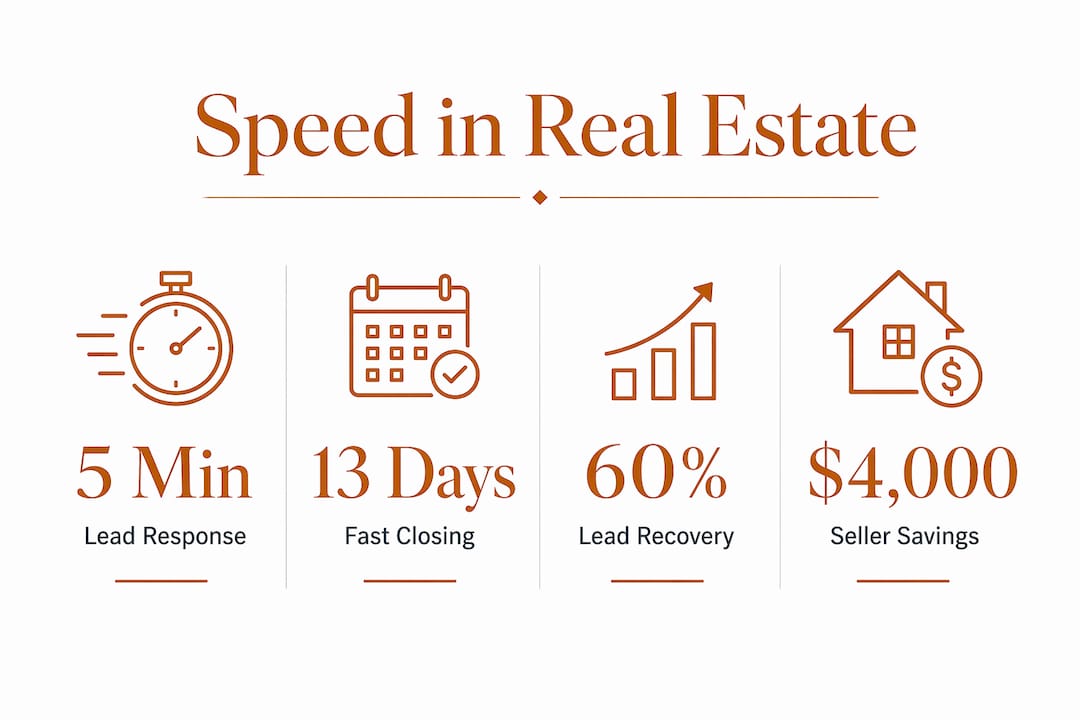
The 5-minute rule is one of the most important findings in real estate lead conversion. Contacting a lead within 5 minutes increases the likelihood of qualifying that seller by 21 times compared to waiting 30 minutes or more. That number is not intuitive, but the psychology behind it is straightforward.
Sellers reach out to multiple buyers at once. The first investor to respond sets the frame for the entire conversation. Qualification odds drop by 80% after just 10 minutes. By the time a slow responder calls back, the seller has already mentally committed to someone else.
This has direct implications for how investors structure their operations:
- Pre-approval readiness: Have financing confirmed before a lead comes in, not after.
- Same-day offer capability: Build workflows that let you submit a written offer within hours of a seller inquiry.
- Dedicated lead intake: Assign a specific person or system to handle inbound seller contacts immediately.
- Callback protocols: Define a hard rule that no lead waits more than 5 minutes for a response during business hours.
Automated callback systems using AI can achieve sub-1-second response times and recover roughly 60% of missed leads. That is a significant operational upgrade for investors running lean teams.
Pro Tip: Set up an automated SMS or voicemail response that fires the moment a seller inquiry comes in. Even a 30-second acknowledgment keeps the lead warm while you prepare a real response.
Why fast closings create a certainty premium that beats higher offers
A fast closing is often worth more to a seller than a higher purchase price. A 13-day closing can beat a 45-day close even when the competing offer is nominally higher. The reason is holding costs, financing risk, and opportunity cost on the seller's side.
On a $200,000 rental property, a faster close can save a seller approximately 2% in holding and opportunity costs. That is $4,000 in real savings. A buyer offering $5,000 more but closing in 45 days may not actually deliver more net value to the seller. Investors who understand this math can use speed as a pricing tool, not just a convenience.
Sellers also fear deal failure. A long closing window means more time for financing to fall through, inspections to derail negotiations, or the buyer to walk. Certainty and fast execution function as a "certainty premium" that sellers price into their decision, often unconsciously.
| Close timeline | Seller holding cost impact | Deal failure risk | Investor capital freed |
|---|---|---|---|
| 13 days | Minimal | Low | Quickly recycled |
| 30 days | Moderate | Moderate | Delayed by 17+ days |
| 45 days | Significant | Higher | Tied up for full period |
| 60+ days | High | Elevated | Severely constrained |
Pre-wiring your closing process is what makes a 13-day close possible. Speed to close comes from running steps in parallel, not from working faster. When you sign a contract, your lender, inspector, and title company should already be briefed and ready to move. Day one of the contract becomes effectively day five of the overall process.
Pro Tip: Build a closing checklist that your team can execute before a contract is even signed. Pre-order title searches and schedule inspectors on standby so you can compress the timeline the moment a deal is agreed.
Cash offers, private lending, and financing speed compared
Not every investor has the capital to make all-cash offers. But speed does not require cash. It requires the right financing structure. Each approach carries different tradeoffs in speed, cost, and availability.
All-cash offers are the fastest option. There is no lender approval, no appraisal delay, and no financing contingency. The downside is capital intensity. Tying up $300,000 in a single deal limits how many deals you can pursue simultaneously.
Private lending, including hard money loans from lenders like Gannlending, offers a middle path. Private lenders close in 5–7 days with minimal appraisal requirements. That speed rivals all-cash offers while preserving your liquid capital for multiple deals. Gannlending, which has funded over $50 million in real estate transactions, covers up to 75% LTV on residential and commercial properties.
Traditional bank financing is the slowest option. Underwriting, appraisals, and compliance reviews routinely push timelines past 30 days. In a competitive market, that pace loses deals.
| Financing type | Typical close time | Capital required | Speed advantage | Best use case |
|---|---|---|---|---|
| All-cash | 7–10 days | Very high | Highest | Single high-value deals |
| Private lending | 5–7 days | Moderate | High | Competitive acquisitions |
| Traditional bank | 30–45 days | Lower upfront | Low | Non-competitive markets |
| Hard money loan | 5–10 days | Moderate | High | Fix-and-flip, fast buys |
Key factors to evaluate when choosing a financing approach:
- How competitive is the market for this specific property?
- Does the seller have a stated preference for close timeline?
- How much capital do you need to preserve for other deals?
- Is the property eligible for short-term real estate loans that accelerate approval?
How to build operational speed as a real estate investor
Most investors lose deals not because they lack capital but because their operations are too slow. The most common pitfalls are predictable and fixable.
- No pre-approval in place. Investors who wait until a deal is under contract to seek financing add 5–10 days to every closing. Get pre-approved before you need it.
- Manual lead handling. Relying on a single person to answer calls and return emails creates bottlenecks. Automate intake and use CRM tools to track every lead in real time.
- Unprepared vendor teams. If your inspector, title company, and attorney are not already briefed on your deal criteria, they cannot move fast when you need them.
- Sequential rather than parallel workflows. Most slow closings happen because each step waits for the previous one to finish. Pre-wiring means all parties are ready to act simultaneously the moment a contract is signed.
- Reactive decision-making. Investors who have not pre-defined their buy criteria waste time analyzing deals that should be instant yes or no decisions.
Building speed into your operations means treating it as a system, not a personality trait. A CRM like HubSpot or a real estate-specific tool like Podio helps you track lead response times and close cycle durations. Reviewing those numbers monthly shows you exactly where delays are happening.
Understanding why real estate deals fall through is equally important. Financing delays and slow due diligence are among the top causes. Fixing those two areas alone can cut your average close time significantly.
Pro Tip: Track your average days from lead to close for every deal. Set a target and review it quarterly. Investors who measure close cycle time consistently outperform those who do not.
Key takeaways
Speed in real estate investing is a measurable competitive advantage that directly determines deal win rates, seller preference, and long-term portfolio growth.
| Point | Details |
|---|---|
| Lead response speed | Responding within 5 minutes increases seller qualification odds by 21x versus waiting 30 minutes. |
| Certainty premium | A fast close often beats a higher offer because sellers value risk reduction over marginal price gains. |
| Capital velocity | A 13-day close versus a 45-day close frees capital faster, enabling 1–2 more acquisitions over five years. |
| Pre-wiring operations | Running financing, inspections, and title work in parallel is what makes fast closings consistently possible. |
| Financing choice matters | Private lending closes in 5–7 days, matching all-cash speed while preserving capital for multiple deals. |
Speed is a system, not a superpower
I have watched investors lose deals they should have won. The property was right. The price was right. The financing was available. But the response came 48 hours too late, or the close took 50 days when the seller needed 20. Speed is not about being aggressive. It is about being ready.
The investors I have seen build real portfolios treat speed as a core operating principle. They have their lender on speed dial. They have their inspector scheduled before a deal closes. They have a CRM that flags every lead the moment it comes in. None of that is complicated. All of it requires intentional setup.
The counterintuitive truth about timing in real estate is that the fastest investors are rarely the most rushed. They are the most prepared. They have already made the decisions that slow investors make in real time. When a deal appears, they execute. That preparation is what separates investors who close 3 deals a year from those who close 12.
If you are serious about building your real estate portfolio with private capital, start by auditing your current close timeline. Find the delays. Fix the bottlenecks. Then find a lender who moves as fast as you need to.
— Brian
Gannlending: close deals in 5–7 days, not 45
Real estate investors who need to move fast cannot afford a lender that takes weeks to approve a loan.
Gannlending specializes in hard money loans for real estate investors who need funding in 5–7 business days. No appraisal requirement. Up to 75% LTV on residential and commercial properties. Gannlending has funded over $50 million in real estate transactions and works with investors facing everything from competitive acquisitions to foreclosure situations. If your next deal requires speed, Gannlending is built for exactly that. Learn how to close deals fast and what financing structure gives you the best shot at winning.
FAQ
Why does speed matter so much in real estate investing?
Speed determines whether you win competitive deals and how efficiently your capital compounds over time. Sellers prefer fast, certain closings, and faster capital recycling lets you acquire more properties with the same funds.
How much does lead response time affect deal conversion?
Responding to a seller lead within 5 minutes makes you 21 times more likely to qualify that lead than waiting 30 minutes. Qualification odds drop by 80% after just 10 minutes.
Can a fast close beat a higher offer price?
Yes. A 13-day closing can outperform a higher-priced 45-day offer because sellers save on holding costs and reduce the risk of the deal falling through. On a $200,000 property, that difference can reach approximately 2% in net savings for the seller.
What financing option closes the fastest?
Private lending and hard money loans close in 5–7 days, making them the fastest financing option for most investors. All-cash offers are equally fast but require significantly more capital per deal.
How do I build faster closing capability as an investor?
Pre-approve your financing before a deal appears, assemble a ready vendor team including inspector and title company, and use a CRM to automate lead intake. Pre-wiring your closing process so all steps run in parallel is the single most effective way to compress your timeline.