
A sheriff's sale is a court-ordered public auction where foreclosed real estate is sold to satisfy an unpaid debt, typically a defaulted mortgage or tax lien. The local sheriff acts as the legal agent of the court, not as a traditional seller. Understanding sheriff sales is critical before you bid, because the rules, risks, and financial demands are unlike any standard real estate transaction. This guide covers the full process, from the first court filing to post-sale possession, so you can approach a sheriff real estate auction with clear eyes and a solid plan.
What is a sheriff sale in real estate?
A sheriff's sale is the final step in judicial foreclosure, where a court issues a writ authorizing the sheriff to auction a property and apply the proceeds to the borrower's unpaid debt. The process begins when a lender or creditor files a foreclosure lawsuit, wins a court judgment, and receives that writ. From the first default notice to the auction date, the timeline typically spans several months and involves court filings, mandatory waiting periods, and public notifications.
Properties reach a sheriff sale for two main reasons: mortgage default or unpaid property taxes. Both paths run through the courts, which is what separates a sheriff sale from a private or trustee sale. The court's involvement means the process is legally supervised, but it also means buyers inherit the legal complexity that comes with court proceedings.

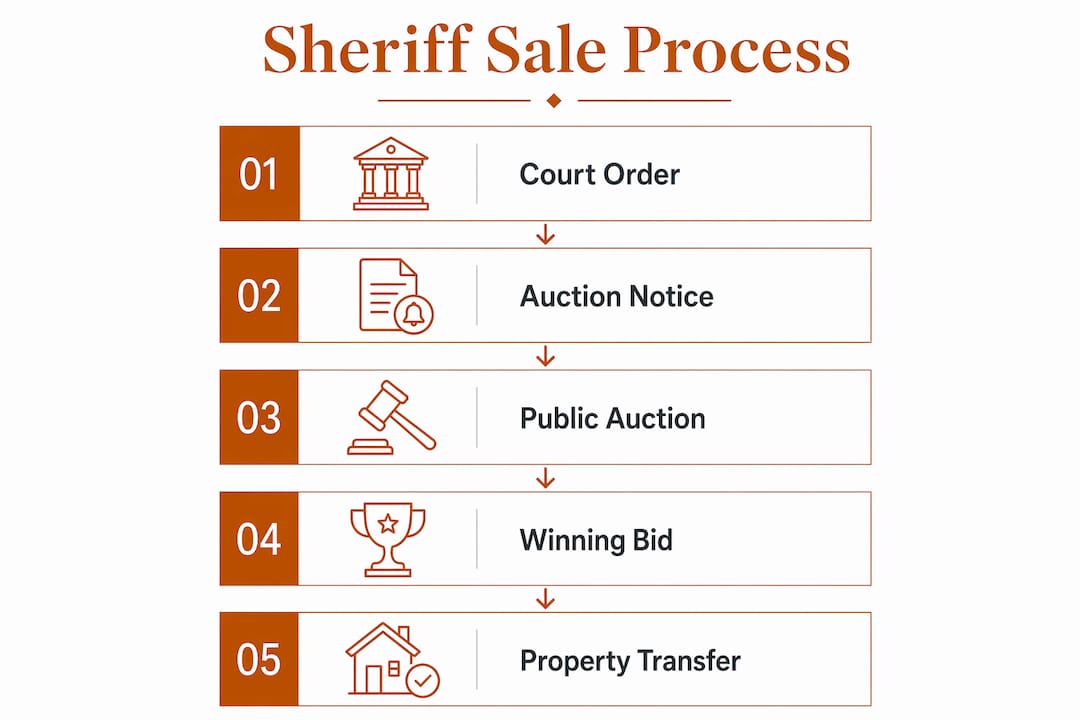
The sheriff sale process explained in plain terms: the court orders the sale, the sheriff runs the auction, and the winning bidder pays the debt. What the court does not do is clean up the title, disclose property defects, or protect the buyer from liens that survive the sale. That responsibility falls entirely on you.
How does the sheriff sale process work?
The judicial foreclosure process follows a structured sequence. Each step is governed by state and local court rules, which vary significantly by jurisdiction.
- Default and lawsuit. The lender files a foreclosure complaint after the borrower misses payments. The court reviews the case and, if the lender prevails, issues a judgment for the amount owed.
- Writ of execution. The court issues a writ directing the sheriff to sell the property. This document is the legal authority behind the entire auction.
- Public notice. The sheriff's office publishes notice of the upcoming sale in local newspapers and on county websites. Most states require a minimum notice period before the auction date.
- Auction day. Bidders gather at the courthouse or a designated location. The lender typically opens bidding with a credit bid equal to the outstanding debt. Outside bidders must beat that amount to win.
- Payment. The winning bidder pays immediately or within a short window defined by county rules. Most counties require full payment in U.S. currency or certified cashier's checks on the day of the sale.
- Court confirmation. In many states, the court must confirm the sale before the deed transfers. This step can add weeks to the timeline.
- Deed and distribution. Once confirmed, the sheriff issues a deed to the buyer. Sale proceeds pay the creditor, court costs, and any junior lienholders in order of priority.
Pro Tip: Verify the sale is still scheduled the morning of the auction. Last-minute postponements are common at sheriff sales, and experienced bidders treat cancellations as routine rather than surprises.
What buyers must know before bidding
Buying property at a sheriff sale carries financial and legal risks that do not exist in a standard purchase. Knowing them before you bid is not optional.
- Full payment is due immediately. Buyers must have 100% of the winning bid ready in cash or certified funds at the time of sale. There is no financing contingency, no escrow period, and no grace period for most counties.
- No inspections, no disclosures. The sheriff acts only as a court-authorized agent, not a seller. You receive no seller disclosures, no home inspection rights, and none of the standard purchase contract protections.
- "As-is, where-is" condition. You buy the property in whatever condition it is in. Structural damage, code violations, and deferred maintenance are your problem the moment the gavel falls.
- No guaranteed clear title. Sheriff sales do not guarantee clear title. Senior liens, IRS liens, and other encumbrances can survive the sale and attach to your ownership.
- IRS right of redemption. IRS liens allow the federal government to redeem the property for up to 120 days after the sale by reimbursing the buyer. That is a real risk on properties with federal tax debt.
- Redemption periods vary by state. Some states allow former owners to redeem the property after the sale; others, like Pennsylvania and Indiana, make the transfer final upon court confirmation.
Pro Tip: Order a professional title search before you bid on any property. A title search costs a few hundred dollars. Discovering a $40,000 IRS lien after you win the auction costs far more.
The biggest mistake new investors make is assuming the court process cleaned up the title. It did not. The foreclosure writ satisfies the specific debt that triggered the lawsuit. Other liens attached to the property may still be very much alive.
How do sheriff sales differ from other foreclosure auctions?
Not all foreclosure auctions work the same way. The table below shows the key differences between the three most common types.
| Auction type | Legal authority | Who runs it | Title risk | Redemption rights |
|---|---|---|---|---|
| Sheriff sale | Court-ordered writ | County sheriff | High, liens may survive | Varies by state |
| Trustee sale | Deed of trust, non-judicial | Lender-appointed trustee | Moderate | Rarely allowed |
| Tax sale | Unpaid property taxes | County tax authority | High, tax liens senior | Often allowed |
Sheriff sales are the most legally supervised of the three. A judge has reviewed the case, issued a judgment, and authorized the sale. That oversight adds procedural legitimacy but does not reduce title risk for the buyer.
Trustee sales, common in non-judicial foreclosure states like California and Texas, move faster because they bypass the court system. The lender appoints a trustee who conducts the auction under the terms of the original deed of trust. Less court involvement means fewer delays, but also less legal protection for all parties.
Tax sales are driven entirely by unpaid property taxes, not mortgage default. The taxing authority, usually the county, sells either the property itself or a tax lien certificate. These auctions can produce properties with complex title histories and multiple competing claims.
State law governs all three formats. Local jurisdiction rules determine notice requirements, bidding procedures, payment deadlines, and redemption rights. What applies in Ohio may not apply in Florida.
How to prepare for and participate in a sheriff sale auction
Sheriff sales serve creditor interests first. Investors who succeed at these auctions combine specialized knowledge of local court procedures with immediate access to capital. Preparation is the only edge available.
- Find upcoming sales. County sheriff websites and courthouse bulletin boards list scheduled auctions. Many counties also publish sale lists in local newspapers. Check these sources weekly, not just the day before.
- Research the property. Pull the county assessor record, review the foreclosure case file at the courthouse, and check for any code violations with the local building department. This is your due diligence window.
- Run a title search. A title search before bidding is the single most important step. It reveals senior liens, IRS claims, and any encumbrances that will survive the sale.
- Arrange your funds. You need certified funds ready before auction day. Fast access to capital is not a nice-to-have at a sheriff sale. It is the entry requirement.
- Attend in person. Most sheriff sales require physical presence. Arrive early, bring your certified check, and know your maximum bid before you walk in.
- Plan for possession delays. Winning the auction does not mean immediate possession. Occupants who refuse to leave require a court-ordered writ of assistance for eviction, which can add weeks or months to your timeline.
- Build your team. A real estate attorney familiar with local foreclosure law, a title company, and a lender who understands auction timelines are not optional extras. They are the team that keeps a deal from becoming a loss.
Key takeaways
Sheriff sales are court-supervised auctions that transfer property "as-is" with no seller protections, requiring buyers to conduct full due diligence on title, liens, and local redemption rules before bidding.
| Point | Details |
|---|---|
| Court-ordered process | A judge authorizes the sale; the sheriff executes it without acting as a traditional seller. |
| Immediate full payment | Bring certified funds on auction day; no financing contingencies or grace periods apply. |
| Title risk is real | Senior liens and IRS claims can survive the sale; a professional title search is mandatory. |
| Redemption rules vary | Some states finalize the transfer at confirmation; others allow former owners to redeem post-sale. |
| Possession takes time | Occupants who refuse to leave require a court eviction order, adding weeks to your timeline. |
What I've learned from watching investors win and lose at sheriff sales
Most investors who lose money at sheriff sales do not lose it on the auction floor. They lose it in the weeks before, when they skip the title search, underestimate the cost of liens, or fail to account for eviction timelines. I have watched buyers win auctions on properties carrying IRS liens they never discovered, only to face a 120-day redemption clock that froze their plans entirely.
The sheriff's role is the most misunderstood piece of this process. The sheriff is a legal agent executing a court order. That is it. There are no disclosures, no warranties, and no recourse if the property turns out to be a disaster. New investors often expect some version of seller accountability. There is none.
Local knowledge matters more than any general guide, including this one. Redemption rules, payment deadlines, and bidding procedures differ county by county. An investor who succeeds in Pennsylvania may walk into an Indiana auction and make expensive assumptions. Hire a local real estate attorney before you bid on your first property in any new jurisdiction.
The investors I have seen succeed treat sheriff sales as highly structured legal auctions, not bargain bins. They show up with certified funds, a completed title search, a clear maximum bid, and a plan for what happens if the occupant does not leave. That level of preparation is what separates a profitable acquisition from an expensive lesson.
— Brian
Gannlending: fast funding for sheriff sale buyers
Sheriff sales do not wait for slow lenders. When you win an auction, you need certified funds ready, often the same day.

Gannlending specializes in hard money loans for real estate investors who need capital fast. With funding in as few as 5–7 business days and no appraisal requirement, Gannlending is built for the speed that auction buyers need. Financing covers up to 75% LTV across residential and commercial properties, and Gannlending has funded over $50 million in deals. If you are preparing to bid at a sheriff sale and need to know your financing is locked before auction day, Gannlending is the partner that moves at your pace.
FAQ
What is a sheriff's sale in real estate?
A sheriff's sale is a court-ordered public auction where a foreclosed property is sold to satisfy an unpaid debt, with the county sheriff acting as the court's legal agent to conduct the sale.
Do you get clear title when buying at a sheriff sale?
No. Sheriff sales do not guarantee clear title. Senior liens, IRS claims, and other encumbrances can survive the sale, making a professional title search before bidding mandatory.
How do you pay for a property at a sheriff sale?
Most counties require full payment in cash or certified cashier's checks at the conclusion of the auction. There are no financing contingencies or extended payment windows.
Can the former owner take the property back after a sheriff sale?
In some states, former owners have a redemption period to reclaim the property by repaying the debt. States like Pennsylvania and Indiana typically finalize the transfer at court confirmation with no redemption right.
How long does it take to get possession after winning a sheriff sale?
Possession is not guaranteed on auction day. If occupants refuse to leave, buyers must obtain a court-ordered writ of assistance for eviction, which can add weeks or months to the process.