
A 1031 exchange is defined as a tax-deferral strategy under IRC Section 1031 that lets real estate investors sell an investment property and defer capital gains taxes by reinvesting the proceeds into a like-kind replacement property. The formal industry term is "like-kind exchange," though most investors know it as a 1031 exchange. The IRS sets strict rules: you must identify a replacement property within 45 days and close within 180 days of selling your original property. Used correctly, this tool lets you grow your real estate portfolio without losing a large portion of your gains to taxes each time you trade up.
What is 1031 exchange real estate and how does it qualify?
A 1031 exchange applies only to properties held for business or investment purposes. The IRS excludes personal residences and vacation homes from eligibility. The property must also be located within the United States.
The term "like-kind" is broader than most investors expect. The IRS cares about investment use, not identical asset class. That means you can swap different property types freely, as long as both are held for investment.
Eligible property types include:
- Residential rental properties (single-family, multifamily)
- Commercial buildings (office, retail, industrial)
- Raw land held for investment
- Apartment complexes
- Commercial warehouses
Properties that do not qualify include:
- Primary residences
- Vacation homes used personally
- Properties held primarily for resale (fix-and-flip inventory)
- Foreign real estate
- Personal property such as equipment or vehicles
The flexibility here is real. You can exchange a single-family rental in Texas for a commercial warehouse in Ohio. The IRS does not require the properties to match in type, size, or quality. What matters is that both are held for investment.
How does the 1031 exchange process work?
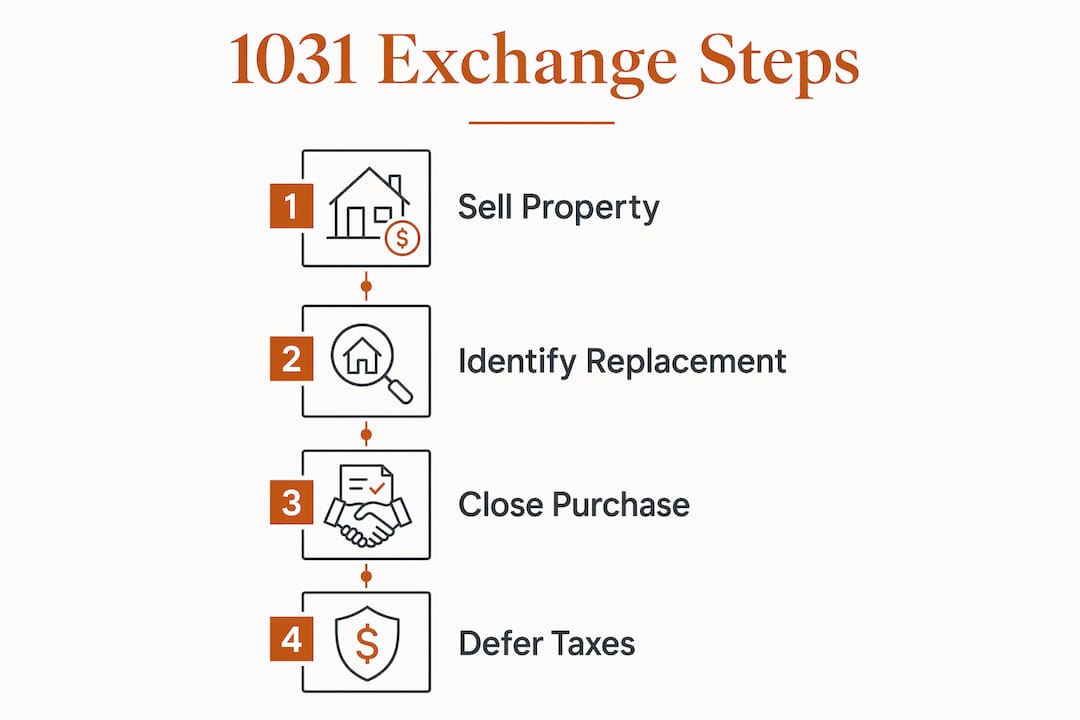
The standard 1031 exchange follows a deferred structure. You sell the relinquished property first, then identify and purchase the replacement property within IRS deadlines. Here is the step-by-step process:
- Sell the relinquished property. The clock starts the moment the sale closes. You cannot take possession of the proceeds at any point.
- Engage a qualified intermediary (QI) before closing. A QI is legally required to hold sale proceeds in escrow. If the money touches your personal bank account, the exchange is disqualified immediately.
- Identify replacement properties within 45 days. The IRS requires identification in writing, signed and delivered to the QI. You can identify up to three properties regardless of value.
- Close on the replacement property within 180 days. This deadline runs from the sale date of the relinquished property, not from the 45-day identification deadline.
- Complete the exchange through the QI. The QI transfers funds directly to the closing of the replacement property.
Missing either deadline ends the exchange. The full gain becomes taxable in the year of sale, with no exceptions.
Pro Tip: Set calendar alerts for both the 45-day and 180-day deadlines the moment your relinquished property closes. These are hard IRS deadlines with no extensions, even for natural disasters in most cases.

There are four recognized exchange types. A simultaneous exchange closes both properties on the same day. A deferred exchange is the most common, with the sale preceding the purchase. A reverse exchange lets you acquire the replacement property first, then sell the relinquished property. An improvement exchange allows you to use exchange funds to build or renovate the replacement property before taking title. Speed matters in all of them. Investors who understand why timing is critical in real estate rarely miss these windows.
What are the financial rules and tax implications?
The replacement property must equal or exceed the value of the relinquished property to defer 100% of capital gains taxes. Any shortfall creates what the IRS calls "boot," and boot is taxable.
| Scenario | Tax outcome |
|---|---|
| Replacement value equals or exceeds sale price | Full capital gains deferral |
| Replacement value is lower than sale price | Taxable boot equal to the difference |
| Investor receives cash from proceeds | Taxable as ordinary income or capital gain |
| Exchange is disqualified (missed deadline, etc.) | Full gain taxable in year of sale |
The basis from your old property carries over to the new one. That means your deferred tax liability travels with the asset. A 1031 exchange defers taxes. It does not eliminate them.
The estate planning angle changes this picture significantly. When an investor dies holding a property acquired through a 1031 exchange, the basis steps up to current market value. Heirs inherit the property at that stepped-up basis, which can eliminate the deferred capital gains entirely. For long-term investors, this makes the 1031 exchange a genuine wealth transfer tool, not just a tax delay.
Pro Tip: Work with a CPA who specializes in real estate before you list your property. The tax planning decisions made before the sale often matter more than anything that happens after.
A common misconception is that a 1031 exchange produces immediate tax savings. It does not. You are moving the tax liability forward, not erasing it. The real benefit is that the capital you would have paid in taxes stays invested and compounding in your portfolio.
What practical tips help investors avoid costly mistakes?
Most failed exchanges come down to a small set of preventable errors. Knowing them in advance is the difference between a clean exchange and a surprise tax bill.
- Never touch the proceeds. If sale proceeds hit your account, the exchange fails immediately. Your QI must receive funds directly from the closing.
- Choose your QI carefully. Not all qualified intermediaries carry the same level of insurance or experience. Verify their credentials and confirm they hold funds in segregated accounts.
- Start identifying replacement properties before you sell. The 45-day window is shorter than it feels. Investors who wait until after closing often scramble and settle for inferior properties.
- Align the exchange with your investment strategy. You do not have to swap like for like. Exchanging a residential rental for a commercial building can shift your cash flow profile significantly.
- Account for transaction costs. Exchange fees, QI fees, and closing costs add up. Factor them into your net proceeds calculation before committing to a replacement property value.
- Monitor tax law changes. Congress has proposed limiting or eliminating 1031 exchanges in past budget discussions. Stay current with IRS guidance and consult a tax attorney annually.
- Consider a Delaware Statutory Trust (DST). A DST qualifies as a replacement property option under IRS rules and gives investors fractional ownership in multiple institutional properties. This supports diversification while preserving the tax deferral.
"Because 1031 exchanges are complex, coordination with tax professionals and attorneys is essential to avoid costly mistakes and ensure compliance." — Fidelity
Real estate deals fail for many reasons beyond tax errors. Understanding why deals fall through helps you protect your exchange from external disruptions like financing gaps or title issues on the replacement property side.
Key Takeaways
A 1031 exchange defers capital gains taxes by requiring reinvestment into like-kind property within strict IRS timelines, making it most valuable for long-term investors building generational wealth.
| Point | Details |
|---|---|
| Core definition | A 1031 exchange defers capital gains taxes when you reinvest proceeds into like-kind investment property. |
| Strict IRS deadlines | Identify replacement property within 45 days and close within 180 days of the relinquished property sale. |
| Qualified intermediary required | A QI must hold all proceeds; touching funds personally disqualifies the exchange immediately. |
| Boot triggers taxes | Any gap between sale price and replacement value creates taxable boot equal to the difference. |
| Estate planning benefit | Heirs receive a stepped-up basis at death, which can eliminate all deferred capital gains taxes. |
Why I think most investors underuse the 1031 exchange
Most real estate investors treat the 1031 exchange as a one-time tax trick. They use it once, feel clever, and then go back to selling properties and paying capital gains taxes like everyone else. That is a mistake.
The real power of a 1031 exchange is compounding. Every time you defer a tax bill and keep that capital working in a larger asset, your equity base grows faster than it would if you paid taxes at each sale. Over a 20-year horizon, the difference between an investor who uses 1031 exchanges consistently and one who does not can be substantial.
The 1031 exchange is best suited for long-term investors focused on portfolio growth, not short-term traders. The complexity and cost of the process do not justify frequent use on small transactions. But for investors trading up into larger, better-performing assets every few years, this tool is one of the most effective wealth-building mechanisms in the tax code.
My honest concern is that many investors skip professional guidance because they think they understand the rules well enough. They do not. The QI requirement alone has tripped up experienced investors who assumed they could briefly hold proceeds in a business account. One misstep and the entire tax deferral evaporates. Hire a real estate CPA and a qualified intermediary before you list your property, not after.
Tax reform is always a risk. Proposals to cap or eliminate 1031 exchanges have surfaced in Washington repeatedly. The investors who benefit most are those who use the strategy consistently now, while the rules remain favorable.
— Brian
How Gannlending helps investors close on time
Timing is everything in a 1031 exchange. A financing delay on the replacement property can blow a 180-day deadline and trigger a full tax event. Gannlending provides hard money loans that close in as few as 5–7 business days, with no appraisal required and financing up to 75% LTV on residential and commercial properties.

Gannlending has funded over $50 million in real estate transactions. The approval process focuses on the asset, not paperwork, which means investors can move fast when a replacement property opportunity appears. If you are working against a 1031 exchange deadline, fast and reliable financing is not optional. It is the difference between completing your exchange and writing a check to the IRS.
FAQ
What is the 1031 exchange definition in simple terms?
A 1031 exchange lets real estate investors sell an investment property and defer capital gains taxes by reinvesting the proceeds into a like-kind replacement property under IRS rules.
What properties qualify for a like-kind exchange?
Properties must be held for business or investment use and located in the United States. Eligible types include rental homes, commercial buildings, and raw land. Personal residences do not qualify.
How long do investors have to complete a 1031 exchange?
The IRS requires investors to identify replacement properties within 45 days and close the purchase within 180 days of selling the relinquished property. Both deadlines are hard and non-negotiable.
What happens if I receive the sale proceeds directly?
The exchange is immediately disqualified and the full capital gain becomes taxable in the year of sale. A qualified intermediary must hold all proceeds throughout the exchange period.
Can a 1031 exchange eliminate capital gains taxes permanently?
A 1031 exchange defers taxes, not eliminates them. However, if the investor holds the property until death, heirs receive a stepped-up basis that can eliminate the deferred capital gains entirely.