
A redemption period is a legally defined window after a foreclosure or tax sale during which a former property owner can reclaim their home or land by paying the full sale price plus applicable fees and penalties. Think of it as a legal grace period, one that exists in many but not all states, giving owners a last real shot at keeping their property after losing it at auction.
Two distinct rights govern this process:
- Statutory right of redemption: Arises after the foreclosure or tax sale has occurred, allowing the former owner to reclaim title by paying the auction price plus associated costs.
- Equitable right of redemption: Exists before the sale, allowing an owner to cure the default and stop foreclosure entirely by paying what is owed.
The statutory right is what most people mean when they ask about the real estate redemption period. About half of U.S. states do not offer any post-sale redemption right, meaning the auction result is final the moment the gavel drops. In states that do allow it, the redemption timeframe for properties typically runs 6 months to 12 months in Michigan (6 months for residential sheriff's sales, 12 months for tax-delinquent properties), and 180 days (6 months) to two years in Texas (180 days for non-homestead tax sale properties, up to two years for homestead and agricultural tax sale properties), depending on state law and property classification. During that window, title does not fully vest with the buyer, which creates real complications for investors and purchasers alike.
How Texas and Michigan handle redemption periods
Texas and Michigan are two of the most instructive states for understanding how differently redemption rules can play out, even within the same country.
Texas, under Tex. Tax Code §34.21, draws a sharp line based on property type:
- Homestead and agricultural properties sold at a tax sale carry a redemption period that lasts up to two years with escalating penalties.
- Non-homestead, non-agricultural properties sold at tax sale have a shorter redemption window lasting 180 days.
- For non-homestead properties going through standard foreclosure (not a tax sale), there is generally no post-sale redemption right at all under the Texas Property Tax Code.
Those penalty percentages are not incidental. A homestead owner redeeming in month 23 owes the full auction price plus 50% on top. On a $200,000 sale, that is $300,000 due before the clock runs out.
Michigan takes a different approach. Residential properties sold at a sheriff's sale typically carry a 6-month redemption period, while tax-delinquent properties get a 12-month window. Michigan also allows former owners to remain in possession of the property throughout the redemption period, which means an investor who buys at a Michigan sheriff's sale may wait several months before gaining any real control of the asset.
Key stat: Michigan redemption windows run 6 months for residential sheriff's sales and 12 months for tax-delinquent properties, with possession often staying with the former owner the entire time.
Understanding foreclosure auction procedures in each state is the only way to price these risks accurately before bidding.
How redemption rights work after HOA foreclosures

HOA foreclosures follow their own set of rules, and they do not map neatly onto tax sale or mortgage foreclosure redemption timelines.
Key distinctions to know:
- Jurisdiction controls everything. Some states grant former owners a statutory redemption right after an HOA foreclosure; others do not. There is no federal standard.
- HOA governing documents matter. The association's CC&Rs and state statutes together determine whether a redemption right exists and how long it lasts.
- Timelines are often shorter. Where redemption rights do exist after an HOA sale, the window tends to be shorter than the 2-year Texas homestead period, sometimes as little as 90 days.
- Redemption costs include HOA fees. To redeem after an HOA sale, the former owner typically must pay the full sale price, outstanding dues, late fees, attorney's fees, and any court costs.
- Possession rights vary. Unlike Michigan's mortgage foreclosure rules, HOA foreclosure statutes in many states do not guarantee the former owner the right to stay in the property during the redemption period.
The practical takeaway: if you are buying at an HOA foreclosure sale, verify whether your state grants a post-sale redemption right before you assume you have clean title. An attorney familiar with your state's HOA statutes is not optional here.
What redemption periods mean for real estate investors
Redemption periods create a specific category of title risk that investors must price into every deal. Until the redemption window closes, title does not fully vest, which limits your ability to resell, refinance, or improve the property.
- Title clouds delay liquidity. You cannot sell or refinance cleanly until the redemption period expires and title is clear.
- Possession is not guaranteed. In states like Michigan, former owners can legally remain in the property throughout the redemption period, sometimes leading to negotiated cash-for-keys agreements.
- Holding costs accumulate. Property taxes, insurance, and maintenance costs run during the redemption window whether or not you control the property.
- Redemption is rare in practice. The right of redemption is rarely exercised because most former owners cannot assemble the full lump-sum payment required. But "rarely" is not "never," and the risk is real.
Pro Tip: Verify that the foreclosing party served proper notice to all lienholders and the former owner. Failure to serve notice can reset or extend the redemption timeline, leaving you in limbo far longer than you planned.
For investors weighing short-term note strategies in redemption states, the embedded title risk must factor into both pricing and exit timing.

What you actually have to pay to redeem
The financial bar for redemption is deliberately high. Paying off the original mortgage arrears is not enough. Here is what redemption typically requires:
- Full auction sale price. Not the outstanding loan balance, the price the property fetched at sale, which can be significantly higher.
- Statutory penalties. In Texas, that means 25% or 50% on top of the sale price, depending on the year of redemption.
- Accrued interest. Most states charge interest on the sale price from the date of the auction.
- Buyer's costs. The purchaser's reasonable expenses, including property taxes paid after the sale, insurance, and sometimes attorney's fees, are added to the redemption amount.
- Court costs. If a foreclosure action has already been filed, court costs and legal fees join the total.
The District of Columbia's Office of Tax and Revenue, for example, requires payment of all delinquent taxes, BID taxes, vault rents, special assessments, and buyer expenses before redemption is complete. The full cost of redemption almost always exceeds what the owner originally owed, which is why selling before foreclosure is often the more realistic path for distressed homeowners.
Deadlines you cannot afford to miss
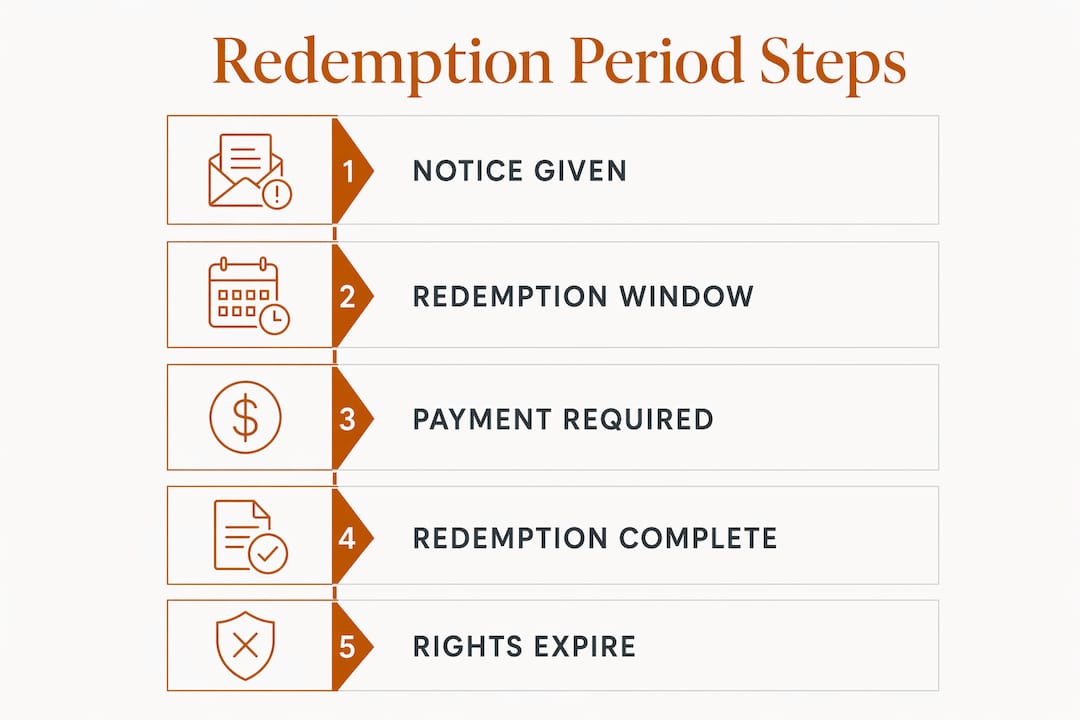
Redemption deadlines are hard stops. Courts do not grant extensions because an owner was unaware of the timeline or could not gather funds in time.
The clock typically starts on the date of the foreclosure or tax sale, not when the owner receives notice. Key timing rules by context:
- Texas homestead/agricultural tax sale: 2 years from sale date, with penalties escalating at the 1-year mark.
- Texas non-homestead tax sale: 180 days from sale date.
- Michigan residential sheriff's sale: 6 months from sale date.
- Michigan tax-delinquent property: 12 months from sale date.
- D.C. tax sale: Redemption is possible at any time until a Superior Court judge enters a final foreclosure order, but the buyer can file a foreclosure action as early as 6 months after the sale.
One underappreciated wrinkle: redemption periods often do not expire until the buyer has fully complied with notice requirements. If notice was defective, the clock may not have started at all.
What happens when the redemption period expires
When the redemption window closes without action, the consequences are permanent and swift:
- Title vests fully in the purchaser. The former owner loses all legal claim to the property with no further recourse.
- A tax deed or sheriff's deed is issued. The buyer receives a deed that conveys ownership free of the former owner's interest.
- Eviction proceedings can begin. If the former owner is still in possession, the new owner can immediately pursue eviction.
- Junior liens are typically extinguished. Most tax sale and foreclosure processes wipe out junior liens upon expiration of the redemption period, though this varies by state and lien type.
- No second chances. Courts treat the expiration as final. Missing the deadline by a single day carries the same result as missing it by a year.
In states like Tennessee, deeds of trust may include redemption waivers that eliminate post-sale redemption rights entirely, giving buyers immediate title certainty without waiting for any window to close.
How to actually initiate a redemption
If you are a former owner trying to redeem, the process follows a predictable sequence, though the specific forms and offices differ by state:
- Get a current payoff statement. Contact the tax authority, the foreclosing lender, or the court to obtain the exact redemption amount, including all penalties, interest, and buyer costs as of the date you plan to pay.
- Confirm the deadline. Pull the official sale record and calculate the expiration date. Do not rely on secondhand information.
- Assemble the full payment. Certified funds are almost universally required. Personal checks are not accepted.
- Pay the correct party. Depending on the jurisdiction, payment goes to the tax authority, the court clerk, or directly to the purchaser's attorney. Paying the wrong party does not stop the clock.
- Obtain a Certificate of Redemption. After payment is confirmed, request an official certificate from the relevant authority. In D.C., this comes from the Office of Tax and Revenue via mytax.dc.gov.
- Record the certificate. File the Certificate of Redemption with the local Recorder of Deeds to give public notice that the property has been redeemed and the purchaser's interest has been extinguished.
For investors on the other side of this transaction, the VA loan foreclosure waiting period and similar post-foreclosure timelines in other states follow comparable logic: the law sets a fixed window, and what happens inside that window determines who ends up with the property.
Key Takeaways
The redemption period is a state-set legal window after a tax sale or foreclosure that gives former owners one final chance to reclaim their property, but the financial and procedural bar is high enough that most never clear it.
| Point | Details |
|---|---|
| Two types of redemption rights | Equitable rights apply before the sale; statutory rights apply after, and only in states that allow them. |
| Texas penalties are steep | Homestead redemption costs 25% above the sale price in year one and 50% in year two, per Tex. Tax Code §34.21. |
| Michigan possession rules | Former owners can legally remain in the property during the 6-month or 12-month redemption window. |
| Notice failures extend timelines | Defective notice to the former owner or lienholders can prevent the redemption period from expiring on schedule. |
| Expiration is permanent | Once the window closes, title vests fully in the buyer and the former owner has no further legal claim. |
Gannlending funds real estate investments in as few as 5–7 business days, with financing up to 75% LTV across residential and commercial properties. If you are an investor navigating redemption risk or a homeowner facing foreclosure, explore your options before the clock runs out.