
Property equity is defined as the difference between your home's current market value and the outstanding balance on your mortgage. This number sits at the center of every foreclosure outcome. Homeowners who understand why property equity matters in foreclosure can make faster, smarter decisions that protect their financial future. Those who ignore it often watch years of built-up value disappear in a matter of months. The gap between those two outcomes comes down to timing, legal knowledge, and a clear picture of what equity actually does during the foreclosure process.
Why property equity matters in foreclosure
Equity is not just a number on paper. It represents real money you have earned through mortgage payments and rising home values. When foreclosure begins, that money is immediately at risk. Foreclosure auction prices run 25–40% below market value because auctions attract only cash buyers willing to purchase properties as-is. That discount alone can wipe out a substantial portion of your equity before a single fee is counted.
The costs that pile up during foreclosure make the damage worse. Legal fees, late penalties, default interest, and property preservation charges all accumulate rapidly and come directly out of whatever sale proceeds remain. By the time a foreclosure auction closes, combined expenses frequently exceed the surplus funds available, leaving homeowners with far less than they expected or nothing at all.

Timing is the single most controllable factor in this equation. Homeowners who sell voluntarily before foreclosure recover 20–40% more equity than those who wait for an auction. That gap represents tens of thousands of dollars in many markets. Acting before the process advances is not just advisable. It is the difference between walking away with capital and walking away with debt.
Pro Tip: Request a current market valuation from a licensed appraiser or real estate agent the moment you miss a payment. Knowing your equity position gives you negotiating power and helps you choose the right exit strategy before options narrow.
The equity trap: why homeowners wait too long
The "Equity Trap" is a documented behavioral pattern where homeowners delay necessary action because they believe their visible equity protects them. The logic feels sound: "I have $200,000 in equity, so the bank cannot really hurt me." That belief is wrong, and it is costly. Equity does not protect itself. Only action does.
What legal rights protect your equity during foreclosure?
Homeowners have more legal tools than most realize. The equitable right of redemption allows you to pay off the full mortgage debt at any point before the foreclosure sale completes. This right is protected by law and cannot be waived in advance by any mortgage contract. The moment the gavel falls at auction, however, this right is extinguished permanently.
Some states also provide a statutory right of redemption, which gives homeowners a limited window after the auction to reclaim the property by paying the sale price plus costs. This period varies by state and is not available everywhere. Knowing your state's rules before the sale date is critical.
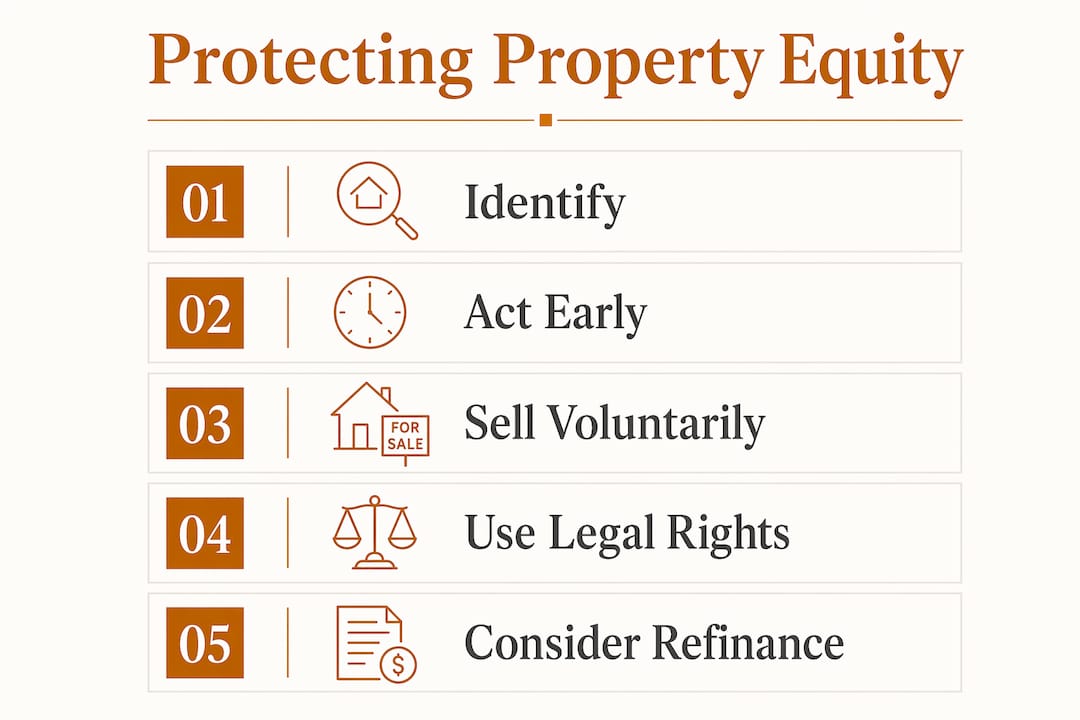
Federal regulation 12 C.F.R. § 1024.41 provides another protective window. Submitting a complete loss mitigation application at least 37 days before a scheduled sale legally requires the servicer to pause foreclosure proceedings. This rule gives you time to negotiate a loan modification, repayment plan, or other resolution without the auction clock running.
Bankruptcy is the most powerful legal tool available. A Chapter 13 bankruptcy filing triggers an automatic stay that halts all foreclosure activity immediately. Chapter 13 also allows you to catch up on missed payments over a 3–5 year repayment plan and, in certain cases, strip junior liens from the property entirely. This can preserve equity that would otherwise be consumed by subordinate debt.
Key legal protections to know:
- Equitable right of redemption: Pay the full debt before the sale to keep your home.
- Statutory right of redemption: Available in select states for a limited time after auction.
- 12 C.F.R. § 1024.41: Federal rule requiring servicers to pause foreclosure when a complete loss mitigation application is filed 37+ days before sale.
- Chapter 13 automatic stay: Stops foreclosure immediately upon filing and allows a structured repayment plan.
- Loan modification: A discretionary option that servicers can approve or deny. It does not carry the legal guarantee of a bankruptcy stay.
Pro Tip: Loan modifications are not guaranteed. Servicers can deny them without legal consequence. If you need a guaranteed halt to foreclosure activity, a Chapter 13 filing is the only tool that provides one by law.
Practical options for homeowners with equity to avoid losing it
Homeowners with meaningful equity have real choices. The key is acting before those choices disappear.
Sell before foreclosure is finalized
Selling your home before the foreclosure sale is the most direct way to preserve equity and protect your credit. An early voluntary sale gives you control over the sale price, the timeline, and the proceeds. You avoid auction discounts, accumulating legal fees, and the long-term credit damage that a completed foreclosure causes. A foreclosure stays on your credit report for seven years. A voluntary sale does not carry that penalty.
For homeowners who want to stay in their home, a sale-leaseback arrangement is worth exploring. You sell the property to an investor and immediately sign a lease to remain as a tenant. This approach converts your equity into cash, stops the foreclosure, and keeps you in the home while you stabilize your finances.
Reinstatement and refinancing
Loan reinstatement means paying all past-due amounts, fees, and penalties in a single lump sum to bring the mortgage current. This stops foreclosure and restores the original loan terms. It requires access to a significant amount of cash quickly, which is where fast private lending can make a practical difference.
Refinancing replaces the existing mortgage with a new loan, ideally at better terms. Traditional refinancing through a bank can take 30–60 days and requires strong credit. Hard money refinancing through a private lender can close in 5–7 business days and focuses on the property's value rather than your credit score.
Understanding lien priority
Equity does not flow directly to you after a foreclosure sale. Surplus funds go first to the primary mortgage lender, then to junior lienholders such as second mortgages, HOA liens, and judgment liens, and finally to the homeowner. If multiple liens exist, they can consume the entire surplus before you receive a dollar. Knowing your lien stack before any sale is not optional. It determines whether you walk away with money or not.
Common misconceptions that lead to equity loss
Several widely held beliefs cause homeowners to make decisions that cost them dearly.
High equity does not make you safe. Lenders know that high-equity homes offer a clear path to full debt recovery. That knowledge can actually accelerate foreclosure proceedings because the lender faces minimal risk of loss. Homeowners with significant equity sometimes receive less patience from servicers, not more.
Waiting for a loan modification is not a strategy. Loan modifications are discretionary decisions. Servicers are not legally required to approve them, and the foreclosure timeline does not pause while you wait for an answer unless you have filed a complete loss mitigation application under 12 C.F.R. § 1024.41.
Junior liens and HOA liens are not minor issues. Homeowners often underestimate how quickly subordinate liens consume equity. An HOA lien for unpaid dues, a judgment lien from a creditor, or a second mortgage can each claim priority over your share of sale proceeds. These liens do not disappear because you have equity. They get paid first.
Credit damage from foreclosure is long-lasting. A completed foreclosure affects your ability to buy another home, qualify for credit, and in some cases, secure employment. The financial impact extends well beyond the loss of equity in a single property.
Key Takeaways
Property equity is your most valuable asset in foreclosure, and protecting it requires early, informed action before costs and delays consume it.
| Point | Details |
|---|---|
| Act before the auction | Voluntary sales recover 20–40% more equity than foreclosure auctions. |
| Costs erode equity fast | Legal fees, penalties, and interest accumulate quickly and reduce your payout directly. |
| Legal tools exist | Federal rule 12 C.F.R. § 1024.41 and Chapter 13 bankruptcy can halt foreclosure legally. |
| Lien order determines payout | Junior liens and HOA liens get paid before homeowners receive any surplus funds. |
| High equity is not protection | Lenders may accelerate foreclosure on high-equity homes to recover debt faster. |
What I have seen homeowners get wrong about equity
Homeowners come to me after the fact more often than I would like. The story is almost always the same. They had equity. They knew they had equity. And they believed that equity was working in their favor while the clock ran out.
The most painful cases involve homeowners who had $300,000 or more in equity and ended up with nothing. Not because the law failed them. Because they waited. They waited for the bank to offer a modification. They waited to see if the market would help. They waited because the equity felt like a cushion. It was not a cushion. It was a target.
What I tell every homeowner I work with is this: your equity is only real if you act on it. The moment foreclosure proceedings begin, that equity starts shrinking. Every month of inaction adds fees, penalties, and legal costs that come straight off the top of whatever sale proceeds remain. The foreclosure timeline is not your friend. It is a countdown.
The homeowners who come out ahead are the ones who get a valuation done immediately, understand their lien position, and make a decision within the first 60 days of financial distress. They do not wait for the bank to tell them what to do. They take the first move. That is the only version of this story where equity survives.
— Brian
How Gannlending helps homeowners protect their equity fast
When time is the problem, traditional financing is rarely the solution. Banks take 30–60 days to approve a refinance, and that timeline can push a homeowner past the point where equity can be saved.

Gannlending provides hard money loans that close in as few as 5–7 business days, with no appraisal required and approval based on the property's value rather than your credit history. With financing up to 75% LTV across residential and commercial properties, and over $50 million funded, Gannlending gives distressed homeowners a real option to reinstate a loan, bridge to a sale, or refinance before the auction date arrives. If you have equity worth protecting, speed is everything. Gannlending is built for exactly that situation. Reach out to explore your options before the window closes.
FAQ
What is property equity in the context of foreclosure?
Property equity is the difference between your home's market value and the amount you still owe on your mortgage. During foreclosure, this equity is at risk of being consumed by auction discounts, legal fees, and lien payments.
How does a foreclosure auction affect my equity?
Foreclosure auctions typically sell homes 25–40% below market value, and all proceeds go first to pay debts, liens, and fees before any surplus reaches you. The result is often far less equity recovered than a voluntary sale would produce.
Can I stop foreclosure to protect my equity?
Yes. Filing a complete loss mitigation application at least 37 days before a scheduled sale legally pauses foreclosure under 12 C.F.R. § 1024.41. A Chapter 13 bankruptcy filing triggers an automatic stay that halts the sale immediately.
Does having a lot of equity guarantee I will be okay in foreclosure?
No. High equity can actually accelerate foreclosure because lenders know they can recover their full debt through a quick sale. Equity only protects you if you act on it before costs and auction discounts erode it.
What is the fastest way to protect my equity when facing foreclosure?
Selling the property voluntarily before the auction is the most effective way to preserve equity and protect your credit. If you need to stay in the home, fast private lending for reinstatement or refinancing can stop foreclosure in days rather than weeks.