
Most rental-income properties can qualify for hard money financing, and the dominant factor is almost never your W-2. It comes down to two things: the property's equity position (lenders typically cap at 75% LTV) and your exit plan, whether that's a DSCR refinance once the unit is stabilized or a sale. Gann Private Lending has funded a large volume of asset-based loans and can close in as few as several business days, which means the bottleneck is usually your paperwork, not the lender's calendar.
Three things to do in the next few days:
- Assemble your current leases and a one-page rent roll showing gross monthly rent per unit
- Pull your current loan balance (or purchase price) and get a rough ARV from a local agent or recent comps
- Estimate your DSCR: divide monthly gross rent by total monthly debt service (principal, interest, taxes, insurance). A result above 1.0 means the property covers its own debt
Table of Contents
- What do lenders actually evaluate when qualifying a rental-income property?
- What are DSCR, LTV, ARV, and LTC — and how do you calculate them?
- What documentation do lenders require to verify rental income and property value?
- What rates, fees, and reserve requirements should you expect?
- How can you improve your odds of qualifying and get better terms?
- What happens between application and funding — and how long does it take?
- Hard money vs. DSCR vs. conventional — which one fits your deal?
- How does Gann Private Lending evaluate rental-income properties?
- Key Takeaways
- What investors consistently get wrong when qualifying rental properties
- Fast asset-based financing: what Gannlending offers investors
- Sources and further reading
What do lenders actually evaluate when qualifying a rental-income property?
Hard money lenders underwrite the asset first, the borrower second. That ordering matters because it changes which documents move the needle.
Property cash flow. Lenders want to see that rent is real and consistent. They'll review executed leases, a signed rent roll, and ideally 3–6 months of bank deposits that match the stated rent. Market rent comps from a local property manager or appraiser serve as a sanity check. A property where the stated rent is 20% above market comps will get scrutinized; one where rent is at or slightly below market comps gets approved faster.
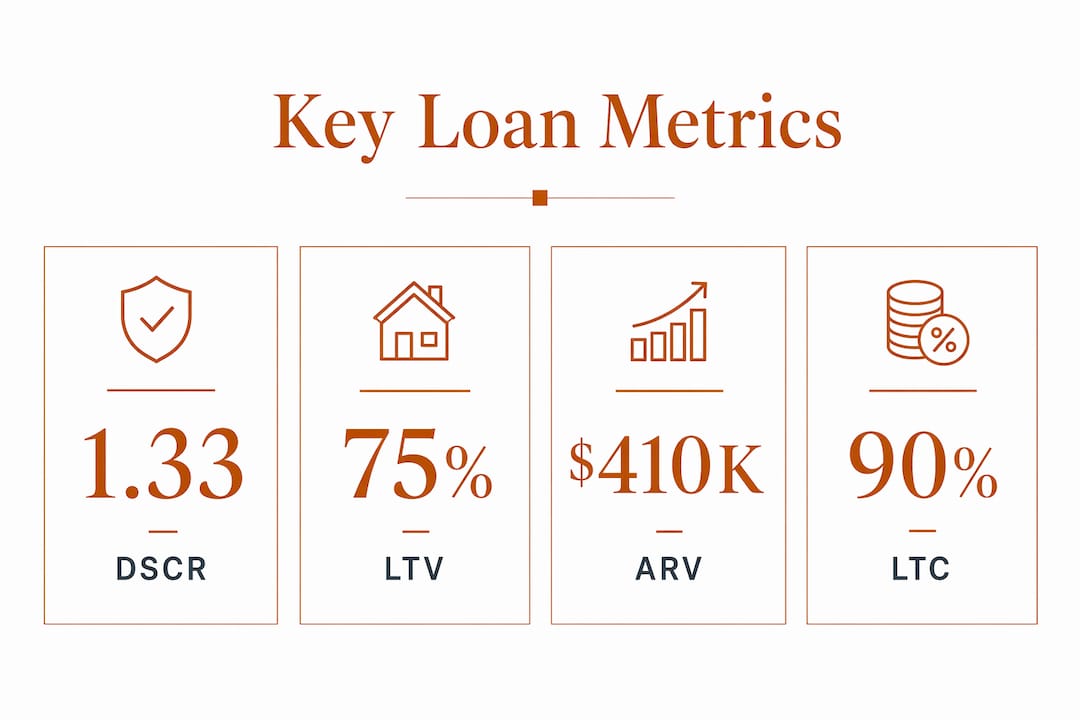
Value metrics. ARV (after-repair value) is the anchor for hard money. Lenders use it to calculate LTV and to stress-test whether the exit plan pencils out. LTC (loan-to-cost) matters on rehab deals where the purchase price plus renovation budget is the relevant denominator. Most hard money lenders cap proceeds at 65–75% of ARV, so an accurate ARV is the single number that determines how much you can borrow.
Borrower-side checks. Credit score requirements vary, but most hard money programs want a minimum in the 620–680 range. DSCR programs often require a minimum credit score in the 680–720 range. Lenders also look at reserves (commonly 2–6 months of PITI), prior real estate experience, and whether the property is held in an LLC. LLC ownership is generally fine and sometimes preferred because it limits lender liability exposure.
Property condition and exit strategy. A property mid-rehab with no tenants qualifies differently than a stabilized, leased asset. For the former, lenders focus almost entirely on ARV and the scope of work. For the latter, cash flow enters the picture. Either way, lenders want a credible exit: a DSCR refinance, a conventional loan, or a sale. Vague exit plans slow approvals.
- Fix-and-flip held briefly: underwriting centers on ARV, rehab budget, and timeline to sale
- Long-term rental hold: lenders add cash flow analysis and want a DSCR refinance path at stabilization
Pro Tip: Before submitting a file, call the lender and ask which exit scenario they're most comfortable with for your deal type. Hard money underwriters are often more flexible than their term sheets suggest, but only when the exit plan is specific and defensible.
What are DSCR, LTV, ARV, and LTC — and how do you calculate them?
These four metrics appear on every loan doc and underwriting checklist. Running the math yourself before you apply saves time and prevents surprises.
DSCR (Debt Service Coverage Ratio) measures whether the property's income covers its debt payments. The formula:
DSCR = Gross Monthly Rent ÷ Monthly Debt Service (PITI)
Worked example: A single-family rental generates $2,000/month in rent. The proposed loan carries a monthly payment of $1,100 (principal + interest), plus $250 in taxes and $150 in insurance. Total PITI = $1,500.
DSCR = $2,000 ÷ $1,500 = 1.33

That clears most DSCR program minimums. DSCR programs often accept ratios as low as 0.75–1.10 on certain products, though a ratio above 1.20 gets you better pricing and fewer conditions.
LTV (Loan-to-Value) = Loan Amount ÷ Current Appraised Value. A $150,000 loan on a $200,000 property = 75% LTV.
ARV (After-Repair Value) = the property's estimated market value after all planned renovations are complete. Hard money lenders underwrite to ARV, not current value, which is why accurate comps matter so much.
LTC (Loan-to-Cost) = Loan Amount ÷ (Purchase Price + Renovation Budget). Used on rehab deals to cap total exposure.
Mini glossary:
- PITI: Principal, Interest, Taxes, Insurance — the full monthly payment used in DSCR math
- Debt service: Total loan payments due in a period, typically monthly
- Rent roll: A one-page summary listing each unit, tenant name, lease term, and monthly rent
- BPO (Broker Price Opinion): A value estimate from a licensed real estate agent, often used in place of a full appraisal for faster underwriting
- Scope of work (SOW): A line-item contractor estimate detailing every planned repair and its cost
Statistic to know: Investment property mortgage rates in 2026 run approximately 8.25% for DSCR loans, 7.75% for conventional, and 12–18% for hard money — a spread that makes the refinance timeline one of the most consequential decisions in a BRRRR strategy.
Use a DSCR calculator to model different rent and rate scenarios before you commit to a purchase price.
What documentation do lenders require to verify rental income and property value?
Getting documentation right the first time cuts underwriting time in half. Lenders issue "conditions" (requests for more info) when files are incomplete, and each condition round adds days.
Essential property documents:
- Current executed leases for all occupied units (month-to-month leases are acceptable but raise more questions)
- Signed rent roll with tenant names, unit numbers, lease start/end dates, and monthly rent
- 3–6 months of bank statements showing rent deposits that match the rent roll
- Lease comparables from a local property manager, appraiser, or MLS data showing market rent for similar units
Property value documents:
- Full appraisal or BPO ordered by the lender (you typically pay for this upfront)
- Contractor estimate with line-item scope of work for any planned or completed repairs
- Before-and-after photos if rehab is underway or recently completed
- Repair invoices and receipts for completed work
Borrower documents:
- Credit report (lender pulls this; you provide authorization)
- LLC operating agreement and articles of organization if the property is entity-owned
- 2–3 months of personal or business bank statements showing reserves
- 12–24 months of tax returns if the program requires income documentation (DSCR programs typically do not)
Quick assembly tips:
- Build your rent roll in a single spreadsheet: one row per unit, columns for tenant, rent, lease dates, and deposit amount. One page, no exceptions.
- Proof of tenancy lenders accept: signed lease plus matching bank deposits. A lease alone, with no deposit history, triggers more scrutiny.
- Red flags that slow files: rent stated above market comps, leases signed within 30 days of application, missing signatures, or deposits that don't match stated rent amounts.
Pro Tip: If a unit is vacant, get a market rent letter from a licensed property manager or appraiser before you apply. Lenders need a rent figure to underwrite DSCR, and a professional letter carries far more weight than your own estimate.
What rates, fees, and reserve requirements should you expect?
| Loan Type | Typical Rate | LTV / ARV Cap | Min. Credit Score | Reserves Required | Close Time |
|---|---|---|---|---|---|
| Hard money | 12–18% | 65–75% ARV | 620–680 | 0–3 months | several days to a few weeks |
| DSCR | ~8.25% | 65–75% | 680–720 | 2–6 months PITI | several days to a few weeks | | Conventional | ~7.75% | 75–80% | 620–720 | 2–6 months PITI | several days to several weeks | | Portfolio / asset-based | approximately 8.25% | 65–75% | 680+ | Varies | several days to several weeks |
Sources: Amortio 2026 investment property matrix; Bankrate investment property rates; NASB investment property loan
How fees affect your proceeds. Hard money lenders typically charge origination points plus underwriting and processing fees, which can add significant upfront costs before you touch rehab funds. Factor this into your total project cost, not just the interest rate.
Reserve requirements change the math significantly. Conventional and DSCR programs commonly require 2–6 months of PITI in reserves per property. On a DSCR refinance with a $1,500/month PITI, a 6-month reserve requirement means $9,000 must sit in your account at closing and cannot be used for the next deal. If you're running a multi-property BRRRR strategy, reserve stacking becomes a real cash-flow constraint.
Rate context: Investment property loans typically run 1–2% above owner-occupied rates because lenders price in the higher default risk. That spread is baked into both DSCR and conventional products, which is why hard money's 12–18% range looks extreme by comparison but is accepted as a short-term cost of speed.
How can you improve your odds of qualifying and get better terms?
The fastest wins come from fixing the two numbers lenders care about most: DSCR and LTV. Everything else is secondary.
Prioritized checklist:
- Raise DSCR first. If your DSCR is below 1.0, the fastest fix is increasing verified rent. Even a $100–$150/month rent increase on a $1,500 PITI moves DSCR from 0.93 to 1.03. Get it in writing with a lease addendum before you apply.
- Lower LTV with equity. A larger down payment or a property that appraises above purchase price reduces LTV and often eliminates conditions. Hard money lenders reward lower LTV with better rates and fewer restrictions.
- Clean up your lease documentation. Month-to-month leases, unsigned addenda, or leases with below-market rent all create underwriting friction. Execute 12-month leases at market rent before submitting.
- Escrow repairs. If the property needs work, get a contractor estimate and offer to escrow repair funds at closing. This reassures lenders that deferred maintenance won't impair value.
- Add a co-borrower or guarantor. If your credit score is borderline (say, 640 on a program that prefers 680), a co-borrower with a stronger profile can move the file from conditional approval to clean approval.
Credit and documentation fixes. Resolving a single collection account or disputing an error can move a credit score 20–40 points in 30–60 days. That's often the difference between qualifying for a DSCR program and being stuck on hard money terms. Organize 12 months of bank statements into a clean PDF before you apply; lenders flag disorganized files as higher risk.
Before/after mini-examples:
Example 1 — DSCR improvement: Property generates $1,800/month rent; PITI is $1,600. DSCR = 1.13. Investor raises rent to $1,950 with a new 12-month lease. DSCR = 1.22. That 0.09 improvement moves the deal from a conditional approval to a clean one at a major DSCR lender.

Example 2 — LTV improvement: Purchase price $180,000; ARV $240,000; requested loan $162,000 (90% LTC). Lender declines at 90% LTC. Investor brings an additional $18,000 to closing, reducing the loan to $144,000 (80% LTC / 60% ARV). Approval follows within 48 hours.
Pro Tip: When ordering an appraisal, provide the appraiser with your own comp set: three to five closed sales within one mile and six months, similar square footage and condition. Appraisers are required to consider comps you submit. A well-supported comp set can add $10,000–$20,000 to an ARV without any physical change to the property.
What happens between application and funding — and how long does it take?
Hard money moves faster than any other loan type, but "fast" still has a sequence. Knowing where delays hide lets you compress the timeline.
- Inquiry and pre-qualification (Day 1). Submit property address, purchase price or current value, loan amount requested, and a brief description of the exit plan. Most hard money lenders give a verbal indication within 24 hours.
- Document submission (Days 1–3). Upload leases, rent roll, bank statements, entity docs, and contractor estimates. The faster this package arrives, the faster underwriting starts.
- Appraisal or BPO (Days 3–7). The lender orders a third-party valuation. This is usually the longest single step. BPOs are faster (2–3 days); full appraisals take 5–10 days. Scheduling delays are the most common cause of a missed close date.
- Underwriting (Days 5–10). The underwriter reviews the full file: value, income, borrower profile, title, and exit plan. Conditions are issued here if anything is missing or inconsistent.
- Clear-to-close (Days 7–14). All conditions are satisfied, title is confirmed clean, and the lender issues a closing disclosure.
- Funding (Days 7–21). Wire transfer at closing. Hard money can fund in as few as 7 days on a clean file; DSCR closings typically take 15–21 days through efficient lender networks.
Timeline reality check: Hard money terms commonly run 12–18% with 7- to 21-day close windows. The 7-day end of that range requires a complete file on Day 1, a BPO (not a full appraisal), and no title complications.
Common delays and how to avoid them:
- Title issues: Order a preliminary title report before you apply. Liens, unpaid taxes, or ownership disputes surface here and can take weeks to resolve.
- Appraisal disputes: If the appraised value comes in below ARV, you can rebut with your own comps. Have them ready.
- Incomplete rent documentation: Missing bank deposits or unsigned leases are the most frequent underwriting condition on rental-income files. Solve this before submission.
Hard money vs. DSCR vs. conventional — which one fits your deal?
| Scenario | Recommended Loan | Why |
|---|---|---|
| Distressed purchase + active rehab | Hard money | Speed and asset-based underwriting; no income docs required |
| Stabilized property, leased, DSCR ≥ 1.0 | DSCR refinance | Lower rate, LLC-friendly, no W-2 required |
| Stabilized property, not yet leased | No-DSCR program | Approval based on credit and equity, not rental income |
| W-2 borrower, strong credit, <4 financed properties | Conventional | Lowest rate; requires income docs and employment history |
| Multi-property portfolio, scaling fast | Portfolio / asset-based | Blanket structure; avoids per-property conventional limits |
The BRRRR cycle in practice. Buy a distressed property with hard money (close in 7–14 days). Rehab over 3–6 months. Lease at market rent. Once DSCR clears 1.0–1.20, refinance into a DSCR product at ~8.25% and pull out equity to fund the next acquisition. This cycle works because hard money held 6–12 months is economical when the refinance produces enough net proceeds to cover the high short-term interest cost.
Key trade-offs:
- Speed vs. cost: hard money closes fastest but costs 4–10% more annually than DSCR
- Documentation burden: DSCR requires rent verification; conventional requires W-2 and DTI; hard money requires exit plan and ARV
- LLC ownership: DSCR and hard money both support LLC-owned properties; conventional programs often do not
- Scaling: conventional programs cap financed properties (often at 10); DSCR and portfolio loans do not
For investors building a rental portfolio, the DSCR product has become the standard exit from hard money precisely because it scales without personal income documentation.
How does Gann Private Lending evaluate rental-income properties?
Gannlending underwrites the asset first. Credit score and employment history matter less than the property's value, the borrower's equity position, and a credible exit plan. That approach is what makes 5–7 business day funding possible on qualifying files.
What Gannlending focuses on:
- ARV supported by comps or a BPO, not just the borrower's estimate
- Borrower equity: financing up to 75% LTV across residential and commercial property types
- LLC-owned properties are fully supported
- Exit plan: DSCR refinance, conventional loan, or sale — the lender wants to see the math, not just the intention
- Property condition: both stabilized rentals and properties mid-rehab are eligible, with appropriate underwriting for each
Sample terms (illustrative): Up to 75% LTV, funding in as few as 5–7 business days, available for single-family, multi-unit, and commercial properties. Gannlending has funded over $50 million in hard money loans, which means the underwriting team has seen most deal structures and can move quickly on files that are well-documented.
Anonymized case example. An investor identified a four-unit property listed at $320,000 with an ARV of $410,000 after light cosmetic rehab. Existing leases showed $4,800/month in gross rent. The investor submitted a complete file — rent roll, leases, bank deposits, contractor estimate, and LLC docs — on a Monday. Gannlending issued a term sheet Tuesday, ordered a BPO Wednesday, and funded the following Monday: eight business days from first contact to wire. The investor used the proceeds to complete rehab, then refinanced into a DSCR product four months later at a rate that made the monthly cash flow positive.
For investors who want to understand which property types qualify under Gannlending's programs, the blog covers residential, multi-unit, and mixed-use eligibility in detail.
Key Takeaways
Qualifying a rental-income property for hard money comes down to three variables: accurate ARV, verified rent that supports a DSCR above 1.0, and a specific exit plan your lender finds credible.
| Point | Details |
|---|---|
| DSCR is the exit metric | A DSCR above 1.0 (ideally 1.20+) unlocks DSCR refinancing and removes you from hard money rates. |
| LTV caps limit proceeds | Most hard money lenders cap at 65–75% of ARV; a lower LTV gets better terms and fewer conditions. |
| Reserves reduce usable cash | DSCR and conventional programs require 2–6 months of PITI in reserves, which affects your next acquisition budget. |
| Documentation speed matters | A complete file on Day 1 (leases, rent roll, bank deposits, SOW) is the single fastest way to compress close time. |
| Gannlending closes in 5–7 days | Asset-first underwriting with up to 75% LTV and $50M+ funded; LLC-owned properties fully supported. |
What investors consistently get wrong when qualifying rental properties
The most expensive mistake I see is investors submitting an ARV they built from optimistic comps. An ARV that's 10–15% above what an independent appraiser will support doesn't just reduce your loan proceeds — it can kill the deal entirely if the lender's BPO comes in below the number you structured around. The fix is simple: before you apply, pull three closed sales within one mile and six months, adjust for square footage and condition, and use the conservative end of that range. If the deal still works at the conservative ARV, it's a real deal.
The second mistake is poor rent documentation. Investors often present a lease and assume that's enough. Lenders want to see that the rent is actually being collected: bank statements with matching deposits, month after month. A lease signed two weeks before application with no deposit history reads as a red flag, not proof of income. Build the deposit trail before you need the loan.
Third: ignoring reserves until closing day. An investor who structures a DSCR refinance without accounting for the 2–6 month PITI reserve requirement can find themselves short $8,000–$15,000 at the closing table. That shortfall either kills the refinance or forces a last-minute cash call. Run the reserve math as part of your initial deal underwriting, not as an afterthought.
Small oversights compound. A missing lease signature delays underwriting by three days. A rent roll that doesn't match bank deposits triggers a full deposit audit. An ARV dispute adds a week while the lender orders a second opinion. None of these are fatal individually, but together they can push a 10-day close to a 30-day close — and on a hard money loan at 15%, that extra 20 days costs real money.
For deeper reading on documentation and deal structure, the Gannlending blog covers fast-funding strategies and what to have ready before you call a lender.
Fast asset-based financing: what Gannlending offers investors
Investors who need capital in days, not weeks, have one realistic option: a lender whose underwriting starts with the property, not a tax return. Gannlending funds hard money loans up to 75% LTV in as few as 5–7 business days, covering residential and commercial properties, including LLC-owned assets. With over $50 million funded, the underwriting team handles both stabilized rentals and active rehab projects.
To start a prequalification, have these ready: property address and current value or ARV, your requested loan amount, a brief description of the exit plan (DSCR refi, conventional, or sale), and your LLC or entity documents if applicable. The process is asset-first — no W-2 required for hard money qualification.
Start your prequalification at Gannlending and get a term sheet within 24 hours on qualifying files. Compare offers before committing, and model your DSCR refinance timeline so you know exactly when and how you'll exit the hard money position.
This article is general information, not financial or legal advice. Confirm current rates, terms, and qualification requirements directly with your lender or a licensed mortgage professional before making financing decisions.
Sources and further reading
Primary sources cited in this article:
- Best Loans to Replace a Hard Money Loan — Lendmire: Covers DSCR program minimums (0.75–1.10 DSCR), no-DSCR specialty programs, and typical close timelines for DSCR exits from hard money.
- Investment Property Mortgage 2026: DSCR vs. Conventional — Amortio: 2026 rate matrix (DSCR ~8.25%, conventional ~7.75%, hard money 12–18%) and BRRRR cycle math.
- Current Investment Property Rates — Bankrate: Rate spread context (investment loans typically 1–2% above owner-occupied) and DSCR market demand.
- Investment Property Loan — NASB: Conventional loan documentation requirements, credit score ranges (620–720), and reserve requirements (2–6 months PITI).
- Hard Money and DSCR Rental Loans — Upright: Hard money underwriting criteria (ARV, exit plan, borrower equity), typical terms (12–18%, 7–21 day close), and scope-of-work requirements.
Practical tools:
- DSCR Calculator — Platinum Capital Advisors: Model your DSCR using actual rent, PITI, and proposed loan terms before you apply.
- Rental Property Loans Explained — Gannlending Blog: Overview of loan types and qualification criteria for rental investors.
- How to Finance Multi-Unit Rental Property Privately — Gannlending Blog: Private lending eligibility and structure for multi-unit deals.
Rent roll template: A basic rent roll can be built in any spreadsheet with five columns: unit number, tenant name, lease start date, lease end date, and monthly rent. Gannlending's resources page may have a downloadable version; contact the team directly to confirm availability.